What Are Miller Indices and How Are They Determined?
TL;DR
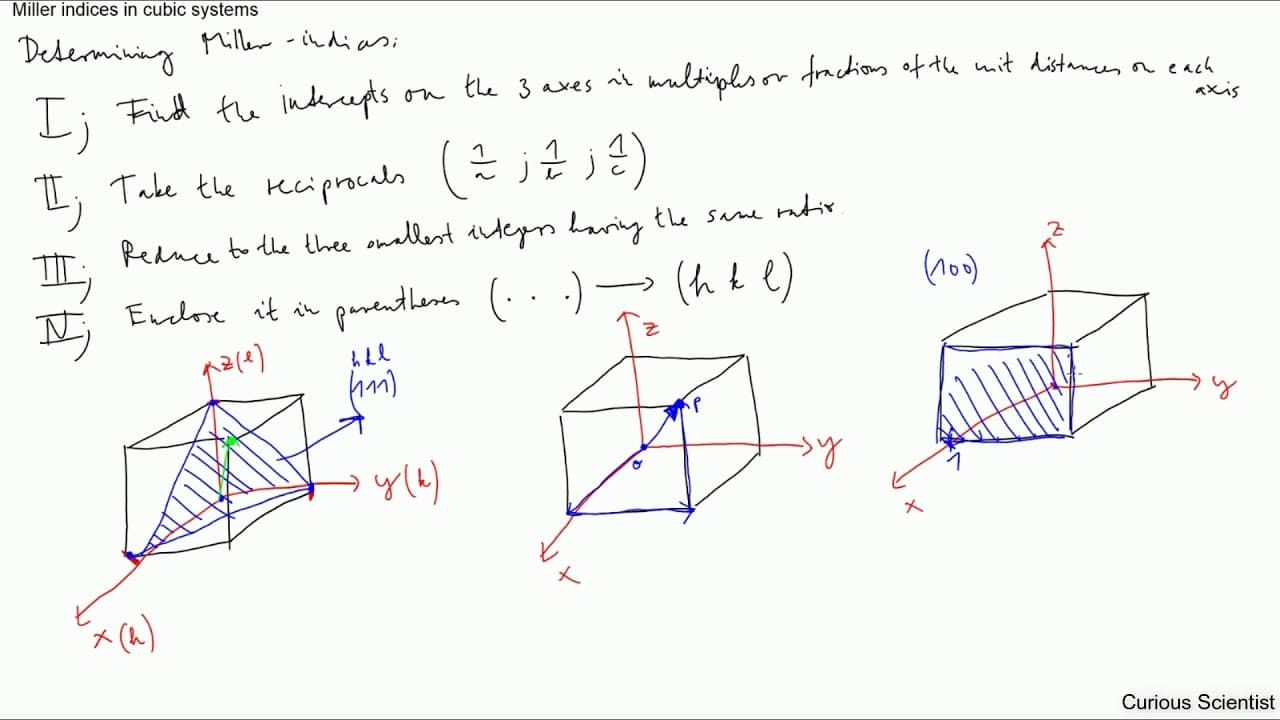
Miller indices are a notation system that represents crystal plane orientations based on their intercepts with crystal axes. To determine them, find intercepts along the three axes, take their reciprocals, and simplify to the smallest integers enclosed in parentheses. This method is crucial for understanding the relationships between planes and directions in crystallography.
Transcript
welcome again in this video I'm going to talk about the so called Miller indices Miller indices is basically a system which is used to describe planes within a crystal or space lattice that specifies orientation without giving position in space so this system is based on the intercepts of a plane with the three crystal axis so basically the three e... Read More
Key Insights
- 💨 Miller indices provide a systematic way to describe planes in a crystal lattice, enhancing the communication of crystallographic information.
- 🫰 The process of calculating Miller indices involves taking dimensions and understanding reciprocals, a straightforward mathematical approach for crystallography.
- 😀 In face-centered cubic systems, the 111 plane hosts the most efficient slip systems, influencing the mechanical properties of materials.
- 💋 The interrelationship between Miller indices, crystal directions, and slip systems is vital for understanding deformation mechanisms in materials science.
- 🫰 Different notations used for Miller indices clarify whether one is discussing planes or directions, which is crucial for accurate communication in crystallography.
- 🔮 Visualizing Miller indices through graphical representations helps comprehend complex spatial relationships in crystal structures.
- 🫰 Negative intercepts in Miller indices are denoted using an overline, differentiating them from positive values and aiding in clear interpretation.
Install to Summarize YouTube Videos and Get Transcripts
Explore YouTube Video Summarizer or Get YouTube Transcript Extractor
Questions & Answers
Q: What are Miller indices and why are they important in crystallography?
Miller indices are a system for describing the orientation of planes within a crystal lattice. They are important because they allow scientists and researchers to communicate about crystal structures effectively, which is essential in studying material properties and behaviors. The indices help in identifying slip systems vital for understanding how materials deform under stress.
Q: How do you determine the Miller indices for a specific crystal plane?
To determine Miller indices, first find the intercepts of the plane with the crystal's three axes. These intercepts can be either fractional or whole numbers. Next, take the reciprocals of these intercepts, and reduce them to the smallest integers that have the same ratio. Finally, represent them in parentheses as (hkl), assigning h, k, and l to these integers.
Q: Can you explain the difference between the various notations used in Miller indices?
In Miller indices notation, rounded parentheses (hkl) indicate a single plane or a set of parallel planes, while curly braces {hkl} represent equivalent planes. Rectangular brackets [uvw] denote directions, while angled brackets <uvw> signify a full set of equivalent directions. This differentiation helps clarify the context of the indices being discussed.
Q: What role do slip systems play in face-centered cubic (FCC) crystals?
Slip systems are critical in FCC crystals as they dictate how the crystal can deform under stress. In FCC systems, there are four independent slip planes, each containing three independent slip directions, leading to a total of twelve slip systems. Understanding these systems is crucial for predicting material behaviors during mechanical testing.
Q: Why is the 111 plane significant in FCC materials?
The 111 plane is significant in face-centered cubic materials because it is the densest packing plane. This means it has the highest atomic density, which contributes to the material's strength and slip behavior. Thus, understanding the properties associated with the 111 plane is essential for engineering applications.
Q: How do you visualize the relationship between Miller indices and crystal directions?
The relationship between Miller indices and crystal directions can be visualized by using vectors. For example, in cubic systems, the normal vector to the Miller indices' plane is perpendicular to the direction vector. This relationship can be illustrated by drawing the crystallographic directions and assessing their angles relative to the planes indicated by the Miller indices.
Summary & Key Takeaways
-
Miller indices are a notation system used to represent the orientation of crystal planes based on their intercepts with crystal axes. The indices are usually expressed as integers, indicating the directional relationship between planes in a crystalline structure.
-
To determine Miller indices, one must find the intercepts of a plane with the three axes, take the reciprocals of these values, and then simplify them to the smallest integers, enclosing them in parentheses to represent the form (hkl).
-
The video illustrates how to visualize Miller indices in cubic systems, particularly with face-centered cubic structures, emphasizing the relationships between the Miller indices, crystal directions, and slip directions which are vital for understanding material properties.
Read in Other Languages (beta)
Share This Summary 📚
Summarize YouTube Videos and Get Video Transcripts with 1-Click
Try YouTube Summary with ChatGPT & Claude or YouTube Transcript Generator
Explore More Summaries from Curious Scientist 📚






Summarize YouTube Videos and Get Video Transcripts with 1-Click
Try YouTube Summary with ChatGPT & Claude or YouTube Transcript Generator