How Does Russia Annex Occupied Ukrainian Land?
TL;DR
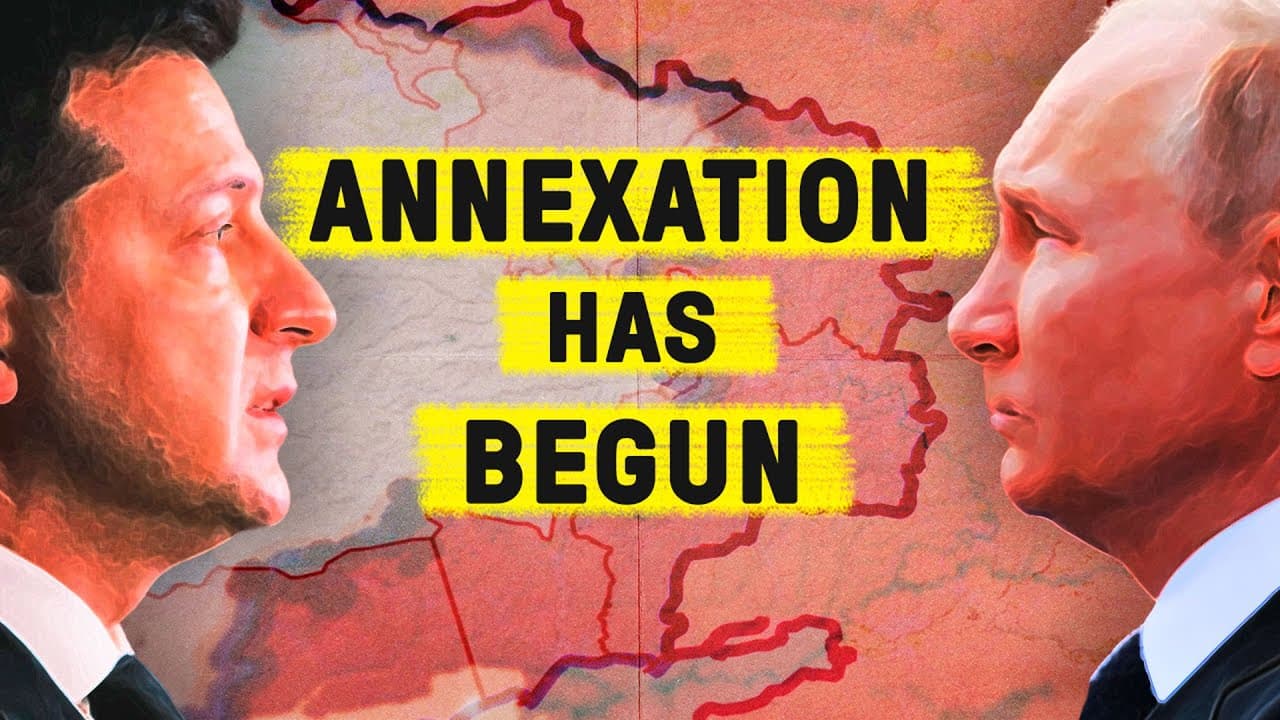
Russia’s emerging strategy was to absorb occupied eastern and southern Ukrainian territories piece by piece after its attempt to seize Kyiv failed. The approach combined military control with Russian officials, currency, media restrictions, accelerated citizenship, and planned votes, while Ukraine continued resisting through counteroffensives that reclaimed substantial territory.
Transcript
(map thumping)
- This is Putin's war seven months on. (dramatic music) I've been looking at this map every day, tracking this war. This war that has led to seven million people fleeing this country, thousands dead, including countless civilians. I wanna show you what's going on kind of in the macro, a time lapse of this war. (dramatic music) And I ... Read More
Key Insights
- Russia’s February invasion was an escalation of a conflict that had already continued in eastern Ukraine for eight years, beginning after Russia occupied and annexed Crimea in 2014 and fighting emerged in the Donbass region.
- Russia’s initial strategy was to attack from several directions and seize Kyiv quickly, but the plan failed after Russian forces overestimated their capabilities and underestimated Ukrainian resistance and the scale of Western weapons support.
- Ukraine’s first major counteroffensive pushed Russian forces away from Kyiv and recovered the surrounding territory within weeks, compelling Russia to regroup and concentrate its forces on a narrower eastern and southern front.
- A war of attrition is a prolonged struggle in which each side tries to wear down the other through destruction and endurance. The conflict increasingly took this form during the summer, with intermittent Russian gains and Ukrainian counteroffensives.
- Kherson became an example of Russia’s occupation strategy because authorities replaced Ukrainian symbols, introduced the Russian ruble, seized broadcasting and internet channels, and promoted the message that Russia intended to remain permanently.
- Russia’s revised territorial objective was to control the Donbass and southern Ukraine, creating a continuous land bridge from mainland Russia to Crimea, which Russia had occupied and annexed in 2014.
- Mariupol was crucial to Russia’s land bridge, and capturing the port city required a bloody battle that left thousands of civilians there while Russian forces ultimately took control after several weeks.
- Russia’s annexation playbook involved installing Russian officials, accelerating access to Russian citizenship, declaring newborns Russian citizens, and preparing votes intended to present occupied Ukrainian territories as willingly joining Russia.
Install to Summarize YouTube Videos and Get Transcripts
Explore YouTube Video Summarizer or Get YouTube Transcript Extractor
Questions & Answers
Q: Why did Russia fail to capture Kyiv quickly?
Russia failed to capture Kyiv because its initial plan misjudged both sides of the conflict. Russian leadership overestimated the ability of its troops while underestimating Ukrainian resistance and the Western response. Ukraine received large quantities of weapons, defended the capital, and launched an effective counteroffensive that pushed Russian forces out of the surrounding territory within weeks.
Q: How did Russia change its strategy after withdrawing from Kyiv?
Russia regrouped its forces and shifted from a broad attempt to seize the capital toward a narrower campaign in eastern and southern Ukraine. The revised strategy focused on taking population centers in the Donbass, consolidating occupied southern areas, and establishing a continuous land bridge connecting mainland Russia with Crimea, which Russia had annexed in 2014.
Q: What does annexation mean in the context of the Ukraine war?
Annexation means conquering and occupying territory, then unilaterally declaring that territory part of the occupying country’s sovereign land. In the account presented, Russia was not merely holding Ukrainian areas temporarily. It was changing their administration, currency, citizenship rules, communications, and political status to absorb them into Russia without a negotiated treaty.
Q: How was Russia transforming occupied Kherson?
Russia replaced the Ukrainian flag with a Russian one, displayed messaging that described Russians and Ukrainians as one people, and claimed Russia was there permanently. Authorities introduced the Russian ruble on May 1, seized broadcasting and internet channels, and restricted residents’ connections with the outside world, despite public protests near Russian tanks.
Q: Why was a land bridge to Crimea important to Russia?
A land bridge would give Russia continuous control across occupied territory from mainland Russia to Crimea, the peninsula it occupied and annexed in 2014. A senior Russian military official described full control of the Donbass and southern Ukraine as the means to establish this connection. Russia made substantial progress toward that objective by capturing areas along the route.
Q: Why was Mariupol important to Russia’s campaign?
Mariupol was a port city located along the territory Russia needed to control for its land bridge between mainland Russia and Crimea. Russian forces fought a bloody battle there for several weeks before taking the city. The fighting was especially destructive, and thousands of civilians remained in Mariupol during the battle and calls for evacuation.
Q: What methods formed Russia’s annexation playbook?
The described playbook combined military occupation with administrative and political integration. Russia installed its own officials, created accelerated routes to Russian citizenship, treated babies born in occupied regions as Russian citizens, introduced Russian currency, controlled communications, and prepared votes that were expected to report overwhelming support for joining Russia regardless of genuine public opinion.
Q: How did Ukraine respond to Russia’s territorial campaign?
Ukraine continued resisting rather than surrendering to the larger Russian military. Its forces first mounted an effective counteroffensive around Kyiv that recovered territory and forced a Russian withdrawal. Later, while the analysis was being produced, another major counteroffensive in the north was reclaiming large areas, demonstrating that Russian occupation and planned annexation remained actively contested.
Summary & Key Takeaways
-
Russia’s February invasion expanded a conflict that had continued in eastern Ukraine since 2014. Russian forces advanced from several directions and sought to capture Kyiv quickly, but Ukrainian resistance, Western weapons, and a counteroffensive forced Russia to withdraw from territory around the capital and narrow its military focus.
-
After the failure around Kyiv, Russia concentrated on the Donbass and southern Ukraine, seeking a land bridge between mainland Russia and Crimea. Its forces captured population centers, including Kherson and Mariupol, while the conflict became a war of attrition shaped by destruction, endurance, limited advances, and Ukrainian counterattacks.
-
Evidence from occupied areas indicated an annexation strategy rather than temporary liberation. Russian authorities installed officials, introduced rubles, controlled communications, accelerated citizenship, and prepared votes expected to support joining Russia. Ukraine continued fighting back, including a major northern counteroffensive that reclaimed large areas while the analysis was being produced.
Read in Other Languages (beta)
Share This Summary 📚
Summarize YouTube Videos and Get Video Transcripts with 1-Click
Try YouTube Summary with ChatGPT & Claude or YouTube Transcript Generator
Explore More Summaries from Johnny Harris 📚



Summarize YouTube Videos and Get Video Transcripts with 1-Click
Try YouTube Summary with ChatGPT & Claude or YouTube Transcript Generator