How to Build an AI Agent With Tools and Loops
TL;DR
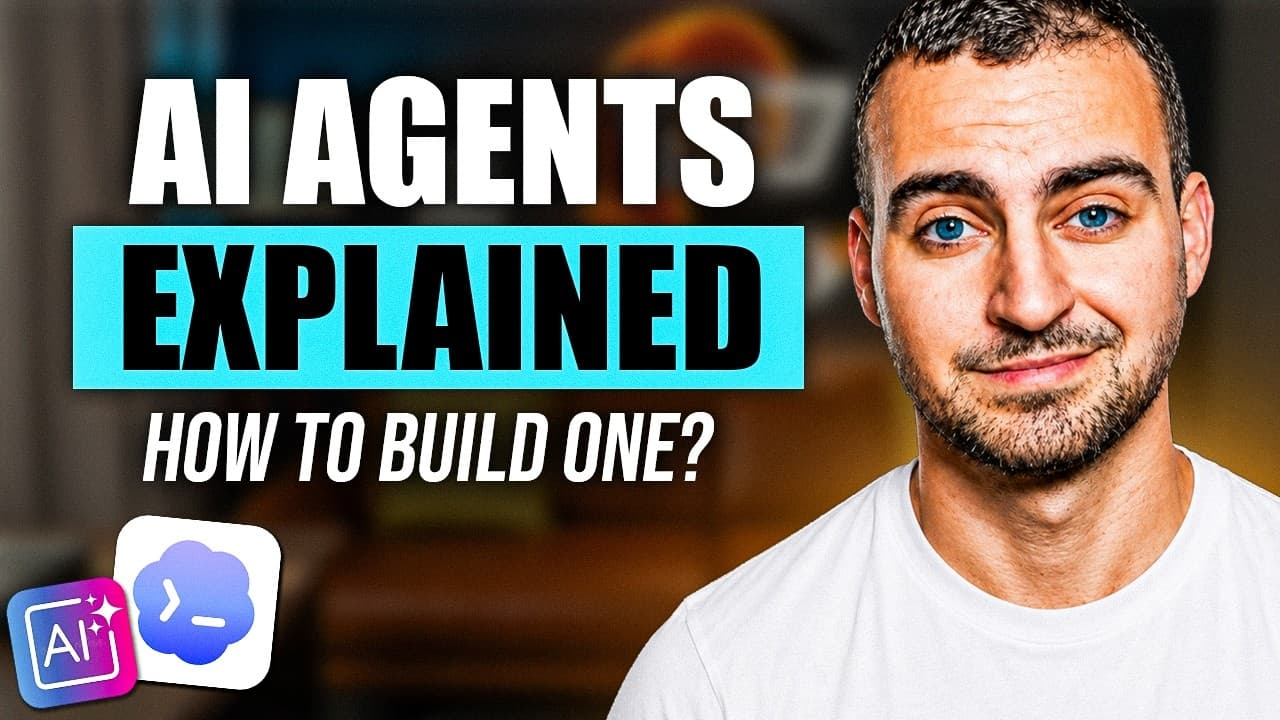
An AI agent is a language model that can use tools and repeatedly evaluate results until it completes a goal. Building one requires a model, an agent harness that executes tool requests, carefully managed context, instructions, and a control loop. The same foundation can be implemented through no-code platforms, low-code tools, customizable agent harnesses, or a fully coded Python system.
Transcript
Everybody is talking about AI agents, but almost nobody explains what it is and how you build it. You get these videos where people talk about AI agents like they think and reason and make decisions like there's some little brain doing a bunch of magic. And that's exactly why all of this feels like a lot of hype and not very practical. So let me gi... Read More
Key Insights
- An AI agent is a language model that can use tools while running in a loop until it finishes a job. Its practical capabilities come from combining text generation with external software that performs actions and returns results for additional processing.
- A chatbot produces a response and stops, while an agent receives a goal and can take multiple steps toward completing it. Tool access and continued execution are the two abilities that distinguish the described agent from a plain conversational language model.
- A language model is a text predictor without independent hands or built-in memory. When it appears to search, update data, or perform another action, it is actually generating a structured request that surrounding software interprets and executes.
- An agent harness is the software responsible for running the model's requested commands. It detects structured tool calls, invokes the appropriate tool, collects its output, returns that output to the model, and supports the repeated cycle of decisions and actions.
- A context window is the agent's limited short-term working memory. It can include the system prompt, user and assistant messages, tool requests, and tool results, so effective context engineering requires selecting information that directly supports the current task.
- Conversation continuity is created by feeding previous messages and results back into the model on later turns. The model does not independently retain earlier interactions, and removing necessary history from the context can cause forgetting or poorer performance.
- Retrieval augmented generation gives an agent access to relevant external information without placing an entire collection in its context. Data is converted into embeddings, stored in a vector database, and retrieved through a search tool when the agent needs particular documents or facts.
- Agent development has four described tiers: no-code platforms, low-code tools, customizable agent harnesses, and full-code implementations. Despite their different interfaces, all require choices about the model, context, data access, tools, and control flow.
Install to Summarize YouTube Videos and Get Transcripts
Explore YouTube Video Summarizer or Get YouTube Transcript Extractor
Questions & Answers
Q: What is an AI agent and how does it work?
An AI agent is a language model that can request tools and continue operating in a loop until it completes a job. The model examines its instructions and current context, chooses an action, and may produce a structured tool request. External software executes that request, returns the result, and lets the model decide whether to act again or provide a final response.
Q: What is the difference between a chatbot and an AI agent?
A regular chatbot receives a message, predicts a textual response, and stops. An AI agent adds two abilities: it can request external tools that take actions, and it can continue through multiple steps without ending after its first reply. This allows the agent to pursue a goal, evaluate tool results, and select further actions until it considers the task complete.
Q: How does tool calling work in an AI agent?
Tool calling works when the model generates a structured message identifying a permitted tool and the action it wants performed. The model does not directly search the web, update a database, or execute the command. The surrounding code recognizes the request, runs the selected tool, captures its output, and places that result back into the model's context for the next decision.
Q: What is an agent harness responsible for?
An agent harness is the software layer that connects a language model to executable capabilities. It sends prompts and context to the model, detects structured tool requests, runs the requested tools, and feeds their outputs back into the conversation. It also maintains the repeated execution cycle that allows the model to observe results and continue working toward the assigned goal.
Q: Why is context engineering important for AI agents?
Context engineering is important because a model can only consider information placed within its limited context window. Instructions, conversation history, tool calls, and tool results all compete for that capacity. A well-designed agent includes the information needed for the current decision while avoiding excessive material, such as an entire large codebase or a very long document collection, that may not fit.
Q: How does an AI agent remember previous steps?
An AI agent remembers previous steps because the surrounding system sends the relevant conversation history back to the model on each turn. That history can include user requests, earlier assistant messages, tool calls, and returned results. The model itself does not store the conversation independently. If necessary information is removed or no longer fits in the context window, the agent may forget it.
Q: How can an AI agent use documents or long-term information?
An agent can access documents or longer-term facts through retrieval augmented generation. Data is converted into embeddings, which are numerical representations of meaning, and stored in a vector database. The agent receives a tool that searches this database and retrieves only relevant information for the current task, reducing the need to place an entire document collection inside the limited context window.
Q: What are the main ways to build an AI agent?
The described development landscape has four tiers. No-code platforms use forms or draggable blocks, low-code tools combine some programming with a visual canvas, agent harnesses provide a complete system that can be installed and customized, and full-code development implements the system directly in a language such as Python. Each approach still requires decisions about models, context, tools, data access, and control flow.
Summary & Key Takeaways
-
An AI agent combines a language model with tools and a repeated control loop. The model produces structured requests for actions, while an external agent harness executes those requests and returns the results. The cycle of thinking, acting, and observing continues until the model determines that the assigned goal is complete.
-
Context functions as an agent's short-term working memory. It contains instructions, user requests, assistant responses, tool calls, and tool results, but its capacity is limited. Developers must choose relevant information carefully and can use retrieval augmented generation with embeddings and a vector database to retrieve longer-term knowledge when needed.
-
AI agents can be built at four levels of abstraction: no-code platforms, low-code visual tools, customizable agent harnesses, and complete implementations written in a language such as Python. Every approach requires similar decisions about the model, available tools, information placed in context, external data access, and the control flow governing actions.
Read in Other Languages (beta)
Share This Summary 📚
Summarize YouTube Videos and Get Video Transcripts with 1-Click
Try YouTube Summary with ChatGPT & Claude or YouTube Transcript Generator
Explore More Summaries from Tech With Tim 📚


Summarize YouTube Videos and Get Video Transcripts with 1-Click
Try YouTube Summary with ChatGPT & Claude or YouTube Transcript Generator