How Does DNA Transcription Produce RNA?
TL;DR
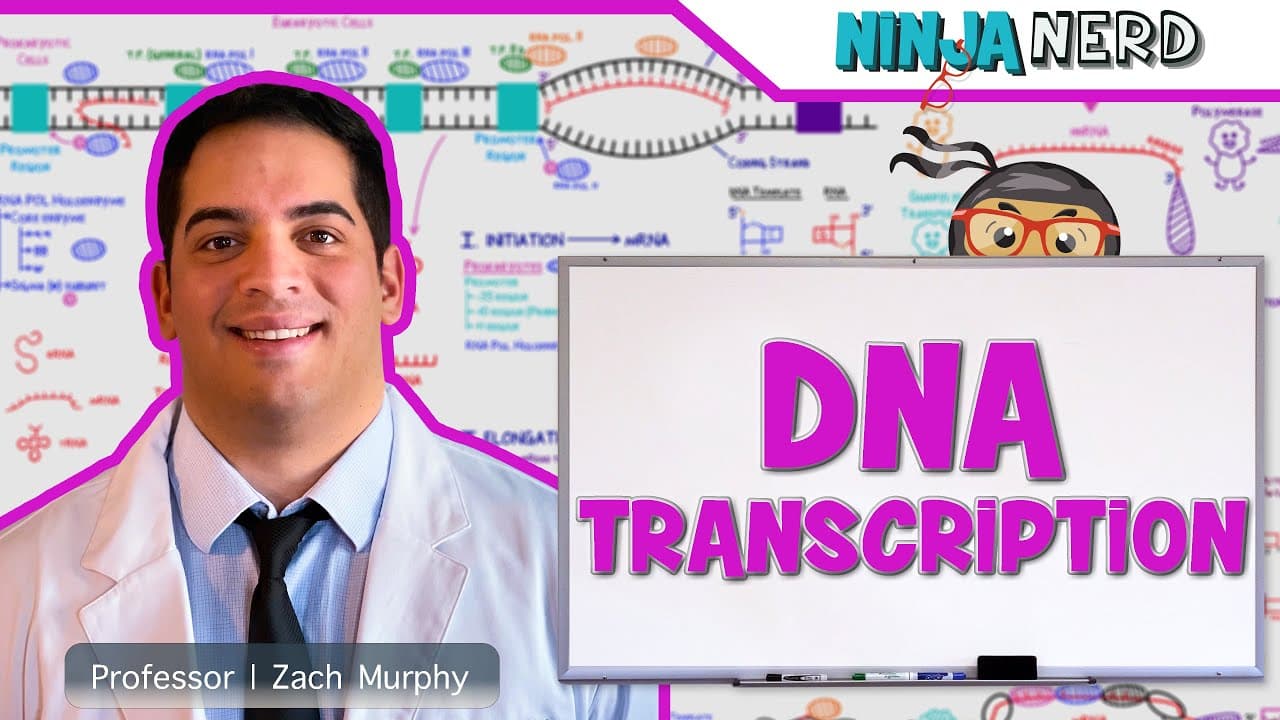
DNA transcription converts genetic information in double-stranded DNA into RNA. RNA polymerase reads the DNA template from 3′ to 5′ and synthesizes RNA from 5′ to 3′, beginning at a promoter with help from sigma in prokaryotes or general transcription factors in eukaryotes. Eukaryotic transcripts can then undergo capping, polyadenylation, and splicing.
Transcript
what's up ninja nerds in this video today we are going to be talking about dna transcription before we get started if you guys do like this video please hit that like button comment down in the comment section and please subscribe also down in the description box we have links to our facebook instagram patreon all that stuff will be there all right... Read More
Key Insights
- Transcription is the conversion of genetic information in double-stranded DNA into RNA. The process requires proteins or enzymes that recognize a promoter, bind the DNA, read its nucleotide sequence, and synthesize an RNA molecule from the selected gene.
- A promoter is a particular nucleotide sequence within DNA that provides a binding region for RNA polymerases and associated factors. Recognizing this region allows the transcription machinery to attach to DNA and begin moving through the gene to produce RNA.
- The prokaryotic RNA polymerase holoenzyme consists of a core enzyme and a sigma factor. The core includes two alpha subunits, beta, beta prime, and omega, while sigma supplies the promoter-binding function required to initiate transcription.
- The sigma factor binds the promoter and enables the prokaryotic RNA polymerase core enzyme to associate with DNA. After promoter recognition, the core enzyme separates from sigma and proceeds along the DNA, reading the template and synthesizing RNA.
- Prokaryotes use one RNA polymerase holoenzyme to produce all major RNA types discussed in the lecture. The same transcription enzyme can synthesize ribosomal RNA, messenger RNA, and transfer RNA rather than assigning these products to separate polymerases.
- Eukaryotic RNA polymerase I works with general transcription factors and primarily produces ribosomal RNA. Ribosomal RNA becomes part of ribosomes, which participate in translation by helping convert the information carried by messenger RNA into proteins.
- Eukaryotic RNA polymerase II works with general transcription factors to produce messenger RNA and small nuclear RNAs. Messenger RNA later participates in protein production, while the small nuclear RNAs discussed in the lecture are involved in RNA splicing.
- Eukaryotic RNA polymerase III works with general transcription factors and primarily produces transfer RNA, while also making a small amount of small nuclear RNA and ribosomal RNA. Transfer RNA carries an amino acid and an anticodon during translation.
Install to Summarize YouTube Videos and Get Transcripts
Explore YouTube Video Summarizer or Get YouTube Transcript Extractor
Questions & Answers
Q: What is DNA transcription and what does it produce?
DNA transcription is the process of using double-stranded DNA to produce RNA. Transcription machinery binds to a promoter within the DNA, reads the appropriate DNA template, and synthesizes an RNA strand. The resulting product may be messenger RNA, ribosomal RNA, transfer RNA, or small nuclear RNA, depending on the cell type and the RNA polymerase involved.
Q: How does a promoter help start DNA transcription?
A promoter is a particular nucleotide sequence within DNA that serves as a binding location for proteins needed to begin transcription. RNA polymerases and promoter-recognizing proteins attach at this region, which positions the polymerase to read the relevant DNA sequence. In prokaryotes sigma supports promoter binding, while eukaryotes use general transcription factors to help recruit RNA polymerase.
Q: What is the prokaryotic RNA polymerase holoenzyme?
The prokaryotic RNA polymerase holoenzyme is the transcription enzyme used to produce the cell's RNA. It contains a core enzyme and a sigma factor. The core consists of two alpha subunits, beta, beta prime, and omega, and it reads DNA and synthesizes RNA. Sigma recognizes the promoter and enables the core enzyme to bind at the correct location.
Q: What does the sigma factor do during prokaryotic transcription?
The sigma factor provides the promoter-binding function of the prokaryotic RNA polymerase holoenzyme. It recognizes and attaches to the promoter region, allowing the polymerase core enzyme to associate with the DNA. Once initiation has occurred, the core enzyme releases from sigma and moves along the DNA to read the template and build the RNA transcript.
Q: In which directions are DNA read and RNA synthesized?
RNA polymerase reads the DNA template strand from 3′ to 5′ and synthesizes the RNA strand from 5′ to 3′. During elongation, the polymerase travels along the DNA template while extending the RNA transcript. These opposing directions describe how information in the selected DNA sequence is transferred into a newly produced RNA molecule.
Q: What RNA products are made by eukaryotic RNA polymerases?
Eukaryotic RNA polymerase I primarily produces ribosomal RNA. RNA polymerase II produces messenger RNA and small nuclear RNAs involved in splicing. RNA polymerase III primarily produces transfer RNA, while also making a small amount of small nuclear RNA and ribosomal RNA. Each polymerase works with general transcription factors that help it bind to its promoter.
Q: How do prokaryotic and eukaryotic transcription differ?
Prokaryotes use one RNA polymerase holoenzyme to produce messenger RNA, ribosomal RNA, and transfer RNA. This enzyme combines a promoter-binding sigma factor with an RNA-synthesizing core. Eukaryotes instead use RNA polymerases I, II, and III for different RNA products, and each transcription process requires general transcription factors to help the appropriate polymerase bind at a promoter.
Q: How is eukaryotic pre-mRNA processed after transcription?
Eukaryotic pre-mRNA undergoes post-transcriptional modifications before becoming a mature messenger RNA transcript ready for translation. The modifications identified in the lecture are 5′ capping, 3′ polyadenylation, and RNA splicing. Small nuclear RNAs produced by RNA polymerase II, with a smaller contribution from RNA polymerase III, are discussed as participants in the splicing process.
Summary & Key Takeaways
-
Transcription is the process of converting information in double-stranded DNA into RNA. It begins when transcription machinery recognizes a promoter, a specific nucleotide sequence in DNA. RNA polymerase then reads the template strand from 3′ to 5′ while synthesizing a complementary RNA transcript in the 5′ to 3′ direction.
-
Prokaryotic transcription uses one RNA polymerase holoenzyme to produce mRNA, rRNA, and tRNA. Its core enzyme contains two alpha subunits, beta, beta prime, and omega, which read DNA and synthesize RNA. A sigma factor recognizes and binds the promoter, enabling the core enzyme to begin transcription.
-
Eukaryotic transcription separates RNA production among RNA polymerases I, II, and III, each assisted by general transcription factors. Polymerase I primarily makes rRNA, polymerase II makes mRNA and small nuclear RNA, and polymerase III primarily makes tRNA. Eukaryotic pre-mRNA is processed through 5′ capping, 3′ polyadenylation, and RNA splicing.
Read in Other Languages (beta)
Share This Summary 📚
Summarize YouTube Videos and Get Video Transcripts with 1-Click
Try YouTube Summary with ChatGPT & Claude or YouTube Transcript Generator
Explore More Summaries from Ninja Nerd 📚




Summarize YouTube Videos and Get Video Transcripts with 1-Click
Try YouTube Summary with ChatGPT & Claude or YouTube Transcript Generator