AI Pioneer Shows The Power of AI AGENTS - "The Future Is Agentic"
TL;DR
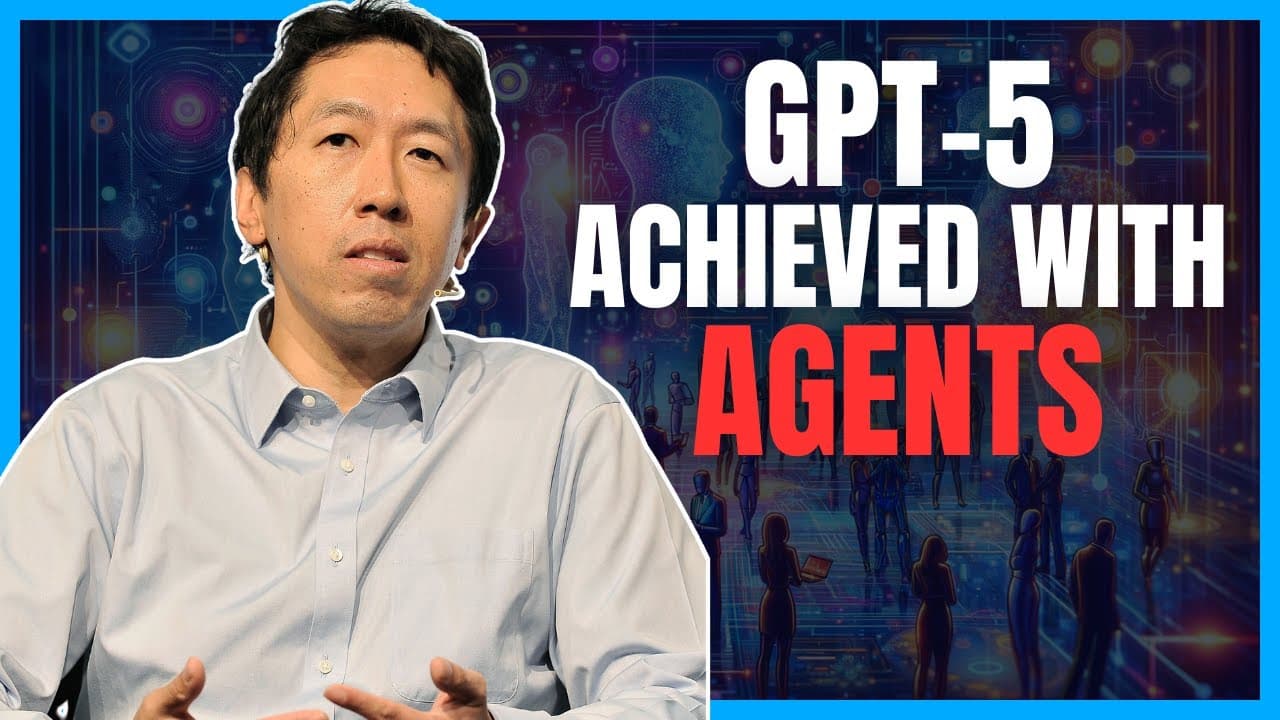
Dr. Andrew Ning shares insights on the potential of AI agents and their workflows.
Transcript
Dr Andrew ning just did a talk at Sequoia and is all about agents and he is incredibly bullish on agents he said things like GPT 3.5 powering agents can actually reason to the level of GPT 4 and a lot of other really interesting tidbits so we're going to watch his talk together and I'm going to walk you through step by step what he's saying and why... Read More
Key Insights
- ❓ Dr. Ning emphasizes that agentic workflows foster collaboration among AI models, vastly improving task execution compared to traditional approaches.
- 👻 The concept of reflection in AI allows for continual self-assessment, helping models refine their outputs effectively over time.
- 😒 Tool use provides AI agents with robust capabilities, allowing them to perform complex tasks using established functions without needing to generate new code from scratch.
- ✖️ Multi-agent collaboration can yield diverse and creative solutions as AI entities assume different roles that mimic human teamwork.
- 💱 The shift from zero-shot prompting to agentic workflows represents a paradigm change in how AI can approach problem-solving.
- 🈸 As AI models advance, the flexibility of agentic systems will likely enhance their application across various industries and tasks.
- 🥡 Efficient task management through agents may reduce the time taken to complete complex procedures in professional settings.
Install to Summarize YouTube Videos and Get Transcripts
Explore YouTube Video Summarizer or Get YouTube Transcript Extractor
Questions & Answers
Q: What is an agentic workflow and how does it differ from traditional AI interactions?
An agentic workflow allows AI to take on specialized roles, enabling collaboration and iterations on tasks instead of simply generating responses to prompts. Unlike traditional AI, where a single request yields a response, agentic workflows mimic human reasoning and planning by breaking tasks into smaller parts, facilitating improvement through repeated interactions.
Q: Who is Dr. Andrew Ning and what are his contributions to AI?
Dr. Andrew Ning is a prominent figure in AI, having co-founded Google Brain and served as the chief scientist at Baidu. He has significantly impacted AI advancement through his expertise in machine learning and his work in online education via Coursera, emphasizing accessible learning in computer science and mathematics.
Q: What findings did Dr. Ning present regarding the performance of agentic workflows compared to zero-shot prompting?
Dr. Ning's research revealed that GPT 3.5 wrapped in an agentic workflow outperformed GPT 4 using a zero-shot approach. This indicates that the iterative nature of agentic workflows can lead to better performance than more advanced models employed in less dynamic ways.
Q: How does reflection contribute to the effectiveness of AI agents?
Reflection enables AI agents to critically assess their outputs, identify improvements, and revise their work. This iterative process enhances their performance over time, allowing them to produce more accurate and effective solutions as they learn from previous attempts.
Q: Can you explain the significance of tool use in AI agent workflows?
Tool use is crucial as it entails giving AI agents access to predefined functions or libraries that can enhance their performance. This means they can leverage established tools for tasks rather than relying solely on language models, thus leading to more consistent and reliable outcomes.
Q: What is multi-agent collaboration and why is it important?
Multi-agent collaboration involves different AI models working in coordination on a task. This approach allows for diverse perspectives and insights, leading to more robust solutions. It is instrumental in tackling complex problems, showcasing the potential of combining strengths from various specialized models.
Q: What trends does Dr. Ning foresee in the development of AI agents and workflows?
Dr. Ning anticipates a significant expansion in the capabilities of AI as agentic workflows become more prevalent. He believes these advancements will lead to more efficient task management, improved iterative processes, and potentially accelerate the journey toward Artificial General Intelligence (AGI).
Q: How does fast token generation impact the effectiveness of AI agents?
Fast token generation enhances the efficiency of agentic workflows by allowing agents to produce and process information rapidly. This speed enables more iterations and refinements, increasing the likelihood of achieving high-quality results, especially when combined with existing models and tools.
Summary & Key Takeaways
-
Dr. Andrew Ning emphasizes the power of agentic workflows, demonstrating their capability to deliver superior results by simulating collaborative human-like processes. Through iterations and specialized roles, these agents can enhance problem-solving efficiency.
-
Equipped with reflection and planning capabilities, AI agents can learn from past outputs, analyze performance, and improve the quality of their tasks, showcasing a significant advancement over traditional zero-shot approaches in AI.
-
The discussion highlights the transformative potential of multi-agent collaboration, where different AI models can work together to tackle complex problems, indicating that future advancements in AI will be driven by improved agent workflows.
Read in Other Languages (beta)
Share This Summary 📚
Summarize YouTube Videos and Get Video Transcripts with 1-Click
Try YouTube Summary with ChatGPT & Claude or YouTube Transcript Generator
Explore More Summaries from Matthew Berman 📚


Summarize YouTube Videos and Get Video Transcripts with 1-Click
Try YouTube Summary with ChatGPT & Claude or YouTube Transcript Generator