Which Open-Source AI Projects Should You Try?
TL;DR
The most useful project depends on the task: OpenMontage and Hyperframes create videos, Deer Flow handles long-running agent work, Codebase Memory MCP indexes large repositories, and Unlimited OCR analyzes documents. The broader collection also includes reusable engineering and cybersecurity skills, plus SkillSpector, Palmier Pro, Hermes, and Voicebox, giving developers several specialized projects to evaluate.
Transcript
Over the weekend, I found some incredible open-source AI projects that I wanted to share with you. Let me show you them right now. All right, the first one is called Open Montage and it turns your AI agent into a full video production team. This one has almost 15,000 stars. It describes itself as turning your AI coding assistant into a full video p... Read More
Key Insights
- OpenMontage is a video-production system for AI coding assistants that can handle research, scripting, asset generation, editing, and final composition from a plain-language request. Its 12 production pipelines cover formats including explainers, talking heads, screen demonstrations, trailers, animation, podcasts, localization, documentaries, and montages.
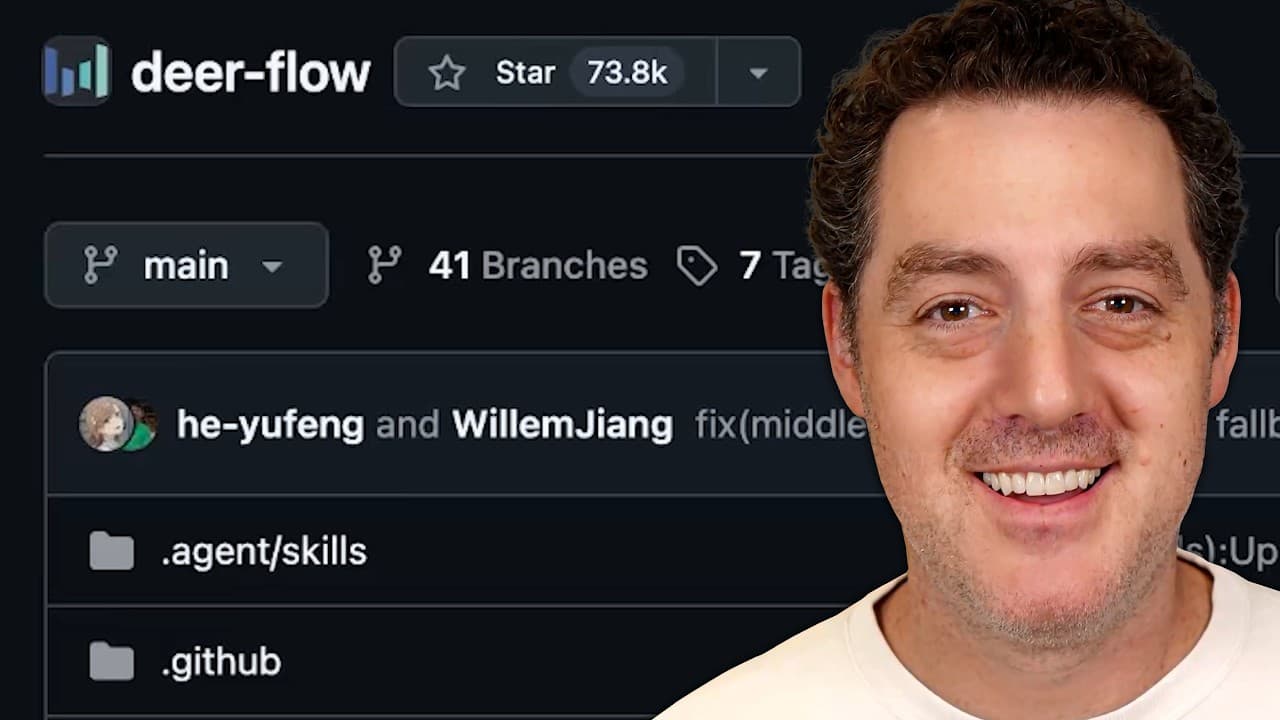
- Deer Flow is an open-source agent harness from ByteDance designed for long-horizon assignments that can run for hours or days. It coordinates sub-agents, memory, sandboxes, tools, and extensible skills for work such as data pipelines, slide decks, dashboards, and automated content workflows.
- Anthropic Cybersecurity Skills is a skills package that equips compatible agents with cybersecurity frameworks, tactics, and techniques. It includes six frameworks, references sources such as MITRE ATT&CK, NIST, and the MITRE Fight Fraud Framework, and works with several coding assistants that support skills.
- Hyperframes is an open-source HeyGen framework that turns HTML, CSS, media, and seekable animations into deterministic MP4 videos. It renders through Chrome and FFmpeg, supports animation libraries including Three.js, and targets uses such as product demonstrations, presentations, motion graphics, and agent-generated animations.
- Codebase Memory MCP is a code-intelligence engine designed to help AI coding agents understand large repositories efficiently. The project claims support for 158 programming languages, operation across 11 agent harnesses, structural query responses under 1 millisecond, 120 times fewer tokens, one-line installation, and built-in 3D visualization.
- Matt Pocock's skills repository is a collection of agent skills based on his software-engineering practices rather than casual vibe coding. Its features include a routing tool called Ask Matt and a documentation grilling workflow that develops the project's domain model, sharpens terminology, and updates context documents and architectural decision records.
- G Stack is a structured engineering process that turns an agent into a broader development team. Its prescribed sequence is think, plan, build, review, test, ship, and reflect, with skills for office hours, executive and design reviews, quality assurance, deployment, canary work, benchmarking, documentation, and releases.
- Unlimited OCR is an open-weights vision-language model from Baidu for fast document reading and analysis. The demonstrated capability identifies relevant content in a research paper and highlights its location within a PDF, combining page understanding with spatial placement, while the downloadable model is described as about 6.5 GB.
Install to Summarize YouTube Videos and Get Transcripts
Explore YouTube Video Summarizer or Get YouTube Transcript Extractor
Questions & Answers
Q: How can OpenMontage create a complete AI-generated video?
OpenMontage accepts a plain-language description and lets an AI coding assistant manage research, scripting, asset generation, editing, and final composition. The demonstrated science-fiction trailer used the system for its concept, script, and scene plan, with VO generating motion clips, a generated soundtrack, and Remotion handling composition. It can also use an existing video as a reference and produce something similar that the user can modify.
Q: What types of videos can OpenMontage produce?
OpenMontage provides 12 production pipelines and about 400 agent skills. The listed formats include explainer videos, talking-head videos, screen demonstrations, cinematic trailers, animation, podcasts, localization projects, documentary pieces, and montages. Users can begin with a written description or provide a video they already like as a reference, then change the generated result to fit their intended style or content.
Q: What is Deer Flow designed to do?
Deer Flow, short for deep exploration and efficient research flow, is an open-source super-agent harness from ByteDance. It is designed for long-horizon assignments that may continue for hours or even days. The system breaks complex work into parts using sub-agents and supports memory, sandboxes, tools, and extensible skills. Mentioned applications include building data pipelines, generating presentations, creating dashboards, and automating content workflows.
Q: How do Anthropic Cybersecurity Skills help coding agents?
Anthropic Cybersecurity Skills gives skill-compatible agents access to cybersecurity frameworks, tactics, and techniques that can inform defensive improvements to an application or codebase. The package includes six cyber frameworks and mentions MITRE ATT&CK, NIST, and the MITRE Fight Fraud Framework. It is presented as compatible with Claude Code, GitHub Copilot, Codex CLI, Cursor, Gemini CLI, and other agents that support skills.
Q: How does Hyperframes turn web content into video?
Hyperframes uses HTML, CSS, media, and seekable animations as the source for deterministic MP4 output. It renders content in Chrome and uses FFmpeg for video production, while supporting animation libraries such as Three.js. An agent can write the underlying web animation, after which the framework converts it into a video. The suggested applications include product demonstrations, slides, motion graphics, animated branding, and transitions.
Q: How does Codebase Memory MCP improve repository understanding?
Codebase Memory MCP fully indexes repositories so AI coding agents can answer structural questions efficiently, including on very large codebases. The project claims that an average repository can be indexed in milliseconds, while the Linux kernel, described as 28 million lines, can be indexed in 3 minutes. It also claims structural queries under 1 millisecond, support for 158 programming languages, and 120 times fewer tokens.
Q: What do Matt Pocock's agent skills provide?
Matt Pocock's repository packages the engineering practices he uses for real software development into reusable agent skills. Ask Matt acts as a router that recommends an appropriate skill or workflow for a situation. Another workflow, Grill with Docs, conducts a questioning session while building the project's domain model, refining terminology, and updating context documentation and architectural decision records directly within the project.
Q: How should developers use G Stack with an engineering agent?
G Stack is intended to be followed as an ordered process rather than treated as an unrelated collection of tools. The sequence is think, plan, build, review, test, ship, and reflect. Its skills cover office-hours questioning, chief executive and design reviews, planning, quality assurance, paired agent work, shipping, landing and deployment, canary work, benchmarking, release documentation, and reflection across the development lifecycle.
Summary & Key Takeaways
-
The collection presents 12 open-source AI projects spanning video production, long-running agents, cybersecurity, code intelligence, software development, document analysis, and additional tools. OpenMontage automates a broad production workflow, while Hyperframes converts web technologies and seekable animations into deterministic MP4 files suitable for product demos, slides, and motion graphics.
-
Deer Flow orchestrates sub-agents, memory, sandboxes, tools, and extensible skills for work that may continue for hours or days. Codebase Memory MCP focuses on efficient repository understanding, supporting 158 programming languages, multiple agent harnesses, fast structural queries, reduced token use, simple installation, and an interactive 3D codebase visualization.
-
The skills collections encode established working processes for compatible coding agents. Anthropic Cybersecurity Skills incorporates six cyber frameworks, Matt Pocock's repository emphasizes disciplined software engineering, and G Stack organizes startup development into an ordered process from thinking and planning through review, testing, shipping, reflection, documentation, deployment, canary work, and benchmarking.
Read in Other Languages (beta)
Share This Summary 📚
Summarize YouTube Videos and Get Video Transcripts with 1-Click
Try YouTube Summary with ChatGPT & Claude or YouTube Transcript Generator
Explore More Summaries from Matthew Berman 📚




Summarize YouTube Videos and Get Video Transcripts with 1-Click
Try YouTube Summary with ChatGPT & Claude or YouTube Transcript Generator