How Does Anthropic Recommend Building Powerful AI Agents?
TL;DR
Anthropic recommends building effective AI agents by starting with the simplest solution and adding complexity only when necessary. Its approach distinguishes predefined workflows from agents that dynamically direct their processes and tool use, then applies composable patterns such as prompt chaining, routing, parallelization, orchestrator-worker workflows, and evaluator-optimizer loops. Read on to choose the right pattern while balancing task performance against latency, cost, and debugging difficulty.
Transcript
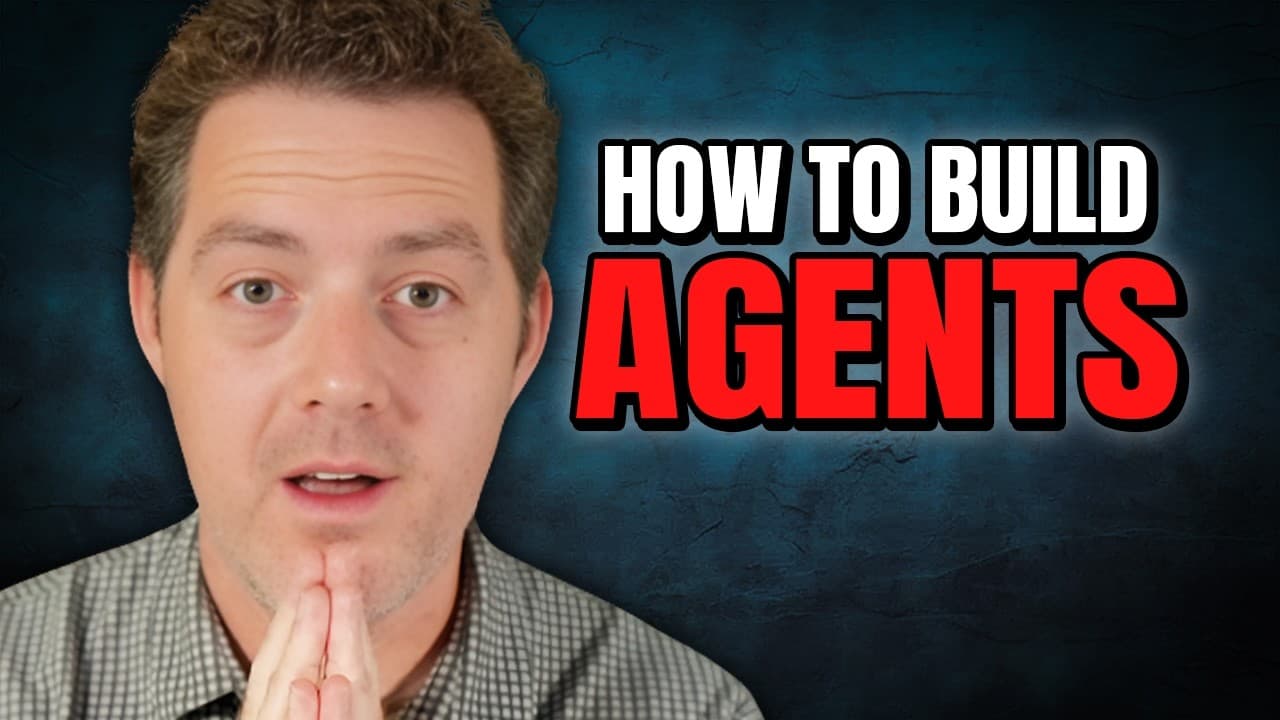
I'm going to tell you how to build effective agents anthropic the company behind the Claud family of models just dropped a bunch of information about how to build effective models and I read through it and it's actually really good we're going to go over it together and I'm also going to give my thoughts after building a bunch of Agents myself so l... Read More
Key Insights
- Effective AI agents don't need complex frameworks; simple, composable patterns are often sufficient.
- Agents are systems where LLMs dynamically direct processes and tool usage, maintaining control over task accomplishment.
- Agentic frameworks provide abstraction layers and built-in tools, helping avoid reinventing best practices.
- Frameworks can obscure underlying prompts and responses, making debugging harder and potentially adding unnecessary complexity.
- Prompt chaining breaks tasks into steps, improving quality by processing outputs sequentially rather than in one go.
- Routing allows specialized agents to handle tasks based on required tools, expertise, and models, optimizing cost and speed.
- Parallelization decreases latency by running independent subtasks or generating diverse outputs for improved quality.
- Orchestrator-worker workflows dynamically delegate tasks, allowing iterative refinement and synthesizing results for complex projects.
Install to Summarize YouTube Videos and Get Transcripts
Explore YouTube Video Summarizer or Get YouTube Transcript Extractor
Questions & Answers
Q: How does Anthropic recommend building effective AI agents?
Start with the simplest solution possible and increase complexity only when needed. Anthropic says successful implementations often use simple, composable patterns instead of complex frameworks or specialized libraries, because more sophisticated agentic systems can increase latency, token usage, and cost.
Q: What is the difference between AI workflows and agents?
Workflows orchestrate LLMs and tools through predefined code paths. Agents dynamically direct their own processes and tool usage, retaining control over how they accomplish tasks, although some agentic frameworks support both structured workflows and flexible agent behavior.
Q: When should you use an AI agent instead of a workflow?
Use workflows when a well-defined task requires predictability and consistency. Agents are more appropriate when flexibility and model-driven decision-making are needed at scale, provided that their potential gains justify additional latency and cost.
Q: What are the benefits and drawbacks of agentic frameworks?
Agentic frameworks provide abstraction, built-in tools, and a predefined path based on established practices, reducing the need to solve ancillary issues repeatedly. Their extra abstraction can obscure prompts and responses, make debugging harder, and tempt developers to introduce unnecessary complexity.
Q: What is prompt chaining in an AI workflow?
Prompt chaining breaks a task into sequential steps, with each LLM call processing the previous step’s output. It can improve quality and support checks between steps, but it trades additional latency for that structured processing.
Q: How does routing work in AI agent systems?
Routing directs a request to a specialized agent according to the tools, expertise, or model the task requires. It can improve cost and speed by sending easier tasks to smaller models and more complex tasks to more capable models.
Q: How does parallelization improve AI workflows?
Parallelization runs independent subtasks concurrently to reduce completion latency. It can also run the same task multiple times to produce diverse outputs, which may then be compared or combined to improve quality.
Q: What are orchestrator-worker and evaluator-optimizer patterns?
In an orchestrator-worker workflow, a central LLM dynamically delegates subtasks to worker LLMs, synthesizes their results, and can request further iteration. In an evaluator-optimizer pattern, one LLM generates a solution while another evaluates it and supplies feedback for repeated refinement against clear criteria.
Summary & Key Takeaways
-
Building effective AI agents doesn't require complex frameworks; simple, composable patterns often suffice. Frameworks provide abstraction layers and built-in tools but can obscure prompts, making debugging harder. Prompt chaining and routing are techniques to improve quality and efficiency by breaking tasks into steps and directing them to specialized agents.
-
Parallelization decreases latency by running subtasks concurrently or generating diverse outputs for improved quality. Orchestrator-worker workflows dynamically delegate tasks, allowing iterative refinement and synthesizing results for complex projects. Evaluator-optimizer patterns involve generating solutions and evaluating them for continuous improvement.
-
Agents are systems where LLMs dynamically direct processes and tool usage, maintaining control over task accomplishment. Choosing the right agentic framework enhances efficiency, allowing for flexibility and model-driven decision-making at scale. Testing and iterating on implementations are crucial for success, as early-stage tools and techniques continue to evolve.
Read in Other Languages (beta)
Share This Summary 📚
Summarize YouTube Videos and Get Video Transcripts with 1-Click
Try YouTube Summary with ChatGPT & Claude or YouTube Transcript Generator
Explore More Summaries from Matthew Berman 📚





Summarize YouTube Videos and Get Video Transcripts with 1-Click
Try YouTube Summary with ChatGPT & Claude or YouTube Transcript Generator