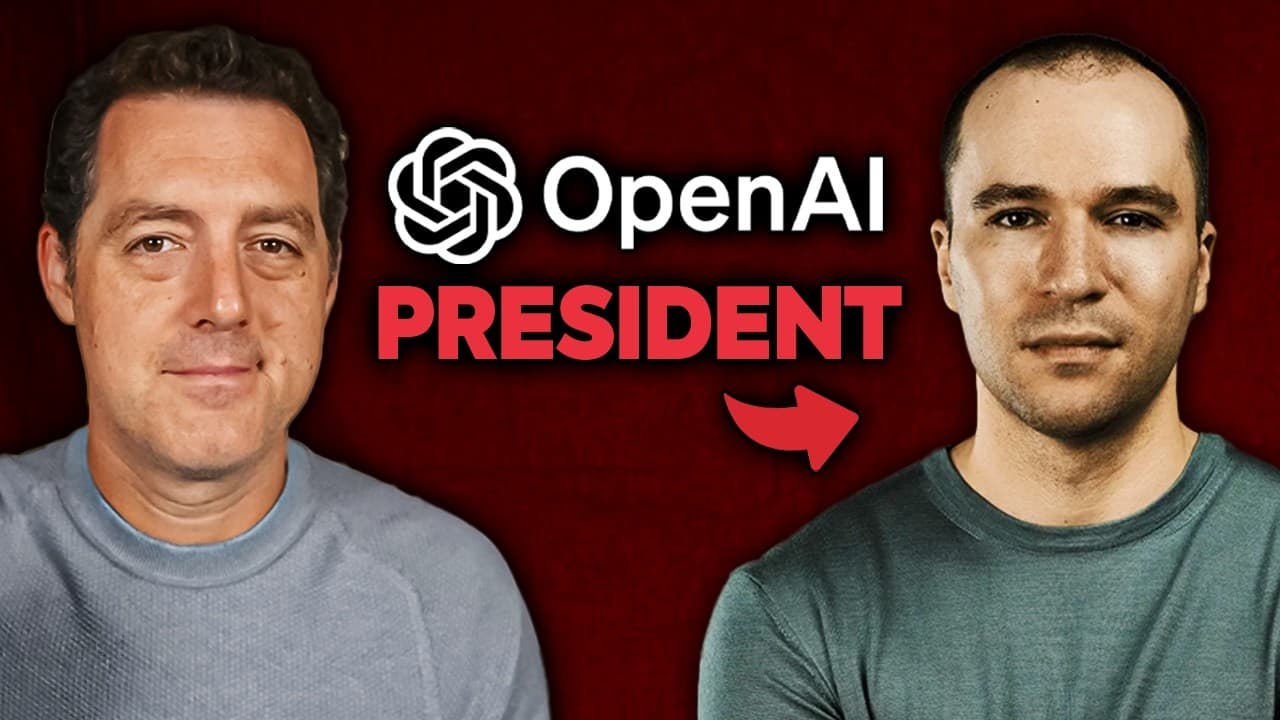
How Does Greg Brockman See AGI, Sora 2, White-Collar Work, and Proactive AI Evolving?
TL;DR
Proactive AI will reshape work by handling increasingly difficult tasks, changing many jobs, and creating opportunities while eliminating some roles. Greg Brockman describes AGI as a continuous process rather than a single destination, while Sora 2 shows that video and text models share transformer-based foundations. Compute and energy remain major constraints on progress, making the discussion worth reading for its view of how AI capabilities, infrastructure, and work may evolve together.
Transcript
Where do you think the biggest bottleneck is today? We're heading to a world where energy is going to be a massive bottleneck. Do you ever consider some of the newer players like a Cerebrus or a Grock? So in 2017, we got super excited when we saw Cerebrus. 2017 Open AI was I guess very different than today Open AI. You'd be surprised. People still ... Read More
Key Insights
- Proactive AI is anticipated to change many jobs, creating new roles while potentially eliminating others.
- Sora 2 showcases the advancement of AI in simulating complex world models, indicating a shift towards more interactive and predictive systems.
- The transformer architecture continues to be foundational for AI development, though future innovations could lead to new architectures.
- Compute scarcity is a significant bottleneck, with energy constraints likely to impact AI scalability.
- OpenAI is investing in partnerships with hardware providers like AMD to optimize performance and expand compute capacity.
- AI's role in economic productivity is increasing, with compute being a critical driver.
- The integration of apps within platforms like ChatGPT is transforming how users interact with the internet, moving away from static websites.
- AI's ability to autonomously think and solve complex problems is expanding, with expectations for models to handle increasingly difficult tasks.
Install to Summarize YouTube Videos and Get Transcripts
Explore YouTube Video Summarizer or Get YouTube Transcript Extractor
Questions & Answers
Q: How will proactive AI shape the future of work?
Proactive AI is expected to optimize tasks, tackle increasingly difficult problems, and change many jobs. Some roles may disappear while new opportunities emerge, potentially requiring changes to fundamentals of the social contract.
Q: What does Greg Brockman say about whether jobs are in danger from AI?
Brockman says AI is going to change a lot of jobs rather than presenting a simple prediction that every job will disappear. The existing discussion also anticipates both the elimination of some roles and the creation of new opportunities.
Q: Why is Sora 2 significant for AI development?
Sora 2 is presented as a major step toward fuller world models. Although video and text are very different modalities, Brockman says their learning and generation processes have substantial computational overlap, with both still based on deep learning and transformers.
Q: Will transformer models be enough to reach AGI?
Brockman says he would not be surprised if AGI looked similar to current models, but he would be shocked if it used exactly the same architecture. He sees room for innovation while noting that algorithmic, scaling, and data curves continue to drive better performance.
Q: How does Greg Brockman define AGI?
Brockman says he once viewed AGI as a destination. He now describes it as a continuous process, reflecting ongoing improvements rather than a single fixed endpoint.
Q: What is the biggest bottleneck for scaling AI?
Compute is described as the fundamental driver of AI innovation, and energy is expected to become a massive bottleneck. Scaling also requires balancing multiple demands for hardware capacity and specialist time across different models.
Q: How is OpenAI working with AMD hardware?
OpenAI has invested in AMD software for a long time through Triton, a project it sponsored and helped develop. Brockman says getting inference working has a massive fixed cost, while getting training working has an even larger fixed cost.
Q: How could AI change software and internet use?
Brockman thinks software will eventually be fully generated. He also says ChatGPT highlights how unnatural it can feel to visit a static website merely to read information, pointing toward more dynamic interactions through AI and integrated apps.
Summary & Key Takeaways
-
Proactive AI is poised to transform industries by optimizing tasks and potentially replacing some jobs while creating new opportunities. As AI models like Sora 2 evolve, they demonstrate a shift towards systems that can predict and fulfill user needs autonomously, challenging traditional internet browsing and monetization structures.
-
The transformer architecture remains foundational for AI development, though future innovations may lead to new architectures. Compute scarcity, particularly energy constraints, is a significant bottleneck, prompting OpenAI to partner with hardware providers like AMD to optimize performance and expand compute capacity.
-
AI's role in economic productivity is growing, with compute being a critical driver. The integration of apps within platforms like ChatGPT is changing user interactions with the internet, moving away from static websites. AI's ability to autonomously think and solve complex problems is expected to expand, handling increasingly difficult tasks.
Read in Other Languages (beta)
Share This Summary 📚
Summarize YouTube Videos and Get Video Transcripts with 1-Click
Try YouTube Summary with ChatGPT & Claude or YouTube Transcript Generator
Explore More Summaries from Matthew Berman 📚






Summarize YouTube Videos and Get Video Transcripts with 1-Click
Try YouTube Summary with ChatGPT & Claude or YouTube Transcript Generator