Why is AI Safety Critical for Our Future?
TL;DR
AI safety is essential to address both immediate and long-term risks as technology evolves. Anca Dragan argues for proactive engagement and alignment with diverse human values to ensure that AI systems remain beneficial and prevent catastrophic outcomes.
Transcript
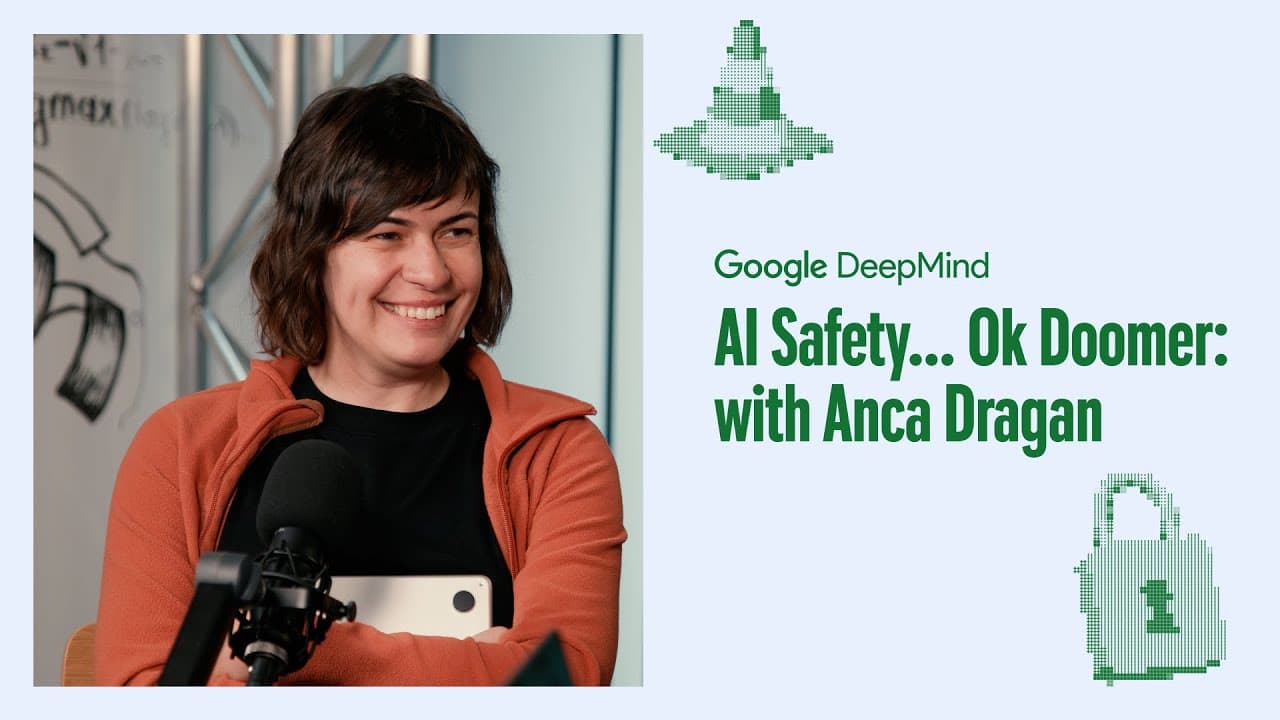
HANNAH FRY: Welcome to "Google DeepMind-- the Podcast." I'm your host, Professor Hannah Fry. Now, in the heart of Silicon Valley, there's a new phrase that has emerged. It mirrors the millennial retort, OK Boomer, in how dismissive it is. But OK Doomer is now the go-to response for people who want to diminish talk of AGI's dangers. And by AGI, we m... Read More
Key Insights
- ✳️ The phrase "OK Doomer" represents a dismissive attitude towards discussions on the dangers of artificial general intelligence (AGI), reflecting a divide in public perception of AI risks.
- 💦 Dragan's work focuses on the safety and alignment of AI models, specifically concerning the present and future capabilities of AI technologies like Google's Gemini.
- 🤩 A key challenge in AI development is the intricate nature of human-AI interactions, requiring designers to anticipate human behaviors and adapt AI responses accordingly.
- 🍉 The podcast emphasizes the need for proactive engagement with AI safety, insisting that it should consider both immediate harms and long-term existential threats.
- ❓ The notion of scalable oversight is critical for ensuring that AI can safely support human decision-making while aligning with individual values.
- 😤 Dragan's team explores innovative approaches such as deliberative alignment, where diverse viewpoints are emulated to foster constructive dialogue and consensus in AI response generation.
- 🥺 The urgent call for safety measures in AI development reflects a general awareness in the AI community that failing to address alignment issues could lead to significant societal harms.
Install to Summarize YouTube Videos and Get Transcripts
Explore YouTube Video Summarizer or Get YouTube Transcript Extractor
Questions & Answers
Q: What is the significance of discussing short-term versus long-term AI risks?
Anca Dragan emphasizes that both short-term ethics and long-term existential risks should not be seen as separate concerns. She argues that understanding immediate harms is essential for preventing potential catastrophic future outcomes, especially as AI capabilities advance rapidly. The integration of both perspectives, addressing current risks while considering future implications, forms a comprehensive safety strategy.
Q: How does Anca Dragan draw parallels between AI systems and real-world examples like bridge construction?
Dragan uses the analogy of bridge building to illustrate that safety should be integrated from the outset of AI development. Just as engineers consider safety when designing structures, she asserts that AI systems must incorporate safety measures at every development stage, rather than retrofitting them after the fact. This proactive mindset is critical for navigating increasingly complex AI systems.
Q: What is the role of feedback in human-AI interaction, according to Dragan?
Dragan stresses that effective human-AI interaction relies on ongoing dialogue and feedback. AI systems must not only respond to user instructions but also engage in clarifying questions to ascertain user intentions. By mirroring human conversational patterns, AI can better align its actions with users' values and needs, facilitating safer and more effective collaborations.
Q: How do societal values factor into AI alignment challenges?
Dragan explains that societal values introduce significant complexity into AI alignment efforts. With diverse perspectives across cultural, political, and demographic lines, AI systems must balance individual preferences with the broader societal context. She advocates for designing AI so that it can reflect multiple values and accommodate differing opinions, ensuring inclusive and safe solutions.
Summary & Key Takeaways
-
Anca Dragan emphasizes the importance of AI safety in both short-term and long-term contexts, arguing against the complacency towards potential catastrophic risks of AI technologies.
-
The discussion explores human-AI interaction, looking into how aligning AI with human values requires proactive engagement and iterative feedback for effective functioning in complex environments.
-
The speakers highlight the complexities of aligning AI with diverse human values and concerns over balancing individual needs with broader societal impacts, particularly as AI capabilities evolve.
Read in Other Languages (beta)
Share This Summary 📚
Summarize YouTube Videos and Get Video Transcripts with 1-Click
Try YouTube Summary with ChatGPT & Claude or YouTube Transcript Generator
Explore More Summaries from Google DeepMind 📚



Summarize YouTube Videos and Get Video Transcripts with 1-Click
Try YouTube Summary with ChatGPT & Claude or YouTube Transcript Generator