What Are Neutron Stars? Atoms As Big As Mountains Explained
TL;DR
Neutron stars are ultradense stellar remnants created when a massive star’s core collapses after fusion reaches iron. A neutron star can contain between 1 and 3 Suns of mass inside an object about 25 kilometers wide, producing extraordinary gravity, heat, rotation and magnetism. Read on to trace their formation, internal structure and most extreme measured properties.
Transcript
Neutron stars are one of the most extreme things in the universe. They’re like giant atom cores. Kilometers in diameter, unbelievably dense and violent. But how can something like this even exist? The life of a star is dominated by two forces being in balance. Its own gravity and the radiation pressure of its fusion reaction. In the core of stars, ... Read More
Key Insights
- Balance determines a star’s survival: Before collapse, gravity pulls the star inward while radiation pressure from fusion pushes against it. The neutron star formation sequence begins only when fusion can no longer maintain that opposition. This balance explains why exhausting fuel is decisive rather than merely another stage in the star’s layered development.
- Iron ends the fusion sequence: Massive stars successively produce helium, carbon, neon, oxygen and silicon before reaching iron. The transcript identifies iron as the point where fusion cannot continue into another element. With no continuing fusion reaction, radiation pressure drops rapidly, removing the support that had kept the core from collapsing under its own gravity.
- Core mass sets the threshold: Catastrophic collapse occurs when the core exceeds about 1.4 solar masses. This stated threshold connects the failure of fusion to the birth of the compact remnant. Once crossed, matter falls inward so violently that the outer portion of the core can reach speeds of up to 70,000 km/s.
- Atomic particles are transformed: During collapse, even quantum-mechanical electron repulsion is overcome. Electrons and protons then fuse into neutrons, which become packed at the density of an atomic nucleus. This conversion explains both the object’s name and how stellar matter can be compressed into a body only about 25 kilometers across.
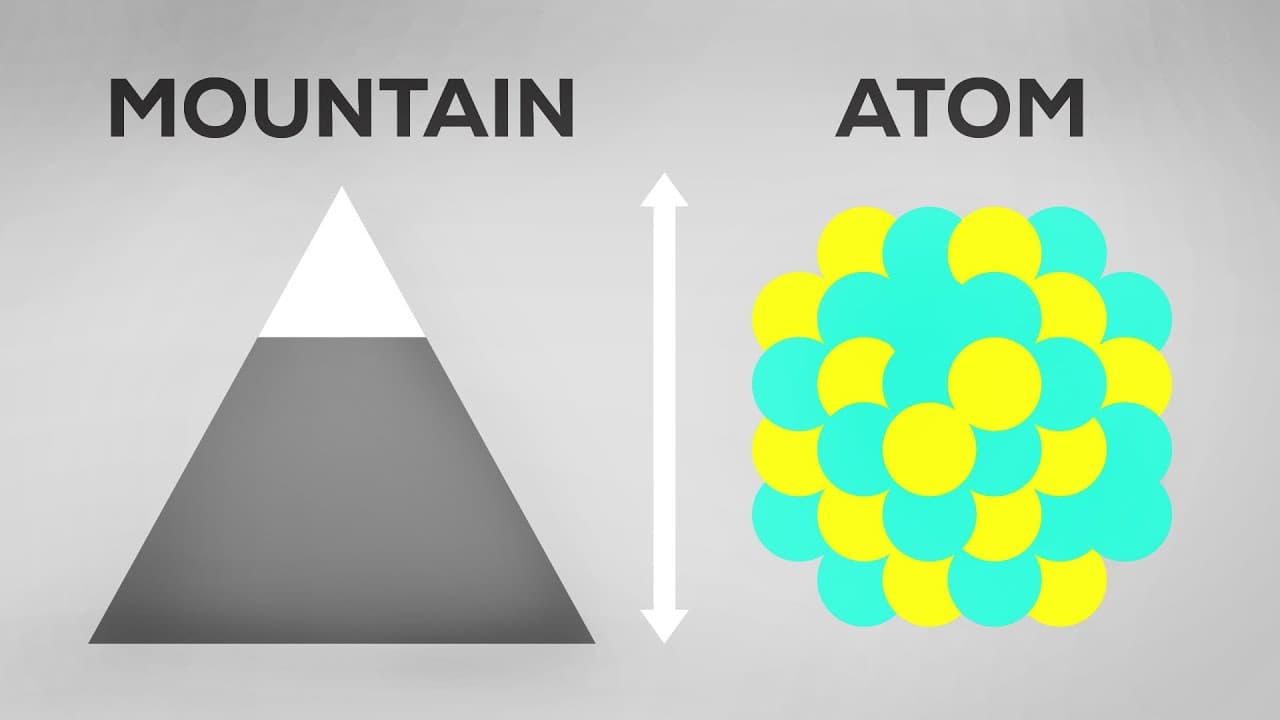
- A mountain fits in a cube: One cubic centimeter of neutron-star material contains roughly 1 billion tons. The transcript compares that mass with Mount Everest and with an iron cube measuring 700 meters across, all represented inside a sugar-cube-sized space. These comparisons make the star’s otherwise difficult density concrete without relying only on its total mass.
- Surface gravity acts almost instantly: From only 1 meter above a neutron star, a dropped object would reach the surface in one microsecond. During that tiny interval, it would accelerate to 7.2 million km/h. The example shows how intensely the star’s mass curves conditions near its surface and why approaching it would be exceptionally dangerous.
- Extreme gravity flattens everything: Surface irregularities can rise no more than 5 millimeters, leaving the neutron star superflat. This smoothness accompanies a superthin atmosphere composed of hot plasma. Together, these details show that the visible boundary is not an ordinary rocky surface, despite the crust beneath it being described as extremely hard.
- The surface remains fiercely hot: A neutron star’s surface temperature is about 1 million kelvin. For comparison, the transcript gives the Sun’s surface temperature as 5,800 kelvin. This contrast establishes that the compact remnant remains extraordinarily hot even after the supernova has expelled the original star’s outer layers into space.
- The crust has flowing electrons: The crust is most likely built from a lattice of iron atom nuclei with a sea of electrons moving through it. Going deeper changes the composition, with neutrons becoming more common and protons less common. Eventually the material becomes an incredibly dense soup of neutrons that cannot be individually distinguished.
- The core remains uncertain: The transcript stresses that the properties of neutron-star cores are not known with confidence. The closest guesses offered are superfluid neutron degenerate matter or ultradense quark matter called quark-gluon plasma. Such matter does not fit traditional expectations and is presented as possible only within this ultraextreme environment.
- Gravity replaces strong interaction: A neutron star resembles a giant atomic core because both contain extraordinarily dense nuclear material. Their crucial difference is what holds them together. Atomic cores depend on the strong interaction, while the much larger neutron star is bound by gravity, linking the atomic-scale analogy to a fundamentally different mechanism.
- Rotation and magnetism create pulsars: Young neutron stars spin several times per second, while one fed by a nearby star can rotate several hundred times per second. PSRJ1748-2446ad is said to spin at approximately 252 million km/h, fast enough to distort its shape. These objects are called pulsars because they emit strong radio signals, alongside magnetic fields roughly 8 trillion times Earth’s.
Install to Summarize YouTube Videos and Get Transcripts
Explore YouTube Video Summarizer or Get YouTube Transcript Extractor
Questions & Answers
Q: What are neutron stars, and how do they form?
Neutron stars are extremely dense remnants produced by the collapse of massive stellar cores. A massive star builds progressively heavier nuclei until fusion reaches iron, which cannot fuse into another element. When fusion stops, radiation pressure drops and a core exceeding about 1.4 solar masses collapses catastrophically. Electron repulsion is overcome, electrons and protons fuse into densely packed neutrons, and the outer stellar layers are expelled in a supernova. The remaining compact object is the neutron star.
Q: How large, massive and dense is a neutron star?
A neutron star is about 25 kilometers wide but contains between 1 and 3 Suns of mass. The transcript also describes it as carrying 500,000 times Earth’s mass inside a ball roughly Manhattan’s diameter. One cubic centimeter of its material has a mass of about 1 billion tons. That equals the stated mass of Mount Everest or an iron cube 700 meters across, showing how nuclear-density matter produces enormous mass in very little space.
Q: Why does a massive star collapse after reaching iron?
A star survives while its inward gravity and outward radiation pressure remain balanced. Fusion supplies that pressure as the core progresses through hydrogen, helium, carbon, neon, oxygen and silicon. Iron ends the sequence because it cannot fuse into another element according to the transcript. Fusion therefore stops, radiation pressure falls rapidly and gravity gains control. If the core exceeds about 1.4 solar masses, the result is catastrophic collapse.
Q: What happens to matter during neutron star formation?
The outer part of the collapsing core can move toward the center at up to 70,000 km/s. Under this pressure, the quantum-mechanical repulsion of electrons can no longer prevent further compression. Electrons combine with protons to form neutrons packed as densely as matter in an atomic nucleus. The star’s outer layers are simultaneously catapulted into space in a violent supernova. This process leaves a compact remnant dominated by densely packed neutrons.
Q: What is the surface of a neutron star like?
The surface is superflat, with irregularities reaching no more than 5 millimeters. A superthin atmosphere of hot plasma lies above it, and the surface temperature is about 1 million kelvin. By comparison, the transcript places the Sun’s surface at 5,800 kelvin. The extreme flatness results from the neutron star’s immense gravity, while the high temperature and plasma atmosphere reflect the remnant’s severe surface conditions.
Q: What would happen to an object dropped near a neutron star?
An object dropped from 1 meter above the surface would hit the neutron star in one microsecond. Before impact, it would accelerate to 7.2 million km/h. This happens because between 1 and 3 Suns of mass are compressed into an object only about 25 kilometers wide. The example demonstrates the enormous gravitational pull at the surface and supports the warning that a spacecraft should not approach too closely.
Q: What is inside a neutron star?
The crust is extremely hard and is most likely an iron nuclei lattice with electrons flowing through it. Deeper inside, the proportion of neutrons increases while the number of protons decreases, eventually producing a dense soup of indistinguishable neutrons. The core’s exact properties remain uncertain. The proposed possibilities are superfluid neutron degenerate matter or ultradense quark matter called quark-gluon plasma. These forms are associated with the star’s uniquely extreme environment.
Q: Why do neutron stars become pulsars?
Neutron stars can rotate extraordinarily fast, with young examples spinning several times each second. If a nearby star feeds one, its rotation can rise to several hundred times per second. PSRJ1748-2446ad is described as spinning at approximately 252 million km/h, fast enough to give it an unusual shape. Such objects are called pulsars because they emit strong radio signals. Their magnetic fields are roughly 8 trillion times stronger than Earth’s and can bend atoms entering their influence.
Summary & Key Takeaways
-
From fusion to iron: A star remains stable while its gravity is balanced by radiation pressure from fusion. After core hydrogen is exhausted, a sufficiently massive star fuses helium into carbon, then builds onion-like layers as carbon leads to neon, oxygen and silicon. The process eventually reaches iron, which cannot fuse into another element. Fusion then stops, radiation pressure falls rapidly and the star loses the balance that had resisted gravitational collapse.
-
The core collapses catastrophically: If the exhausted core exceeds about 1.4 solar masses, its outer portion can fall inward at up to 70,000 km/s. Electron repulsion is overcome, allowing electrons and protons to fuse into neutrons packed as densely as an atomic nucleus. Meanwhile, the star’s outer layers are thrown into space in a violent supernova explosion. What remains is a neutron star supported under conditions dominated by extreme gravity and atomic-scale forces.
-
Immense mass fills little space: The resulting neutron star contains between 1 and 3 Suns of mass but measures only about 25 kilometers across, roughly Manhattan’s diameter. Its mass is described as 500,000 times Earth’s. One cubic centimeter holds around 1 billion tons, comparable to an iron cube 700 meters across or Mount Everest compressed into a sugar-cube-sized volume. This density makes the remnant resemble a gigantic atomic core.
-
Gravity reshapes the surface: An object dropped from 1 meter above the surface would strike it in one microsecond after accelerating to 7.2 million km/h. The enormous gravity leaves a superflat surface whose irregularities reach no more than 5 millimeters. Above it lies a superthin atmosphere of hot plasma. The surface temperature is about 1 million kelvin, far above the Sun’s stated surface temperature of 5,800 kelvin.
-
Inside an extreme spinner: The hard crust is probably an iron nuclei lattice surrounded by flowing electrons. Deeper layers contain progressively more neutrons and fewer protons, ending in a dense neutron soup and an uncertain core that may contain superfluid neutron degenerate matter or quark-gluon plasma. Young neutron stars rotate several times per second, while fed stars can reach several hundred rotations per second. Pulsars emit strong radio signals, and their magnetic fields can bend atoms.
Read in Other Languages (beta)
Share This Summary 📚
Summarize YouTube Videos and Get Video Transcripts with 1-Click
Try YouTube Summary with ChatGPT & Claude or YouTube Transcript Generator
Explore More Summaries from Kurzgesagt – In a Nutshell 📚





Summarize YouTube Videos and Get Video Transcripts with 1-Click
Try YouTube Summary with ChatGPT & Claude or YouTube Transcript Generator