How to Make AI Agent Chat the Primary Interface
TL;DR
AI agent products become more useful when chat is the primary interface and the visual canvas serves as a configurable source of truth. For Ace, the proposed redesign gives chat about 80% of the workspace, keeps the canvas accessible for setup and inspection, and introduces a native AI model that can configure projects from conversational requests.
Transcript
Yeah. [music] Know my [ __ ] so bad. Spend your cash on a [ __ ] you never had. I'mma tell me boy don't last. So I ain't going to slide [music] if that [ __ ] ain't by the bag. Yeah. My life changed so fast that I don't even recognize myself from last. Yeah. [music] Said she never needed no man. But when she with you said she need somebody else. An... Read More
Key Insights
- Ace is shifting from a canvas-first product toward a chat-first interface because users may configure the visual workspace once but communicate with their AI agents repeatedly during daily use.
- The proposed Ace layout gives chat about 80% of the available workspace and the canvas about 20%, reversing the current arrangement while keeping both interfaces visible and useful.
- The canvas is intended to remain a source of truth where users can inspect, move, and organize the components of an agent setup after creating it.
- A native AI model could let Ace users describe a goal, such as creating something for a dog-walking business, and have the system configure the product through conversation.
- The latest Ace update followed more than 600 minutes of continuous Codex agent work that tested features, buttons, and mechanisms throughout the application.
- The new M5 Pro MacBook Pro was purchased because earlier livestreams experienced lag, Chrome crashes, unstable Wi-Fi, and difficulty running more than two AI agents at once.
- Ace’s current chat interface is considered too limited and visually bland, prompting a planned redesign focused on making conversations with agents more useful and enjoyable.
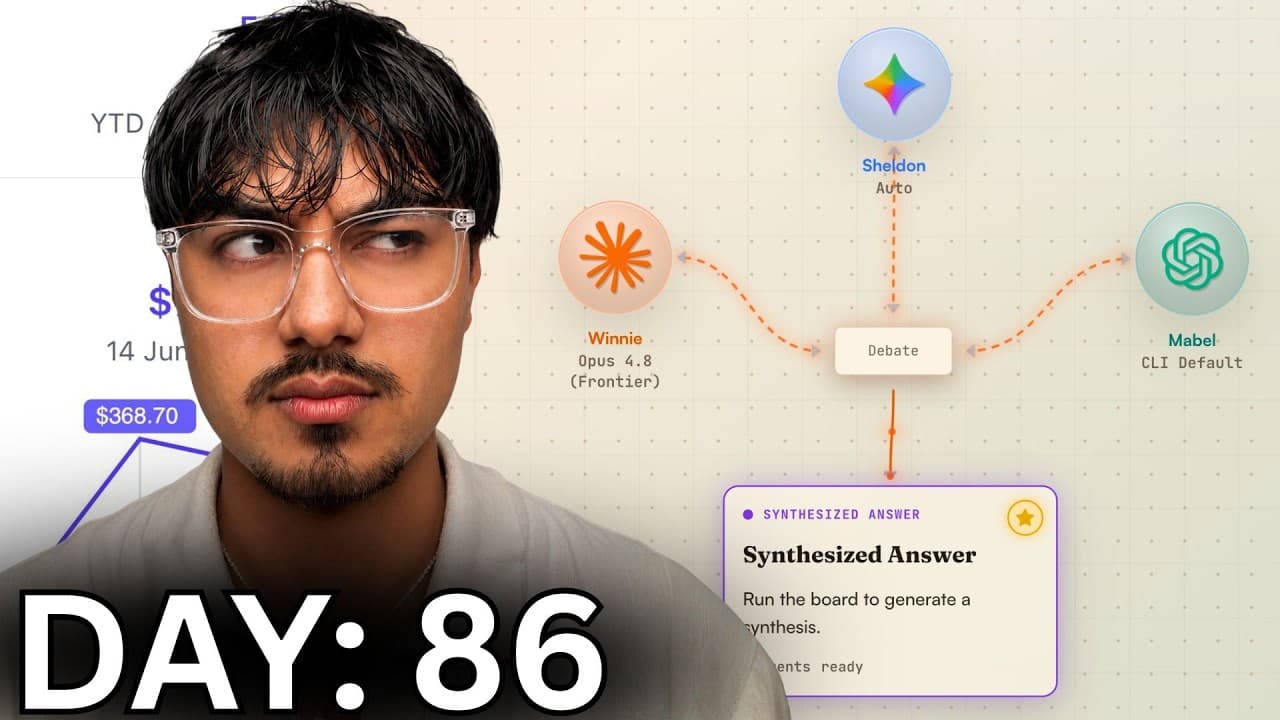
- The project had reached more than $2,000 in revenue, while the title reported total revenue of $49,801.28 on day 86 of the creator’s public building challenge.
Install to Summarize YouTube Videos and Get Transcripts
Explore YouTube Video Summarizer or Get YouTube Transcript Extractor
Questions & Answers
Q: Why is Ace changing from a canvas-first interface to a chat-first interface?
Ace is changing priorities because the creator believes users will interact with chat far more often after completing their initial canvas setup. The canvas is useful for arranging and inspecting an agent system, but everyday work centers on communicating with agents. The redesign therefore makes chat the primary experience while preserving the canvas as an accessible supporting tool.
Q: How will the redesigned Ace workspace divide space between chat and the canvas?
The proposed redesign gives chat about 80% of the workspace and the canvas about 20%. This reverses the current layout, where the canvas occupies roughly 80% and chat receives about 20%. Both features remain side by side, and the creator also considers allowing users to change this balance through settings.
Q: What role will the canvas play after Ace becomes chat-first?
The canvas will continue to act as a visual source of truth for an agent setup. Users can open it to inspect the underlying structure, move components, and understand how everything is connected. Its importance does not disappear, but it becomes secondary after configuration because routine use is expected to happen through the chat interface.
Q: How could a native AI model help users configure Ace?
A native AI model could provide a conversational entry point directly inside Ace. A user might describe a goal, such as building something for a dog-walking business, and the AI could respond by configuring the relevant project or agent setup. The planned chat box would appear prominently, with the user’s projects displayed underneath it.
Q: How was the major Ace update tested before the livestream?
The creator used a Codex agent for more than 600 minutes, described as roughly 10 hours of continuous looping work. During that period, the agent tested features, buttons, and mechanisms across the application. The resulting release was characterized as a major update, and the livestream was intended to uncover additional bugs through further testing.
Q: Why did the creator buy a new MacBook Pro for development?
The previous computer setup struggled with the development workload. Livestreams became slow and laggy, Chrome tabs crashed, Wi-Fi repeatedly disconnected, and running about two AI agents at once could overwhelm the machine. The creator purchased an M5 Pro MacBook Pro to improve the setup and support a more intensive Ace development session.
Q: What problems does the creator see in Ace’s current chat experience?
The current chat interface is described as bland, limited, and insufficiently enjoyable to use. The creator believes too much attention has gone into making the visual canvas attractive while the conversational experience has received less attention. The next design phase therefore focuses on improving chat and making communication with AI agents the product’s central activity.
Q: How much revenue had the creator’s projects generated by day 86?
The day 86 title reports total revenue of $49,801.28. The description attributes $36,922 to Oreminer.io, $10,139 to Moltboard, and more than $2,000 to Ace. It also lists SWAY as a failed project and the Auto-App Factory as unfinished, showing that the reported progress includes both successful and unsuccessful experiments.
Summary & Key Takeaways
-
The creator returns with a new M5 Pro MacBook Pro after previous livestreams suffered from lag, browser crashes, Wi-Fi interruptions, and limits on running multiple AI agents. The upgraded setup is intended to support a demanding development session focused on testing Ace after a major debugging and quality-assurance update.
-
Ace received a major update following an extended debugging session in which a Codex agent ran for more than 600 minutes. The agent continuously tested features, buttons, and app mechanisms. The livestream’s immediate goal is to test the updated product, identify additional bugs, and improve the experience further.
-
The proposed product direction makes conversation the dominant Ace experience. Chat would occupy about 80% of the workspace while the canvas uses roughly 20%, reversing the existing emphasis. The canvas remains available for initial configuration and detailed inspection, but everyday interaction would happen primarily through agents in chat.
Read in Other Languages (beta)
Share This Summary 📚
Summarize YouTube Videos and Get Video Transcripts with 1-Click
Try YouTube Summary with ChatGPT & Claude or YouTube Transcript Generator
Explore More Summaries from Dubibubi 📚




Summarize YouTube Videos and Get Video Transcripts with 1-Click
Try YouTube Summary with ChatGPT & Claude or YouTube Transcript Generator