How to Choose the Right AI Career Path in 2025
TL;DR
Choose a specific AI role before investing in training, then assess yourself against the competencies employers actually need. Targeted eight-question interviews can distinguish whether you are qualified now, nearly qualified, facing significant gaps, or currently not viable, while producing a personalized roadmap that may prevent months of unfocused learning.
Transcript
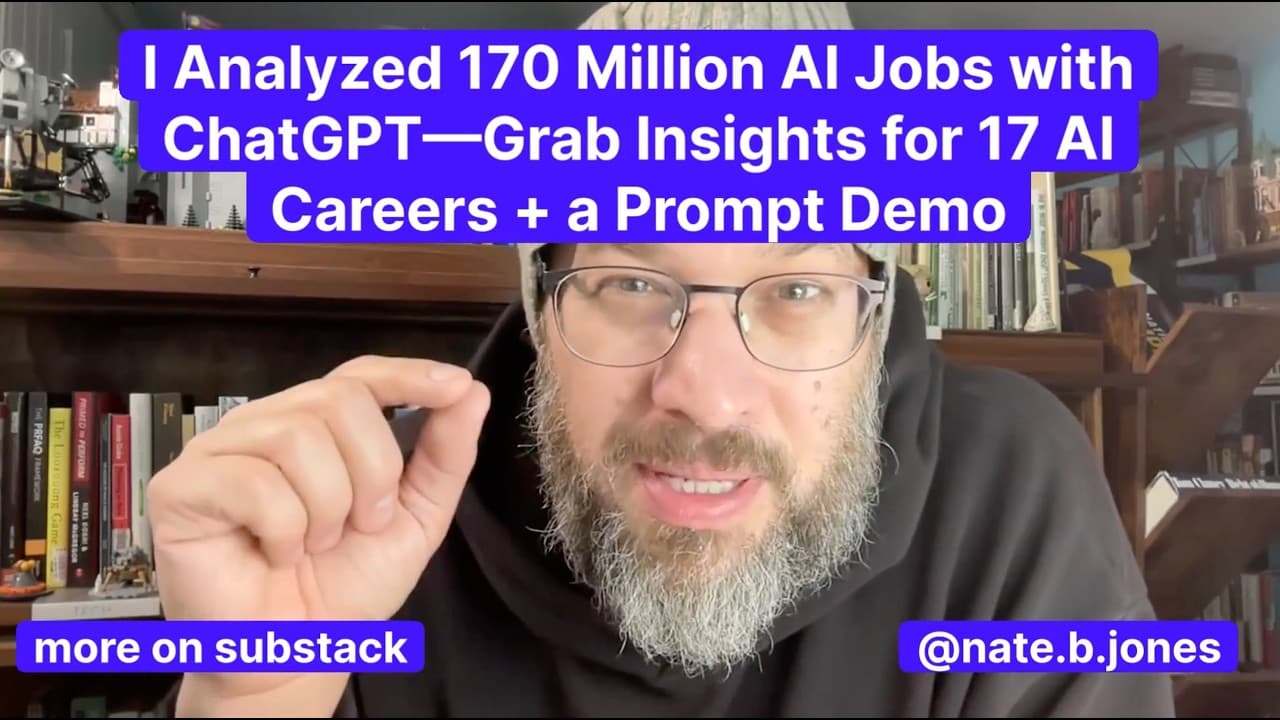
Most of what you read about how to break into AI is wrong. Not because it's incorrect, but because it's too vague to be useful. It's too high level. It's too general. Learn AI. Don't do that. Get specific. Get useful. I have spent the last few days taking apart 17 different career paths in AI that people are hiring for right now. I've looked into t... Read More
Key Insights
- AI career planning is a role-selection problem, not a generic commitment to learn AI. The field contains distinct career paths with substantially different prerequisites, responsibilities, and compensation, so candidates must identify a target role before choosing courses, certifications, or projects.
- The projected AI labor market contains simultaneous expansion and displacement. The World Economic Forum projects 170 million new AI jobs and 92 million destroyed jobs by 2030, resulting in a projected net gain of 78 million positions rather than universal opportunity.
- Entry-level access is becoming more difficult in AI-exposed work. Stanford research cited in the transcript found a 13% employment decline for workers aged 22 to 25 in exposed roles since late 2022, even as new AI-related career opportunities continue to develop.
- Role-specific evidence is more useful than broad self-ratings. An assessment for machine learning engineering should ask about Python, TensorFlow or PyTorch, and production deployments because completing a course provides less signal than successfully deploying a meaningful model.
- AI prompt engineering depends heavily on writing and editing rather than coding. A useful assessment asks candidates to demonstrate how they transformed AI-generated material into publication-quality content, reflecting the claim that meaningful value comes from editing rather than merely generating a first draft.
- AI governance readiness requires knowledge of specific market-relevant regulation. Asking about the EU AI Act produces stronger evidence than asking about regulations generally because companies operating in the European Union must address it, including companies that are not based there.
- Career assessments can classify readiness into four practical outcomes. A candidate may be qualified now, nearly qualified, facing significant gaps, or not currently viable, with suggested preparation periods of 3–6 months for near readiness and 6–18 months for significant gaps.
- AI product management combines established product skills with AI-specific competence. Relevant assessment areas include product experience, supervised and unsupervised learning concepts, stakeholder management, strategy, analytics, leadership, communication, road mapping, and experience incorporating AI capabilities into products.
Install to Summarize YouTube Videos and Get Transcripts
Explore YouTube Video Summarizer or Get YouTube Transcript Extractor
Questions & Answers
Q: How do I choose the right AI career path?
Start by selecting a specific role instead of pursuing AI as one broad field. Compare your existing education, technical ability, writing, leadership, regulatory knowledge, and practical experience with the competencies required for roles such as machine learning engineer, prompt engineer, AI coach, governance specialist, research scientist, or AI product manager. Then use targeted questions to identify concrete gaps and build a personalized roadmap.
Q: Why does generic advice about breaking into AI fail?
Generic advice fails because AI is not a single career path. Recommendations such as learning Python in 30 days, earning a PhD, or founding a startup apply only to narrow groups of people. Each AI role has different prerequisites and hiring signals, so broad advice can lead candidates to spend 6 months, 12 months, or longer pursuing goals that do not fit their abilities or intended work.
Q: What is happening to jobs as AI adoption grows?
AI is creating positions while also automating work, including entry-level positions that traditionally helped people begin their careers. The World Economic Forum figures cited project 170 million new AI jobs and 92 million destroyed jobs by 2030, for a net gain of 78 million. Stanford research cited also reports a 13% employment decline among workers aged 22 to 25 in AI-exposed roles since late 2022.
Q: What qualifications does a machine learning engineer need?
Machine learning engineering is presented as a growing technical role that requires strong technical skills. A useful readiness assessment should ask candidates to rate their Python proficiency, explain their experience with TensorFlow or PyTorch, and describe whether they have deployed models to production. Production deployment is especially important evidence because many people complete courses, while fewer deliver meaningful models in real operating environments.
Q: What skills matter for an AI prompt engineer?
Strong writing and editing are central skills for AI prompt engineering, while coding is not described as a requirement. A meaningful assessment should ask for an example of heavily editing AI-generated content until it reaches publication quality. The important distinction is that generating content is widely accessible, but recognizing weaknesses, revising the material, and producing polished work demonstrate the practical value expected from the role.
Q: How does an AI career assessment evaluate readiness?
Each proposed assessment conducts an eight-question interview designed around the requirements of one role. Instead of asking vague questions about whether someone knows AI, it requests evidence such as production deployments, publication-quality editing, knowledge of the EU AI Act, or experience adding AI capabilities to products. The responses support four outcomes: qualified now, nearly qualified, significant gaps, or currently not viable.
Q: How long can it take to close AI career skill gaps?
The assessment framework associates near qualification with an estimated 3–6 month path and significant gaps with an estimated 6–18 month path. These timelines are described as approximate because some people can progress faster by using AI to improve how they learn. The purpose is to predict a plausible path from current evidence, not to guarantee that every candidate will advance at the same speed.
Q: What should an AI product manager know?
An AI product manager needs both established product management capabilities and knowledge relevant to AI-enabled products. Assessment areas include overall product experience, product strategy, road mapping, stakeholder management, analytics, leadership, communication, and AI or machine learning concepts. Candidates may also be asked to explain the difference between supervised and unsupervised learning and describe how they have incorporated AI capabilities into a product.
Summary & Key Takeaways
-
The AI labor market presents a paradox: the World Economic Forum projects 170 million new AI jobs by 2030 while 92 million jobs may disappear, producing a net gain of 78 million. At the same time, workers aged 22 to 25 have experienced employment declines in roles exposed to AI.
-
Breaking into AI requires choosing among distinct career paths rather than following generic advice. Research scientists, machine learning engineers, prompt engineers, coaches, governance specialists, and product managers require different combinations of education, coding, writing, deployment, regulatory knowledge, leadership, strategy, and communication, so each role needs a separate qualification assessment.
-
The proposed assessments use eight targeted questions to extract meaningful evidence about role readiness. Responses lead to one of four outcomes, accompanied by a timeline and personalized roadmap. Strong prompts can also direct reasoning models to find current courses and certifications that match a candidate's particular experience and competency gaps.
Read in Other Languages (beta)
Share This Summary 📚
Summarize YouTube Videos and Get Video Transcripts with 1-Click
Try YouTube Summary with ChatGPT & Claude or YouTube Transcript Generator
Explore More Summaries from AI News & Strategy Daily | Nate B Jones 📚






Summarize YouTube Videos and Get Video Transcripts with 1-Click
Try YouTube Summary with ChatGPT & Claude or YouTube Transcript Generator