Why Do I Feel Like I'm Never Good Enough?
TL;DR
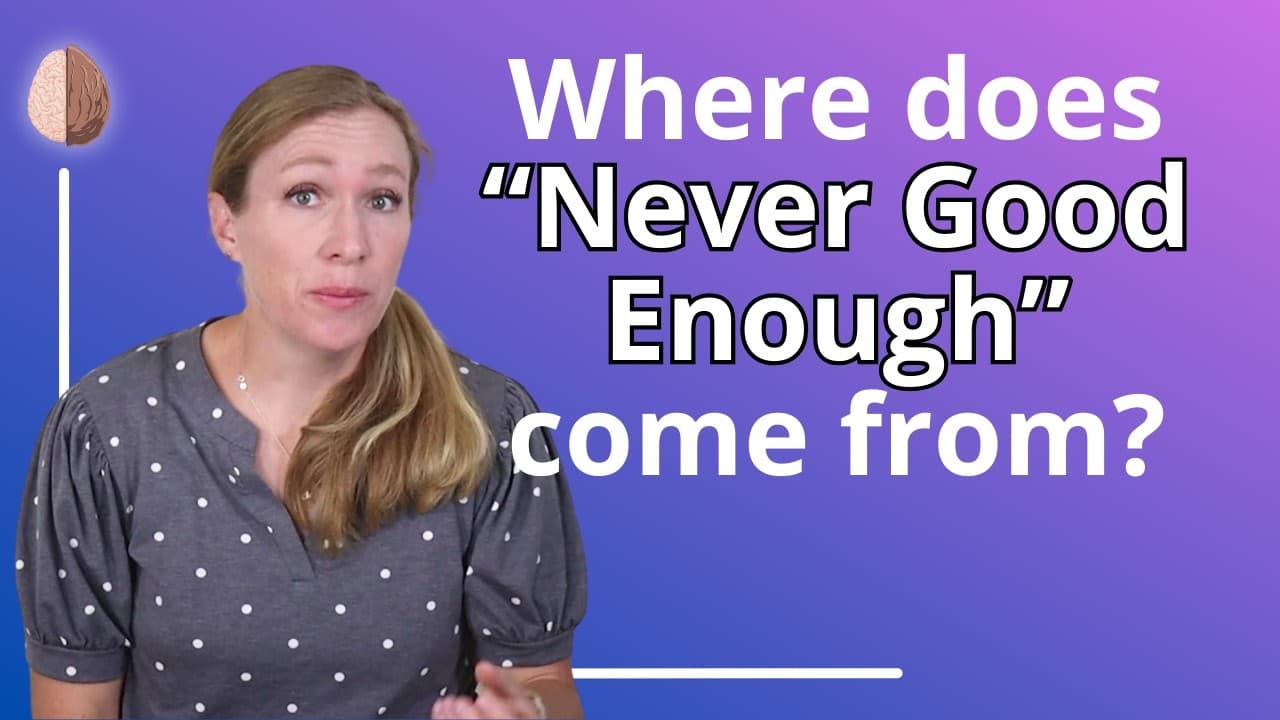
Feeling never good enough usually breaks into three smaller parts: comparison, perfectionism, and not having reached your goals yet. A poll found 92% of one therapist's audience always or sometimes feels this way. The fix starts with getting specific about what the imaginary finish line even is, then limiting media exposure, defining your own values, and engaging in life as a work in progress.
Transcript
I polled my audience, and 92% of you said you always or sometimes feel like you are never good enough. This is so crushing. Believing that you're never good enough can contribute to depression and anxiety. So we're going to break it down in a way that won't make you feel like a failure for feeling like a failure, and we're going to explore some... Read More
Key Insights
- A poll of the channel's audience found 92% of respondents always or sometimes feel they are never good enough. The therapist calls this belief crushing and says it can contribute to depression and anxiety, which is why she breaks it into smaller, workable pieces.
- The couch analogy is the core method: a 300-pound couch that would not fit through a doorway or a 90-degree hallway turn was, once unboxed, six click-together pieces of about 20 pounds each. Big beliefs become manageable when unpacked and broken down.
- Getting specific is the first step. The question to ask is never good enough for what. Without clarifying what the imaginary finish line actually is, a person will keep feeling like they are never reaching it, because no measurable target exists.
- Comparison outsources your worth to other people. Deciding that others hold an imaginary ruler creates a lose-lose setup, because no one can be better than all the people at all the things, so the internal rule makes winning impossible by design.
- Self-improvement media and marketing are two modern challenges that intensify comparison. Social media shows only others' facades, the 59 seconds they let you see, while marketing works by convincing you that you lack something. Research shows children exposed to more marketing feel unhappier.
- Willpower is an unreliable defense against media exposure. The therapist points to the atomic habits author having his assistant change his social media password at the start of the work week, and says she deleted Instagram from her own phone.
- Perfectionism often shows up subtly: feeling like a complete failure over one mistake, believing you must be flawless socially to be approved of, or thinking you should already have life's problems figured out. The therapist states flawlessness in social settings is not possible.
- Research shows good enough parenting is actually better for kids than parenting by people striving to be perfect. Making mistakes and making amends is part of building meaningful relationships, and flaws have to be accepted as part of progress and connection.
Install to Summarize YouTube Videos and Get Transcripts
Explore YouTube Video Summarizer or Get YouTube Transcript Extractor
Questions & Answers
Q: Why do I feel like I'm never good enough?
According to this therapist, the feeling usually comes from three separate sources rather than one. The first is comparison, where you base your worth on other people and effectively hand them an imaginary ruler. The second is perfectionism, often subtle, such as feeling like a complete failure over a single mistake. The third is simply not having arrived at your goals yet, which gets misread as a verdict on you as a person. Because the three have different causes, they also have different responses, which is why she recommends getting specific about which one applies before trying to fix anything.
Q: How do I stop comparing myself to other people?
The therapist gives two steps. First, set limits on media exposure, because social media shows only others' facades and marketing works by convincing you that you lack something. She suggests limiting time on social media, carefully curating and unfollowing content that is not uplifting, and using phone limits rather than willpower, since most people are bad at willpower. Second, break the comparison ruler entirely: get clear on your own values and what you want your life to be about, then each day or week ask whether you lived that way, and take action to become that person.
Q: What is the couch story in this video about?
The therapist and her husband Ryan bought a new couch from Costco, rented a truck, and drove it home. The box was roughly 4 feet by 7 feet, weighed about 300 pounds, and would not fit through the garage door, then would not make the 90-degree turn in their hallway. Exhausted and frustrated, they considered returning it. When they finally opened the box, the couch was six click-together pieces of about 20 pounds each that were easy to carry individually. The point is that overwhelming beliefs, like overwhelming couches, become manageable once you unpack them and break them into pieces.
Q: What is the first step to dealing with the belief that I'm not good enough?
Getting specific. The therapist says the starting question is never good enough for what. If you do not clarify what the imaginary finish line actually is, you will probably keep feeling like you never reach it, because there is no defined target to reach. Naming the specific standard, such as compared to other people, or by a perfectionistic rule, or against a goal you have not hit yet, turns a vague and crushing belief into something concrete enough to examine and work through with support.
Q: How does marketing make people feel not good enough?
The therapist describes marketing as the silent but deadly modern challenge. The goal of marketing is to sell products by convincing you there is something you lack, and it works by showing you what other people have that you do not. She notes that even news pieces and educational listicles carry the same message, that if you only follow these five steps you can be happier, skinnier, faster, richer, or stronger. She cites research showing that children exposed to more marketing feel unhappier, and says adults are not immune to the same effect.
Q: What are the subtle signs of perfectionism?
The therapist lists several that people often do not recognize as perfectionism. Feeling like a complete failure after making a mistake. Believing you need to be flawless in social settings to be approved of, which she notes is not actually possible. Believing you should already have figured out most of life's problems and wondering why you are still struggling when others seem sorted. Feeling you are not a good enough daughter, son, spouse, or parent, where an honest desire to show up for others gets escalated into the rule that you must be perfect to have value.
Q: Is it better to be a perfect parent or a good enough parent?
The therapist says research shows that good enough parenting is actually better for kids than parents who strive to be perfect. Her broader point is that perfectionism is a belief rather than a reality, something constructed with words that feels oddly comforting but is deeply wounding and not truthful. Relationships work by bringing flaws and vulnerability into them, which creates opportunities to make the relationship stronger. Living with other humans guarantees that at times you will offend someone, miscommunicate, or make mistakes, and making mistakes and then making amends is part of building meaningful relationships.
Q: What should I do instead of waiting until I'm good enough to engage?
Replace the rule that you have to be good enough first with the stance that you will engage as a work in progress and get good at making repairs. Perfectionism tells you to improve yourself until you qualify, but the therapist argues the healthier approach is to increase your capacity to be vulnerable, to feel, to engage, and to mess up, then get good at tolerating discomfort when you show up in a real way. She notes that is a goal you can actually achieve, unlike flawlessness.
Q: What experiment does the therapist suggest for perfectionists?
She asks viewers to start questioning perfectionistic thoughts and then deliberately do something that is good enough instead of perfect. Her examples include bringing a friend a gift that is totally adequate rather than presented perfectly, calling someone when you have nothing to say, asking someone on a date when you think you might be rejected, and turning in homework that is decent but not perfect. She invites people to report in the comments what happens when they engage on an imperfect level instead of protecting themselves by withdrawing from life.
Q: Why does withdrawing from opportunities make the problem worse?
Perfectionism can show up as withdrawing from people and opportunities out of fear of messing up, which costs you the experiences themselves. The therapist gives a personal example: about 20 years ago at a primitive skills gathering, an instructor offered to teach her pine needle basketry and she said no because she was too embarrassed that she would not be good at it, so she missed the chance to learn. She says she can tell she is healthier now because she does things she is not good at far more often, embraces discomfort, and is learning a bunch of new things.
Q: Is it true that I'm not good enough if I haven't reached my goals?
The therapist separates two very different statements. Saying you are not good enough for something specific, like an Olympic weightlifting gold medal, might simply be true as a factual assessment of a particular skill. But saying you are never good enough as a person is what she calls a self-justifying, sneaky, lying little thought. She compares it to claiming an airplane is not good enough because it is still flying toward its destination rather than having already arrived. Being in progress is not the same as being inadequate.
Q: How can I limit social media if willpower doesn't work?
The therapist says outright not to rely on willpower, because most people are bad at it, and recommends structural limits instead. She points to the atomic habits author, who had his assistant change the password on his social media at the beginning of the work week so he could get work done, and says she has deleted Instagram off her own phone again. She also suggests setting limits on your phone, curating and unfollowing content that is not uplifting, and mentions liking a video about turning a smartphone into a dumb phone.
Summary & Key Takeaways
-
A poll of the channel's audience found that 92% of respondents always or sometimes feel they are never good enough, a belief that can contribute to depression and anxiety. The therapist frames the problem with a couch story: a 300-pound boxed couch that would not fit through doors or a 90-degree hallway turn.
-
Once the couch was taken out of its box, it turned out to be six click-together pieces of roughly 20 pounds each that were easy to carry individually. The belief that you are never good enough works the same way: it feels too heavy to unpack, but broken into pieces it becomes manageable, especially with support.
-
The belief breaks into three chunks: comparison with other people, perfectionism, and the feeling of not having arrived at your goals yet. Each has its own response, from limiting social media and marketing exposure to practicing being good enough rather than perfect and recognizing that being in progress is not failure.
Read in Other Languages (beta)
Share This Summary 📚
Summarize YouTube Videos and Get Video Transcripts with 1-Click
Try YouTube Summary with ChatGPT & Claude or YouTube Transcript Generator
Explore More Summaries from Therapy in a Nutshell 📚




Summarize YouTube Videos and Get Video Transcripts with 1-Click
Try YouTube Summary with ChatGPT & Claude or YouTube Transcript Generator