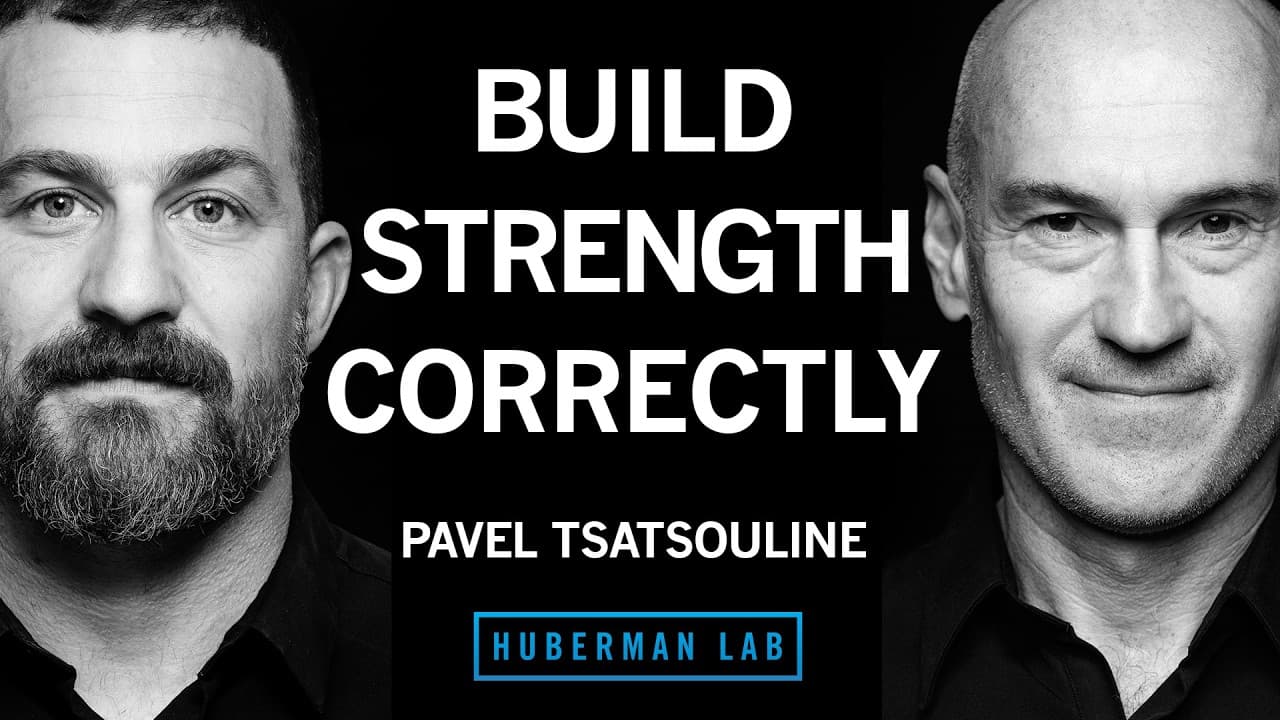
Huberman Lab: How Do Pavel Tsatsouline and Andrew Huberman Build Strength, Endurance and Flexibility at Any Age?
TL;DR
This Huberman Lab YouTube discussion explains how Andrew Huberman and Pavel Tsatsouline approach strength, endurance and flexibility at any age. Pavel describes strength as the foundation of fitness and explains that bodyweight exercises, free weights and occasional machines can build it without necessarily increasing muscle size. Read on for practical insights about exercise selection, recovery, training variety and greasing the groove.
Transcript
welcome to the huberman Lab podcast where we discuss science and science-based tools for everyday life I'm Andrew huberman and I'm a professor of neurobiology and Opthalmology at Stanford School of Medicine my guest today is Pavo satlin Pavo satlin is considered one of the Premier strength training and fitness coaches in the world he has pioneered ... Read More
Key Insights
- Strength is the foundation for all other fitness qualities, necessary for both athletic performance and general health.
- Building strength does not require hypertrophy; it can be achieved through neurological training and practice.
- Effective strength training involves a mix of bodyweight exercises, free weights, and machines.
- Training should focus on a few key exercises that offer significant carryover to other activities.
- Variety in training is beneficial, but should be approached with a focus on effective exercises rather than random variety.
- Grip strength is crucial for overall strength and has correlations with longevity.
- Recovery and rest are essential components of a successful training regimen, allowing for muscle and nervous system recovery.
- Strength training can be incorporated into daily life through 'greasing the groove,' which involves frequent, moderate practice of movements.
Install to Summarize YouTube Videos and Get Transcripts
Explore YouTube Video Summarizer or Get YouTube Transcript Extractor
Questions & Answers
Q: What does the Huberman Lab YouTube discussion with Pavel Tsatsouline teach about strength training?
Andrew Huberman and Pavel Tsatsouline discuss strength as a skill and the foundation for other fitness qualities. They explain how bodyweight exercises, free weights and occasional machines can improve strength, endurance and general fitness at any age.
Q: Why does Pavel Tsatsouline call strength the foundation of fitness?
Pavel says that strength is the mother quality of all other physical qualities and that nothing can be built without a foundation of strength. The required level varies by activity, but both competitive athletes and people training for everyday life benefit from having a reserve of strength.
Q: Can strength training improve endurance performance?
Pavel says that heavy, low-repetition strength training has been shown to make athletes in triathlon, marathon running and distance cycling race faster. His explanation is that once an athlete becomes stronger, every movement becomes easier.
Q: Can you become stronger without increasing muscle size?
Yes. Pavel describes heavy, low-repetition training that makes a person stronger neurologically without adding much muscle, and Andrew emphasizes that strength can be pursued independently of hypertrophy.
Q: Which types of exercise can build strength at any age?
The discussion identifies bodyweight exercises, free-weight exercises and occasional machine exercises as ways to build strength. It also mentions people in their 70s and 80s performing strength feats, including 100 pull-ups per week.
Q: How should noncompetitive athletes decide how much strength they need?
Pavel recommends developing a reserve of strength for the activities a person might encounter in life. He suggests considering physical training standards from settings such as the military or law enforcement instead of imposing one universal standard.
Q: When should strength become the main training priority?
Pavel says mobility and symmetry should be addressed first. After that, strength should become the priority until the person reaches a level appropriate for their sport or lifestyle, at which point it can be maintained while other qualities receive more focus.
Q: What is the greasing the groove method?
Greasing the groove is a method of practicing a movement frequently with moderate effort. It aims to improve strength and skill through repeated practice without relying on muscle fatigue.
Summary & Key Takeaways
-
Strength is a skill that can be developed through consistent practice, focusing on essential exercises like squats, deadlifts, and pull-ups. Pavel Tsatsouline emphasizes strength as a foundational fitness quality, necessary for all ages and fitness levels. Training should be efficient, incorporating bodyweight, free weights, and machines.
-
Recovery is crucial for effective strength training, allowing for muscle and nervous system adaptation. Pavel discusses the importance of balancing training intensity and frequency to optimize strength gains without overtraining. He introduces 'greasing the groove,' a method of frequent, moderate practice to build strength efficiently.
-
Variety in training is important, but should be approached strategically. Pavel highlights the significance of grip strength and its correlation with longevity. He advises on using a few key exercises that have broad carryover to other activities, ensuring a comprehensive and effective strength training program.
Read in Other Languages (beta)
Share This Summary 📚
Summarize YouTube Videos and Get Video Transcripts with 1-Click
Try YouTube Summary with ChatGPT & Claude or YouTube Transcript Generator
Explore More Summaries from Andrew Huberman 📚
Summarize YouTube Videos and Get Video Transcripts with 1-Click
Try YouTube Summary with ChatGPT & Claude or YouTube Transcript Generator