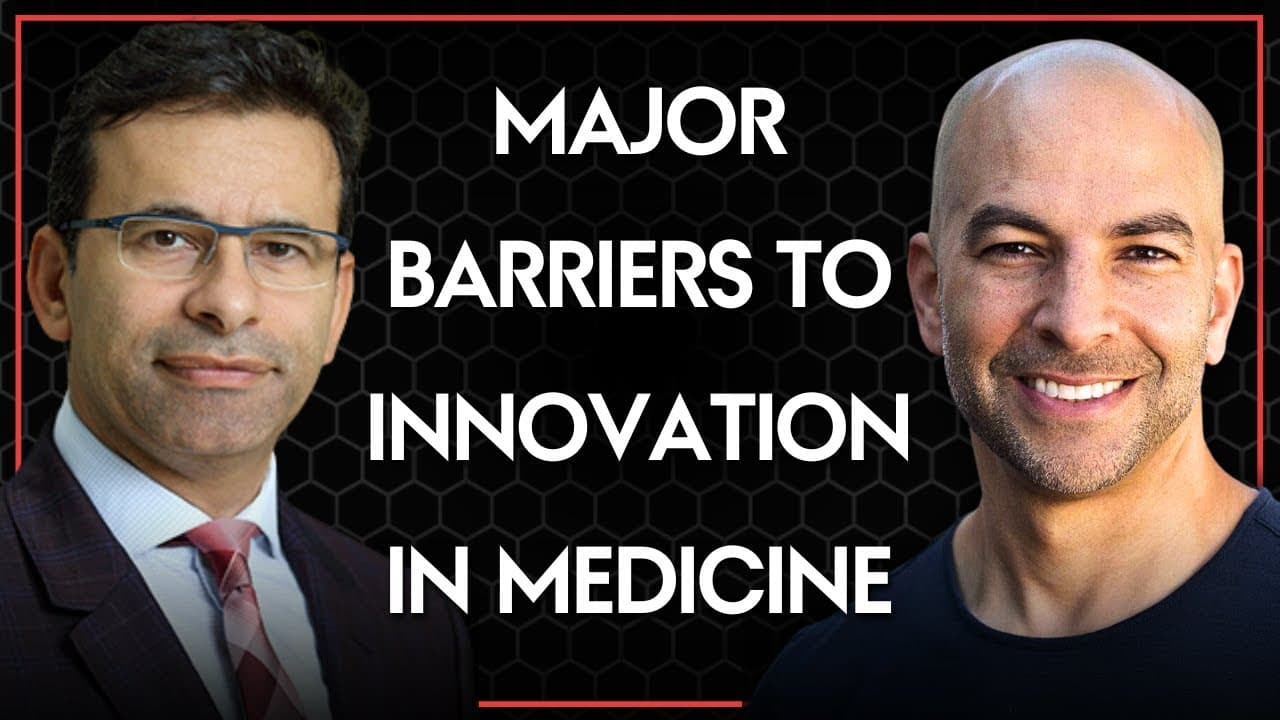
Why Is Medical Research So Hard to Fund?
TL;DR
Research on lifestyle pillars like nutrition, exercise, sleep, and emotional health goes unfunded because it lacks the financial engine and placebo-based study design that molecules and procedures have. The NIH's siloed, legacy funding centers reward small incremental studies over big ideas, leaving common practices with no scientific evidence behind them.
Transcript
but who would fund This research Marty I mean I think when I when I talk about the pillars of of medicine right we have nutrition and exercise and sleep and emotional health and then molecules so that's roughly five things then you could really add a sixth pillar which would be like a a sort of a waste bucket uh you know of everything else that may... Read More
Key Insights
- Medicine rests on roughly five pillars: nutrition, exercise, sleep, emotional health, and molecules, plus a sixth 'waste bucket' of things like sauna, cold plunge, and red light therapy that may or may not have benefit.
- Medical school and residency teach procedures and medications well but teach nothing about exercise, sleep, nutrition, and emotional well-being.
- Molecules and procedures attract research funding because their study design is straightforward (intervention versus placebo) and a financial engine justifies the cost of the studies.
- The NIH is described as broken, with siloed funding centers where senior professors fund only legacy ideas that fall within categories like kidney or cardiovascular disease.
- Cutting the frenulum under a newborn's tongue is surging in the US, driven by dentistry and lactation consultants, yet the claim it improves breastfeeding has never had scientific evidence and desperately needs a randomized controlled trial.
- The NIH controls $80 billion but funded a cruel University of Iowa dog experiment on sandfly-spread disease rather than basic clinical research answering real medical controversies.
- The NIH funds small incremental ideas, not big ones; a top ASCO paper showed a drug increased glioblastoma survival by only two months, reflecting a terrible ROI on cancer research.
- 62% of Americans in a Harvard survey say they don't trust the medical profession to bill them fairly, avoiding or delaying care for fear of the bill, which undermines even effective cures.
Install to Summarize YouTube Videos and Get Transcripts
Explore YouTube Video Summarizer or Get YouTube Transcript Extractor
Questions & Answers
Q: What are the pillars of medicine according to Marty Makary?
Marty Makary describes roughly five pillars of medicine: nutrition, exercise, sleep, emotional health, and molecules. He adds a potential sixth pillar he calls a 'waste bucket' of everything else that may or may not have benefit, including sauna, cold plunge, and red light therapy. He notes medical school and residency teach procedures and medications well but teach nothing about exercise, sleep, nutrition, and emotional well-being.
Q: Why is it hard to fund research on lifestyle interventions?
Lifestyle interventions like exercise, sleep, nutrition, and emotional health are hard to fund because, unlike molecules and procedures, they lack a straightforward study design and a financial engine. With molecules you can easily test the intervention against a placebo, and there is commercial incentive that justifies the cost of the studies. For lifestyle research, funding is very difficult to obtain outside of philanthropic and government causes such as the NIH, which largely ignores these areas.
Q: What is wrong with the NIH funding model?
According to Makary, the NIH could not be more broken. It has siloed funding centers, so unless your research falls under categories like kidney or cardiovascular disease and matches what the senior professors want to fund, it is not supported. It is a legacy system where established researchers fund small, incremental ideas that reinforce their reputations, rather than big, innovative ideas. The NIH controls $80 billion but funds work with poor return on investment.
Q: Why does the newborn frenulum cutting practice need a randomized controlled trial?
Cutting the frenulum under a newborn's tongue is surging in the United States, driven largely by dentistry and the lactation consultant world. The claim is that it improves breastfeeding and lactation rates, and some claim it helps with sleep apnea and speech impediments. However, this dogma has never had scientific evidence to support it, and some babies stop breastfeeding from pain. Makary says it desperately needs a randomized controlled trial of a couple hundred babies followed over five years to answer the controversy.
Q: How is private industry disrupting medical research funding?
Makary says disruption is happening right now through private industry. Private companies are funding research on different probiotics and bacteria you can introduce into the body. Private industry also funded the speakers' own research on price gouging and predatory billing, which is a big blind spot in medicine the NIH does not address. This shows private funding is filling gaps left by the NIH's siloed, legacy-focused system, supporting ideas that do not fit government funding categories.
Q: What example shows the NIH's poor use of tax dollars?
Makary cites a cruel dog experiment at the University of Iowa funded by the NIH, where dogs were trapped in cages and sandflies were made to bite their heads. The published article concluded that Leishmaniasis can spread from dog to dog via sandfly bites. He argues this is where tax dollars go while basic clinical research that could answer real medical controversies, such as questions about natural immunity, goes unfunded. The NIH controls $80 billion yet neglects impactful clinical research.
Q: Why does medicine discourage big ideas from young researchers?
When students and residents arrive in medicine with big ideas, such as connections between the microbiome, antibiotics, and rising chronic disease rates, they are told to pick one narrow area and work on small incremental papers. On day one they are handed the Netter anatomy textbook and told to pick a single organ to focus on. This structure, reinforced by how the NIH funds small ideas, suppresses the broad, systems-level thinking needed for genuine innovation in medicine.
Q: How does lack of trust affect medical care effectiveness?
Makary cites a Harvard survey in which 62% of Americans say they don't trust the medical profession to bill them fairly, causing them to avoid or delay care for fear of the bill. He argues this erodes the benefit of even the best treatments: you could have a cure for pancreatic cancer, but if patients avoid care due to distrust, an intervention that should be 100% effective becomes only 38% effective. That is why rebuilding trust is currently the hottest topic in medical journals.
Summary & Key Takeaways
-
Medicine has five pillars (nutrition, exercise, sleep, emotional health, molecules) plus a sixth waste bucket of unproven interventions. Medical training covers procedures and medications well but ignores lifestyle pillars. Molecules and procedures get funded because study design is simple and a financial engine justifies the cost.
-
The NIH is portrayed as broken, with siloed funding centers where established professors fund only legacy research areas. Private industry is now disrupting this by funding research on probiotics, bacteria, and health care issues like price gouging and predatory billing that the NIH ignores.
-
Many practices like newborn frenulum cutting operate in a scientific black hole without evidence and need randomized trials nobody will fund. Medicine rewards narrow incremental papers over big ideas, so the speakers refocused their work on impact: medical errors, frailty, predatory billing, and rebuilding patient trust.
Read in Other Languages (beta)
Share This Summary 📚
Summarize YouTube Videos and Get Video Transcripts with 1-Click
Try YouTube Summary with ChatGPT & Claude or YouTube Transcript Generator
Explore More Summaries from Peter Attia MD 📚
Summarize YouTube Videos and Get Video Transcripts with 1-Click
Try YouTube Summary with ChatGPT & Claude or YouTube Transcript Generator