How to Create Plastic Printed Circuits with a Laser Cutter
TL;DR
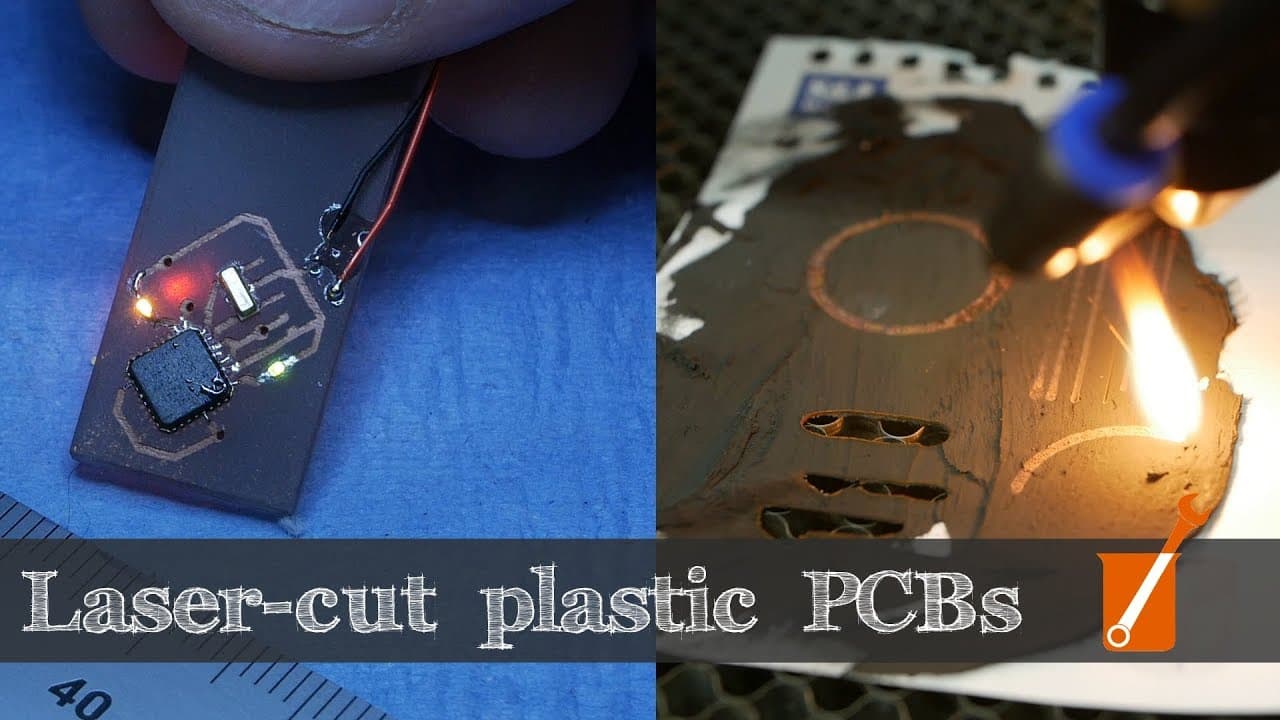
Plastic printed circuits can be created by 3D printing a part, laser cutting it, and using electroless copper plating. The process involves controlling a catalyst solution and applying a surfactant to ensure copper adheres only to desired areas, making it functional for various applications in electronics manufacturing.
Transcript
today on Applied Science we're going to talk about plastic printed circuits so these have been available commercially for a while but in this video I'm going to show you a new process tour we can take a 3d printed part put it in the laser cutter dip it in some chemicals and end up with this this shows a 1/2 millimeter pitch a leadless part soldered... Read More
Key Insights
- 👣 Plastic printed circuits can be created using a combination of 3D printing, laser cutting, and electroless copper plating.
- 🎮 The process involves controlling the catalyst solution and using a surfactant to ensure selective plating.
- 🛢️ Adhesion of the copper to the plastic can be improved by coating the part with oil before laser cutting.
- 🈸 The process has potential applications in various industries, including electronics manufacturing.
- 👣 The commercial process for creating plastic printed circuits involves using a special powder in the injection molding process and selectively laser activating it for plating.
- 😥 PLA is not suitable for this process due to its susceptibility to disintegration in the high pH plating bath.
Install to Summarize YouTube Videos and Get Transcripts
Explore YouTube Video Summarizer or Get YouTube Transcript Extractor
Questions & Answers
Q: How is plastic printed circuit creation different from traditional circuit board manufacturing?
Plastic printed circuits involve 3D printing a part and using a laser cutter to create the necessary traces and holes, whereas traditional circuit board manufacturing involves etching copper traces onto a rigid board.
Q: Why is electroless copper plating used in the process?
Electroless copper plating is used because it allows for copper to be deposited on non-conductive surfaces, such as plastic, without the need for an electrical current.
Q: What is the role of the catalyst solution in the process?
The catalyst solution is used to prepare the surface of the plastic part for plating. It ensures that the copper only plates where desired.
Q: How can the adhesion of the copper to the plastic be improved?
The adhesion can be improved by coating the plastic part with oil before laser cutting and using a surfactant to control the hydrophilicity of the surface during the plating process.
Summary & Key Takeaways
-
Plastic printed circuits can be created using a new process that involves 3D printing a part, laser cutting it, and dipping it in chemicals to plate it with copper.
-
The process uses electroless copper plating, which is commonly used in the circuit board industry to make circuit boards.
-
The key to the process is controlling the catalyst solution and using a surfactant to ensure that the copper only plates where desired.
Read in Other Languages (beta)
Share This Summary 📚
Summarize YouTube Videos and Get Video Transcripts with 1-Click
Try YouTube Summary with ChatGPT & Claude or YouTube Transcript Generator
Explore More Summaries from Applied Science 📚


Summarize YouTube Videos and Get Video Transcripts with 1-Click
Try YouTube Summary with ChatGPT & Claude or YouTube Transcript Generator