How Will Smart Glasses Replace Phones and Jobs?
TL;DR
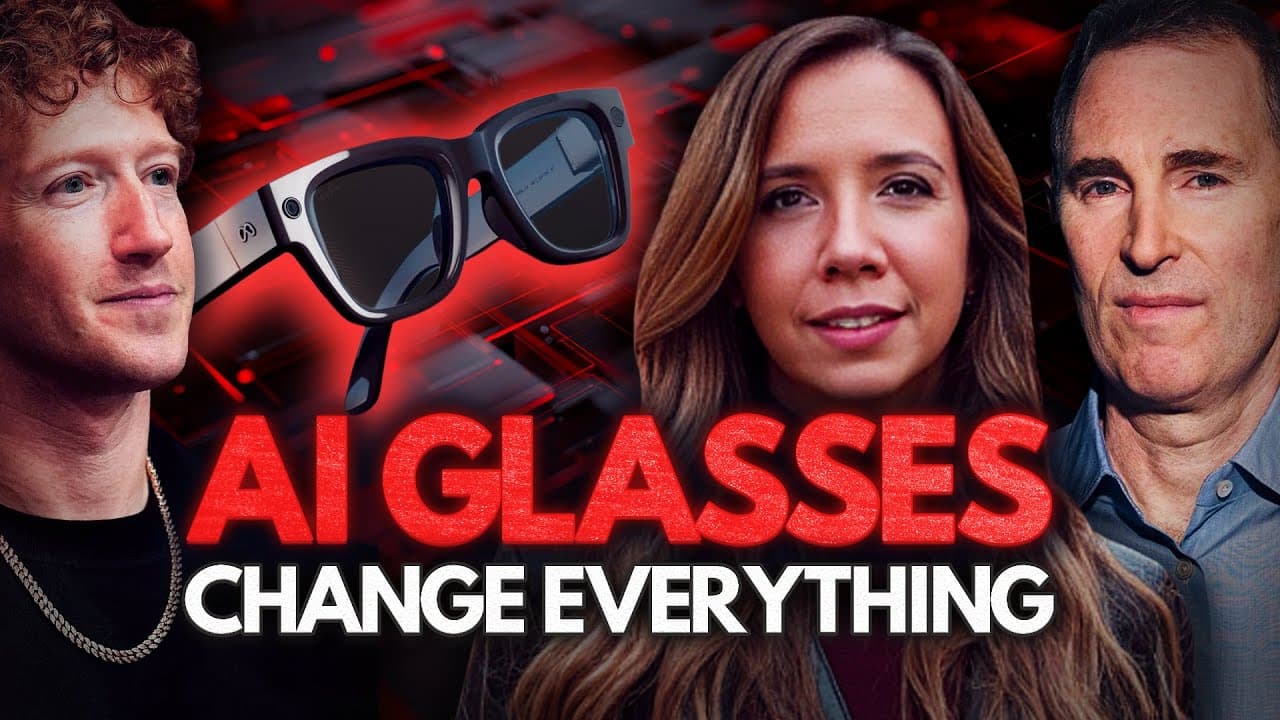
Smart glasses could reduce reliance on phones by combining visual displays, AI assistance, and subtle gesture controls in familiar eyewear. Meta’s consumer glasses and Amazon’s proposed delivery glasses also point to a larger shift: first-person video, attention patterns, and hand movements may become training data for digital assistants and humanoid robots, raising concerns about privacy and workers helping automate their own jobs.
Transcript
Good morning. [Applause] [Applause] Hey. 2025, 2026, 2027, 2028, 2029. I believe these five years will fundamentally reshape human computer interaction in ways that make the smartphone revolution look slow. Starting with some wild, almost unbelievable predictions I'm going to make about what's happening right now. This isn't sci-fi speculation. Thi... Read More
Key Insights
- Smart glasses are presented as a potential successor to smartphones because they can place navigation, messages, translation, captions, photography, and AI responses directly within the wearer’s field of view while accepting discreet voice and finger-based commands.
- Meta’s neural band is an EMG wristband that reads muscle signals associated with finger movements and translates them into digital commands with millisecond response times, including pinching to select, using another finger combination to return, and swiping on a surface to write.
- The neural band was developed over four years with 200,000 research participants, according to the transcript. It offers an 18-hour battery life, IPX7 water resistance, and operation when the user’s hands are outside the camera’s view or in complete darkness.
- Amazon’s proposed delivery glasses could record first-person examples of workers selecting packages, moving from vans to doorsteps, navigating obstacles, and interacting with customers. The transcript argues that these recordings could become imitation-learning data for warehouse and delivery robots.
- Robot training from human video has important limitations because robotic arms, fingers, proportions, and joints differ from human bodies. Glasses-based recordings also omit direct measurements of weight and physical force, creating risks such as grasping packages too tightly or too loosely.
- Meta’s display is described as a 600 by 600 pixel, full-color monocular display with 42 pixels per degree, brightness from 30 to 5,000 nits, automatic UV adjustment, and less than 2 percent light leakage for privacy.
- Meta’s public demonstration showed practical capabilities but also exposed reliability problems. Spotify control, reminders, text responses, and photo sharing worked, while a WhatsApp video call and an AI cooking demonstration failed. Private demonstrations for journalists were reported as successful in controlled settings.
- The competitive race reflects distinct goals for smart glasses. Meta is pursuing consumer adoption, neural interfaces, and social computing, Amazon is pursuing logistics automation and robotic labor, and Apple is reportedly preparing competing AR glasses for 2026.
Install to Summarize YouTube Videos and Get Transcripts
Explore YouTube Video Summarizer or Get YouTube Transcript Extractor
Questions & Answers
Q: How could smart glasses replace smartphones?
Smart glasses could replace many routine phone interactions by presenting maps, translations, captions, messages, camera controls, and contextual AI responses inside the wearer’s field of view. Meta’s approach combines voice input with an EMG wristband for discreet finger commands, allowing users to control digital functions without holding a phone or making large, visible gestures.
Q: What is Meta’s neural band and how does it work?
Meta’s neural band is an EMG wristband that detects muscle signals generated by subtle finger movements and translates them into digital commands with millisecond response times. Users can pinch an index finger and thumb to select, use the middle finger and thumb to return, or swipe a finger across a surface to write text, even in darkness or outside camera view.
Q: How could Amazon’s delivery glasses train humanoid robots?
Amazon’s proposed AR glasses could record first-person footage of experienced delivery workers handling packages, navigating from vans to doorsteps, avoiding obstacles, solving physical problems, and interacting with customers. The transcript suggests that these human demonstrations could become imitation-learning data, helping humanoid robots reproduce useful delivery and warehouse behaviors after the movements are adapted to robotic bodies.
Q: Why might delivery workers be training their own replacements?
Delivery workers could generate training examples simply by performing their normal jobs while wearing data-collecting glasses. If Amazon uses those recordings to teach humanoid robots package handling, navigation, and customer-facing routines, human expertise could be transferred into an automated workforce. The transcript characterizes this as both technically efficient and concerning for the future of delivery employment.
Q: What prevents robots from learning perfectly from first-person video?
First-person video does not provide every signal needed for reliable physical manipulation. Robotic arms and fingers have different proportions, joints, and motion patterns from human bodies, so captured actions require human-to-robot motion transfer. Video also lacks direct information about package weight and grasping force, which could cause a robot to squeeze an item too hard or hold it too loosely.
Q: What features do Meta’s display glasses provide?
The glasses are described as supporting turn-by-turn navigation with visual maps, real-time language translation shown as text, live conversation captions with speaker identification, and a camera viewfinder with gesture-controlled 3x zoom. Meta AI can provide voice and visual responses based on what the wearer is viewing, while the neural band controls messaging, media, and other functions.
Q: Did Meta’s smart glasses work during the demonstrations?
Several core functions worked during Mark Zuckerberg’s presentation, including Spotify control, calendar reminders, text responses, and photo sharing through neural band gestures. However, a WhatsApp video call failed to connect, and an AI cooking demonstration could not correctly analyze ingredients. The transcript reports that private journalist demonstrations succeeded, suggesting that infrastructure and edge cases still require refinement.
Q: How do Meta’s glasses compare with Apple’s Vision Pro?
The transcript says Meta’s Ray-Ban Display glasses cost $799 and weigh 69 grams, while Apple’s Vision Pro costs $3,500 and weighs more than 600 grams. Meta’s display is stated to provide 42 pixels per degree, compared with 34 pixels per degree for Vision Pro. The products have different forms, but Meta’s lighter glasses target broader everyday adoption.
Summary & Key Takeaways
-
Meta’s Ray-Ban Display glasses combine a monocular color display, contextual AI, and an EMG wristband that converts subtle finger movements into commands. The proposed interface supports navigation, translation, captions, messaging, photography, and media control while addressing the visible and awkward control methods that contributed to Google Glass’s limited appeal.
-
Amazon’s reported AR glasses for delivery drivers could capture first-person examples of package handling, navigation, obstacle avoidance, and customer interaction. Such recordings may provide imitation-learning data for humanoid robots, although human movements must be translated to robotic bodies and ordinary video does not directly capture grasping force or package weight.
-
The emerging competition reflects different strategies for spatial computing. Meta emphasizes lightweight consumer glasses, neural interfaces, and social computing. Amazon emphasizes logistics automation and physical robotics. Apple is described as preparing competing glasses for 2026, while Meta’s lower price and lighter design could provide an early advantage in adoption and ecosystem development.
Read in Other Languages (beta)
Share This Summary 📚
Summarize YouTube Videos and Get Video Transcripts with 1-Click
Try YouTube Summary with ChatGPT & Claude or YouTube Transcript Generator
Explore More Summaries from Julia McCoy 📚






Summarize YouTube Videos and Get Video Transcripts with 1-Click
Try YouTube Summary with ChatGPT & Claude or YouTube Transcript Generator