What Are the Basics of Google's AI Course for Beginners?
TL;DR
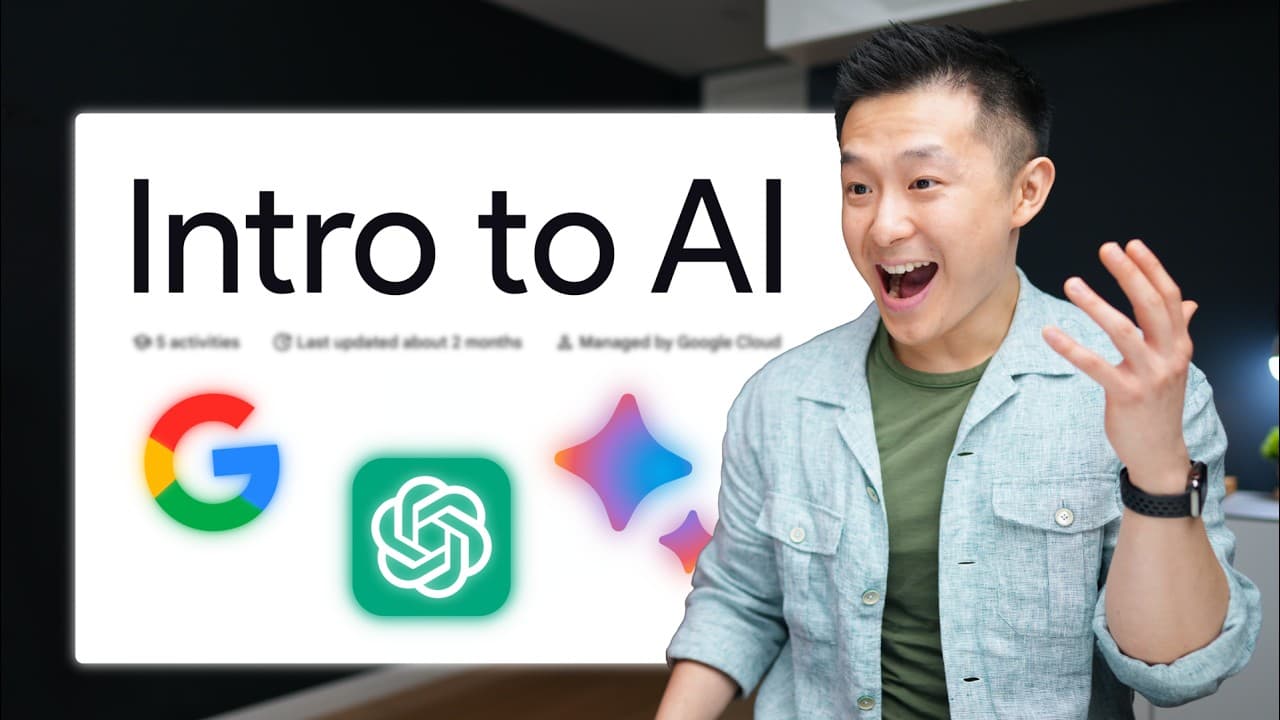
Google's AI course covers fundamental concepts of artificial intelligence, with a focus on machine learning, deep learning, and large language models. It distinguishes between supervised and unsupervised learning, explains how deep learning utilizes neural networks, and details the roles of generative models and large language models in practical applications.
Transcript
if you don't have a technical background but you still want to learn the basics of artificial intelligence stick around because we were distilling Google's 4-Hour AI course for beginners into just 10 minutes I was initially very skeptical because I thought the course would be too conceptual we're all about practical tips on this channel and knowing... Read More
Key Insights
- 🏑 AI is a broad field with machine learning and deep learning as subsets.
- ⚾ Machine learning involves training models to make predictions based on input data.
- 😒 Supervised models use labeled data, while unsupervised models use unlabeled data.
- 🧠 Deep learning utilizes neural networks inspired by the human brain.
- 👶 Generative models generate new samples based on learned patterns.
- 😑 Large language models are pre-trained and fine-tuned for specific tasks.
- 🥠 Industry-specific datasets can be used to fine-tune large language models.
Install to Summarize YouTube Videos and Get Transcripts
Explore YouTube Video Summarizer or Get YouTube Transcript Extractor
Questions & Answers
Q: What is the relationship between AI, machine learning, and deep learning?
AI is a field of study, with machine learning as a subset, and deep learning as a subset of machine learning, using neural networks inspired by the human brain.
Q: How do supervised and unsupervised learning models differ?
Supervised models use labeled data for predictions, while unsupervised models use unlabeled data to identify natural groupings.
Q: What are discriminative and generative models in deep learning?
Discriminative models classify data points based on labels, while generative models generate new samples based on learned patterns.
Q: How do large language models differ from generative AI?
Large language models are pre-trained on vast datasets and fine-tuned for specific tasks, while generative AI creates new samples based on patterns in the data.
Summary & Key Takeaways
-
Google's 4-Hour AI course distilled into 10 minutes, focusing on practical tips.
-
Breakdown of AI, machine learning, and deep learning concepts.
-
Explanation of supervised and unsupervised learning models, deep learning, and large language models.
Read in Other Languages (beta)
Share This Summary 📚
Summarize YouTube Videos and Get Video Transcripts with 1-Click
Try YouTube Summary with ChatGPT & Claude or YouTube Transcript Generator
Explore More Summaries from Jeff Su 📚




Summarize YouTube Videos and Get Video Transcripts with 1-Click
Try YouTube Summary with ChatGPT & Claude or YouTube Transcript Generator