How Do No-Code AI Agents Work and Take Action?
TL;DR
AI agents turn language models into action-taking systems by combining a trigger, reasoning engine, memory, tools, and output. Unlike rigid automations, they begin with a goal, choose and evaluate actions dynamically, and adjust their approach when needed. No-code platforms can assemble these components, but users should supervise early runs and handle logins or confirmations the agent cannot complete independently.
Transcript
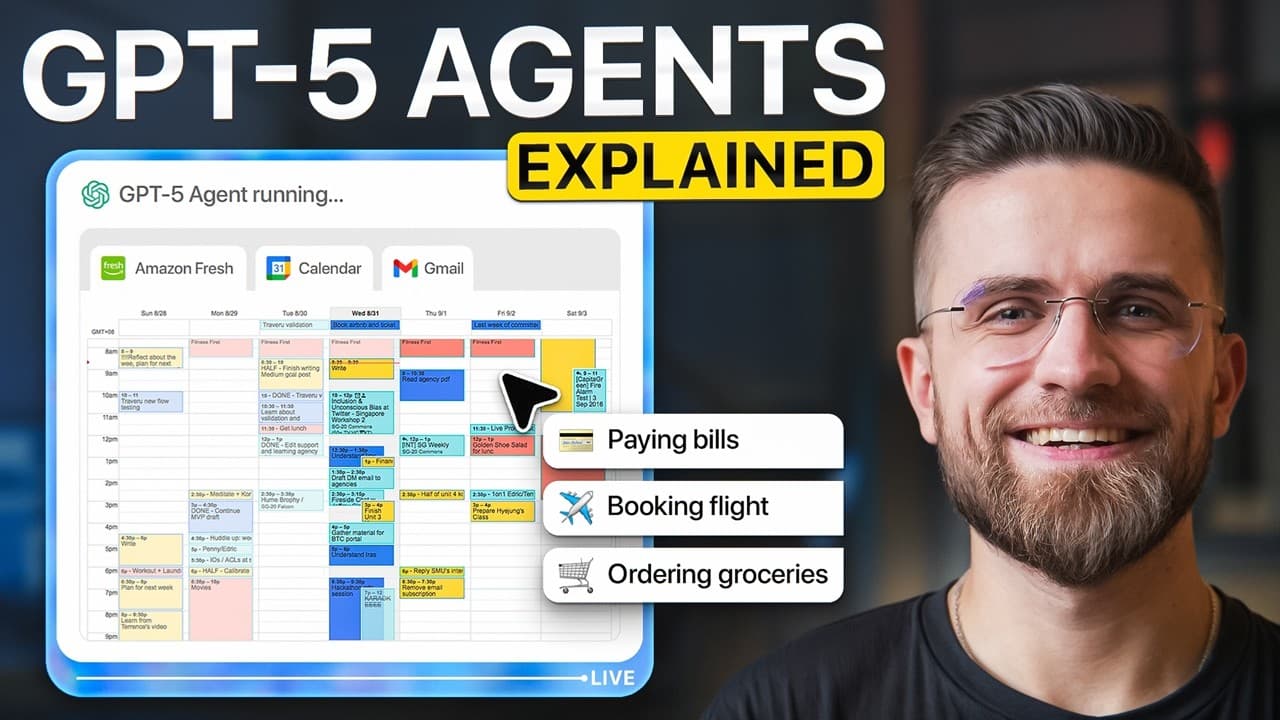
Open AI just changed the game with the Asian feature. Now Chad GBT is truly all powerful, baddest, meanest, coolest AI Asian there is. All without you, all without any setup or steep learning curve. It's deep research operator and reasoning all in one package. Connects to apps, browses the web for you, creates automations and a lot more. If you can... Read More
Key Insights
- An AI agent is a chatbot-like system that can independently take actions through connected software or tools. Its language model provides decision-making ability, while integrations let it move beyond conversation to perform tasks such as checking calendars, querying data, sending emails, or browsing websites.
- Traditional automation is a rigid sequence of predefined steps that starts when a specific trigger occurs. It performs its scripted actions without deviation, so an unexpected request or condition can make it fail unless a human previously created a branch for that exact situation.
- An AI agent starts with a goal and dynamically selects the actions needed to reach it. It can break a broad objective into subtasks, choose tools, evaluate whether their results are sufficient, and attempt a different approach when the first tactic does not work.
- The five core elements of an AI agent are a trigger, reasoning engine, memory, tools, and output. These elements form a modular structure that can be adapted to different tasks by changing individual components without rebuilding the agent's entire operating pattern.
- A trigger is the event that starts an agent and often supplies its initial data. Examples include a scheduled time, a new Slack or Telegram message, a spreadsheet row, or a webhook, with the incoming message or record becoming the material the agent processes.
- The reasoning engine is typically a large language model that interprets the input and instructions, creates a plan, selects an action, evaluates the result, and determines the next step. This repeated decision cycle distinguishes agent behavior from a fixed sequence of commands.
- Agent memory includes short-term context for the current session and long-term information stored outside that session. Short-term memory helps the agent track recent actions and requests, while long-term memory can preserve user preferences, prior results, or learned facts in databases, spreadsheets, or vector stores.
- Agent autonomy is limited and should be supervised during initial runs. The OpenAI agent described can perform browser-based work, but users may still need to log in or click when it cannot proceed, making prompt and pipeline testing important before relying on repeated execution.
Install to Summarize YouTube Videos and Get Transcripts
Explore YouTube Video Summarizer or Get YouTube Transcript Extractor
Questions & Answers
Q: What is an AI agent and what can it do?
An AI agent is a chatbot-like system that can take actions through external software, applications, APIs, or functions. A language model interprets the goal and decides what to do, while connected tools let it check calendars, query spreadsheets or databases, perform calculations, send emails, browse websites, update records, and create files instead of only producing conversational text.
Q: How is an AI agent different from traditional automation?
Traditional automation follows a predetermined recipe, such as doing X, then Y, then Z after one specific trigger. It cannot readily handle an unanticipated request unless that possibility was explicitly programmed. An AI agent starts with a goal, chooses its own actions, evaluates results, and can change tactics when a tool fails or another approach becomes necessary.
Q: What are the five core components of an AI agent?
The five core components are a trigger, reasoning engine, memory, tools, and output. The trigger starts the process, the reasoning engine plans and makes decisions, memory preserves relevant context, tools provide external capabilities, and the output delivers the final response or action. The agent may cycle through reasoning, tool use, and memory updates before producing that result.
Q: How does an AI agent's reasoning engine work?
The reasoning engine is usually a large language model that receives the trigger data along with prompts or instructions. It interprets the overall goal, divides that goal into subtasks, selects an action, executes it through a tool, and evaluates the returned result. It then decides whether the task is complete or whether another action or different approach is required.
Q: Why do AI agents need short-term and long-term memory?
Short-term memory preserves the current conversation and recent events, preventing the agent from losing context as it moves between tools during one run. Long-term memory stores information outside the immediate session so it can be recalled later. That persistent information can include user preferences, earlier results, or learned facts kept in a database, spreadsheet, or vector store.
Q: What tools can an AI agent use to take action?
An agent can use explicitly provided tools such as HTTP requests, website access, database queries, Google spreadsheet operations, mathematical calculations, email sending, and calendar checking. These tools act as the agent's hands and eyes. The language model reasons about which tool is needed, calls it, reviews the result, and then decides what action should follow.
Q: What makes an AI agent autonomous?
An agent becomes autonomous when its language model begins choosing steps without a human pre-programming every branch. It can interpret a fuzzy goal, create a plan, divide work into subtasks, decide which tool to use, judge whether a result is adequate, and loop back to try another method. However, the OpenAI agent described still requires human help for some logins or clicks.
Q: How can someone build an AI agent without coding?
No-code platforms can provide agent blocks or nodes that combine a language model with triggers, memory, tools, and outputs. A builder can configure instructions and integrations for tasks such as scheduling meetings, fetching data, summarizing content, supporting e-commerce customers, or handling calls. The transcript also identifies n8n, Make.com, and Zapier's AI blocks as no-code platform options.
Summary & Key Takeaways
-
An AI agent is a chatbot-like system that can take actions through external software and tools. Instead of merely generating text, it can browse websites, check calendars, query databases, send messages, update records, or create files. The language model decides which available action best advances the assigned goal.
-
Traditional automations execute predetermined steps after a specific trigger, while agents use a language model to choose steps dynamically. Agents can divide broad goals into subtasks, call tools, inspect results, and change tactics. This flexibility lets them address situations that were not individually encoded as branches in a conventional workflow.
-
The agent architecture contains five modular elements: trigger, reasoning engine, memory, tools, and output. Short-term memory preserves current-session context, while long-term memory retains information between runs. No-code platforms package these elements into reusable blocks, allowing builders to change models, triggers, and integrations without redesigning the entire framework.
Read in Other Languages (beta)
Share This Summary 📚
Summarize YouTube Videos and Get Video Transcripts with 1-Click
Try YouTube Summary with ChatGPT & Claude or YouTube Transcript Generator
Explore More Summaries from AI Master 📚


Summarize YouTube Videos and Get Video Transcripts with 1-Click
Try YouTube Summary with ChatGPT & Claude or YouTube Transcript Generator