How to Structure a Sales Page That Converts
TL;DR
Lead with a clear promise, outline the plan for achieving it, and provide proof that matches the promised result. Use plain language, prominent visual tiles, concise feature descriptions, and a final statement identifying who the offer is and is not for, so visitors can quickly understand the offer and decide whether to join.
Transcript
Let's get mine supply. Let's look at this puppy. All right, let me share my screen again. I'll keep going until you guys tell me that you're bored and you want to go do other stuff. Okay. So, Phoenix challenge, this is cool. I like the colors. Designed to help you think just a little bit differently. Okay. Um three tasks, six calls, nine days. Okay... Read More
Key Insights
- A sales page is easier to understand when its opening immediately identifies the offer, intended audience, and promised outcome. In the reviewed page, references to creators and inner work appeared too late and created uncertainty about what the Phoenix Challenge actually offered.
- Visual tiles are likely to receive attention before long passages of copy because the reviewer naturally scanned the tiles first. The most important details should therefore appear within those tiles, including the core promise, the major elements of the plan, and the action visitors should take.
- Concise numbers are memorable only when their meaning is clear. The phrase "three tasks, six calls, nine days" communicates structure efficiently, but it does not explain the promised transformation or show how those components help participants reach a specific result.
- Insider language is a conversion obstacle when outsiders cannot translate it into a concrete benefit. Terms associated with a community's worldview should be simplified so that a person unfamiliar with the creator's language can understand the offer without interpreting abstract or fluffy phrases.
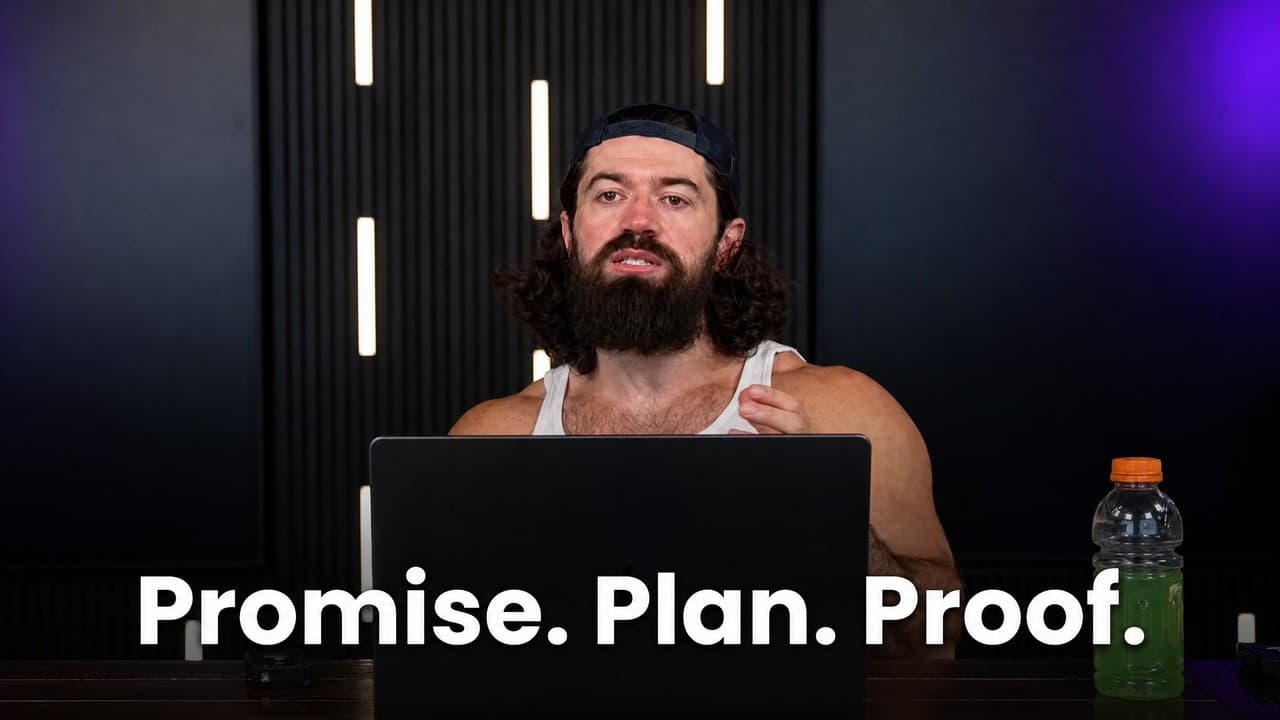
- The promise, plan, and proof framework gives a sales page a coherent narrative. The promise defines the desired outcome, the plan shows the steps or features that produce it, and the proof demonstrates that another participant achieved an outcome matching the original promise.
- Effective testimonials show fulfillment of the specific promise rather than offering generic praise. When evidence describes the same change advertised at the beginning, readers can imagine experiencing that journey themselves and may become more willing to risk their money or time.
- A sales page can be treated as a compressed hero's journey in which the reader previews the full transformation. The reader sees the desired destination, understands the path, and experiences the result vicariously through someone else's evidence before deciding whether to participate.
- A final postscript can improve audience fit by stating who the offer is for and who it is not for. This closing qualification attracts people prepared for the required work while discouraging people whose expectations, needs, or level of commitment do not match the offer.
Install to Summarize YouTube Videos and Get Transcripts
Explore YouTube Video Summarizer or Get YouTube Transcript Extractor
Questions & Answers
Q: How should a sales page be structured to convert?
Structure the page around three connected sections: promise, plan, and proof. Begin with a plain-language statement of the result the buyer can expect. Next, explain the tasks, calls, features, or steps that create that result. Finally, present evidence showing that someone achieved an outcome matching the original promise, then close with a clear action to join.
Q: What should appear at the top of a sales page?
The top should immediately tell visitors what the offer is, whom it serves, and what result it is designed to produce. A concise phrase such as "three tasks, six calls, nine days" can support the opening, but the numbers cannot replace the promise. Visitors should not have to search through testimonials or detailed copy to understand the offer.
Q: Why should sales copy avoid jargon and insider language?
Jargon makes outsiders work harder to understand what they will receive. Language that feels natural inside a creator's community may sound abstract or fluffy to someone encountering the offer for the first time. The copy should explain the promise as if speaking to a toddler, using familiar words and concrete outcomes instead of terminology that requires prior knowledge.
Q: How should visual tiles be used on a sales page?
Visual tiles should carry the page's most important information because visitors may scan them before reading paragraphs. Each tile can represent a major part of the plan, such as a task, call, or stage of the challenge. Their labels should be concise, visually prominent, and directly connected to the promised result rather than serving as decoration alone.
Q: What makes a testimonial effective on a sales page?
An effective testimonial proves that the advertised plan can produce the promised outcome. Instead of giving only general praise, it should describe a result that closely matches the claim made at the beginning of the page. This alignment lets readers experience the transformation vicariously and gives them a clearer reason to believe that following the plan could work for them.
Q: What is the promise, plan, and proof framework?
The promise is the clear outcome offered to the customer. The plan is the set of features, tasks, calls, or steps used to reach that outcome. The proof is evidence that the process worked for another person. These sections should connect tightly, with the proof demonstrating the same result named in the promise rather than an unrelated benefit.
Q: Why does a sales page resemble a hero's journey?
A sales page lets the reader preview a transformation before committing. The promise establishes the desired destination, the plan describes the journey, and the proof shows another person reaching that destination. By mentally following that complete story, the reader can approximate the fulfillment of the promise and decide whether the opportunity is worth the required money, time, or effort.
Q: What should the final postscript on a sales page say?
The final postscript should state who the offer is for and who it is not for. This acts as a last qualification step, attracting people who fit the intended audience and are ready to do the required work while discouraging those with mismatched needs or expectations. It should reinforce fit without introducing a different promise at the end.
Summary & Key Takeaways
-
The reviewed page earns praise for its bright colors and design, but its purpose remains unclear during an initial scan. The audience and offer emerge only gradually through scattered references to creators, community, inner work, healing, shadow exploration, inner-child work, attachment theories, three tasks, six calls, and nine days.
-
Visitors commonly scan visual tiles before reading detailed copy, so the most important information should appear in those high-attention elements. The page should replace fluffy language and insider terminology with a concise explanation of what participants receive, what result the challenge promises, and how its activities move them toward that outcome.
-
A stronger sales page follows a promise, plan, and proof sequence. The opening states the desired result, the middle presents the tasks, calls, or other elements that create it, and the evidence shows someone achieving a matching outcome. A final postscript can clarify who should participate and who should not.
-
Key Insights are... Wait invalid?
Read in Other Languages (beta)
Share This Summary 📚
Summarize YouTube Videos and Get Video Transcripts with 1-Click
Try YouTube Summary with ChatGPT & Claude or YouTube Transcript Generator
Explore More Summaries from MoreMozi 📚
Summarize YouTube Videos and Get Video Transcripts with 1-Click
Try YouTube Summary with ChatGPT & Claude or YouTube Transcript Generator