What Is OpenAI's Circuit Sparsity in Neural Networks?
TL;DR
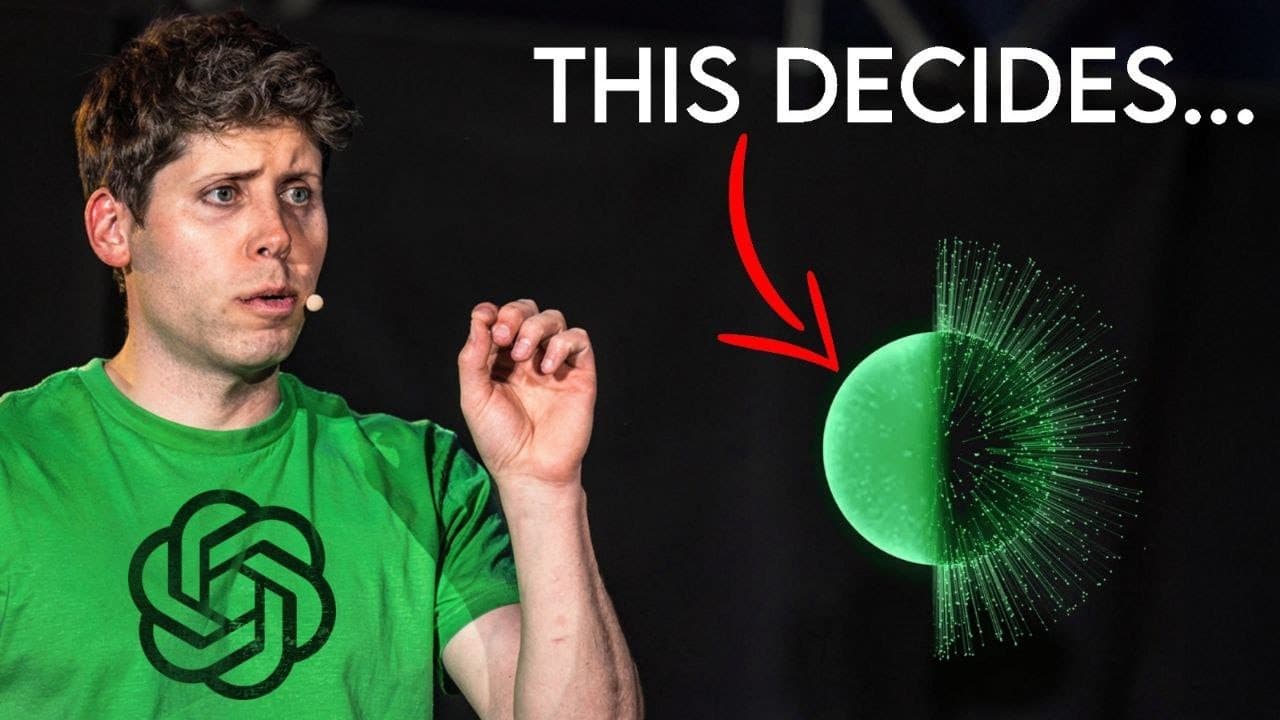
OpenAI trained a GPT-2 style transformer on Python code while cutting over 99.9% of its internal connections during training, forcing its logic into tiny readable circuits. In the most aggressive version only about 1 in 1,000 connections survives, yet accuracy holds. For the same accuracy, the sparse model's internal machinery is about 16 times smaller than a dense one.
Transcript
Open AAI dropped a release that feels like somebody finally caught an AI midthought and I mean that literally. You can trace a decision down to a handful of tiny components like you are following a circuit on a motherboard. That is the vibe of this whole thing. The project is called circuit sparity and it comes from a paper with a pretty blunt titl... Read More
Key Insights
- Circuit sparsity is OpenAI research, released alongside a paper titled 'Weight sparse transformers have interpretable circuits', that lets you trace a model's decision down to a handful of tiny components like following a circuit on a motherboard.
- Sparsity is enforced during optimization, at every training step, not applied afterward. Every time the model updates, OpenAI keeps only the strongest connections and fully zeroes out the rest rather than weakening or ignoring them.
- The most aggressive version keeps only about 1 out of every 1,000 connections, meaning over 99.9% of the internal wiring is gone. Roughly only 1 out of every 4 internal signals is allowed to activate at any moment.
- The model survives extreme pruning because it starts normal and flexible, then the allowed number of connections shrinks slowly over time, compressing what it learned into the most essential surviving logic.
- For the same level of accuracy, the internal thinking machinery inside sparse models is about 16 times smaller than in normal dense models, so the same behavior fits inside a much simpler internal program.
- A circuit is defined concretely as a small group of internal units and the exact connections between them. Each unit is one neuron, attention channel, or memory read/write slot, and each connection is a single surviving weight.
- The quote-closing task resolves to a circuit of just 12 internal units and 9 connections that detects a quote, classifies single versus double, copies the signal to the end, and outputs the closing quote step by step.
- Bridges act as translators that let information flow between a sparse readable model and a normal dense model, so an interpretable feature can be tweaked in the sparse model and injected into a full-scale dense system.
Install to Summarize YouTube Videos and Get Transcripts
Explore YouTube Video Summarizer or Get YouTube Transcript Extractor
Questions & Answers
Q: What is OpenAI's circuit sparsity project?
Circuit sparsity is an OpenAI research release that exposes how a language model makes decisions internally. It comes from a paper titled 'Weight sparse transformers have interpretable circuits' and lets you trace a decision down to a handful of tiny components, like following a circuit on a motherboard. OpenAI trained a GPT-2 style transformer on Python code while cutting most of its connections, and also shipped an actual model on Hugging Face and a toolkit on GitHub, making it both research and tooling you can touch.
Q: How does OpenAI train a weight-sparse transformer?
Instead of pruning after training, OpenAI enforces sparsity during optimization at every training step. Each time the model updates itself, it keeps only the strongest connections and fully zeroes out the rest, rather than weakening or ignoring them. The model starts out normal and flexible, then over time the allowed number of connections gets smaller and smaller, forcing it to compress what it learned into fewer internal pieces. Whatever survives that process ends up being the most essential logic.
Q: How many connections survive in the sparsest model?
In the most aggressive version, only about one out of every 1,000 connections survives, meaning over 99.9% of the internal wiring is fully zeroed out. OpenAI also limits how many internal parts can activate at all, allowing roughly only one out of every four internal signals to light up at any moment. The result is far fewer connections, fewer active parts, and much less internal chaos, yet the model still functions rather than falling apart.
Q: Why doesn't the heavily pruned model collapse?
The model survives because of how OpenAI trains it gradually. Early on, the model starts out normal and flexible with its full capacity available. Then slowly over time, the allowed number of connections gets smaller and smaller, so the model is forced to compress what it learned into fewer and fewer internal pieces. Because the reduction is gradual rather than sudden, whatever survives ends up being the most essential logic needed to keep performance the same while the internal machinery shrinks.
Q: What is a circuit in this research?
OpenAI defines a circuit concretely as just a small group of internal units and the exact connections between them. Each unit is tiny, such as one neuron, one attention channel, or one read or write slot in memory. Each connection is literally a single surviving weight. This precise definition lets OpenAI ask whether they can find the smallest possible internal circuit that still solves a task, instead of talking about vague features or hidden states, so circuits can actually be read and named.
Q: How does the model decide which closing quote to output?
For the quote-closing task, the final circuit has just 12 internal units and 9 connections. Two units appear almost immediately: one activates whenever the model sees any quote, and the other carries a signal distinguishing single from double quotes. Later, another component copies that signal to the end of the sequence where the closing quote is needed. So the model runs a tiny internal routine, detect then classify then copy then output, that you can follow step by step rather than guessing or loosely pattern matching.
Q: What are bridges in the circuit sparsity work?
Bridges act as translators that let information flow between a clean, readable, sparse model and a normal dense model. You can take a specific internal signal from the sparse model, tweak it, and inject that change into a dense model. This means that instead of saying a behavior only exists in a toy model, you can say a feature exists and show how it affects a full-scale system. Bridges keep interpretable features from staying trapped in research demos so they can map onto real models.
Q: What did OpenAI actually release and under what license?
OpenAI released an actual model called openai/circuit-sparsity, which has 0.4 billion parameters and is available on Hugging Face under an Apache 2.0 license. They also released the full toolkit on GitHub as openai/circuit_sparsity, including the 20 coding tasks and a visual interface for exploring circuits. You can load it, run it on Python code, and see that inside almost everything is zeroed out, leaving only the minimum machinery needed to function. The goal is making AI legible rather than stronger.
Summary & Key Takeaways
-
OpenAI released circuit sparsity, training a GPT-2 style transformer on Python code while enforcing sparsity during training itself. At every step it keeps only the strongest connections and zeroes out the rest, so in the most aggressive version only about 1 in 1,000 connections survives and over 99.9% of wiring is removed.
-
The model does not fall apart because pruning is gradual: it begins flexible, then the allowed connection count shrinks over time until only essential logic remains. For equal accuracy, the sparse model's internal machinery is about 16 times smaller, letting OpenAI find the smallest circuit that still solves a task.
-
Using 20 simple two-token coding challenges, OpenAI isolates tiny circuits, such as 12 units and 9 connections for closing a quote, revealing detect-classify-copy-output routines. Bridges connect sparse and dense models, and OpenAI shipped a 0.4 billion parameter model on Hugging Face under Apache 2.0 plus a GitHub toolkit.
Read in Other Languages (beta)
Share This Summary 📚
Summarize YouTube Videos and Get Video Transcripts with 1-Click
Try YouTube Summary with ChatGPT & Claude or YouTube Transcript Generator
Explore More Summaries from AI Revolution 📚




Summarize YouTube Videos and Get Video Transcripts with 1-Click
Try YouTube Summary with ChatGPT & Claude or YouTube Transcript Generator