How to Analyze Respiratory Data for Inspiration and Expiration
TL;DR
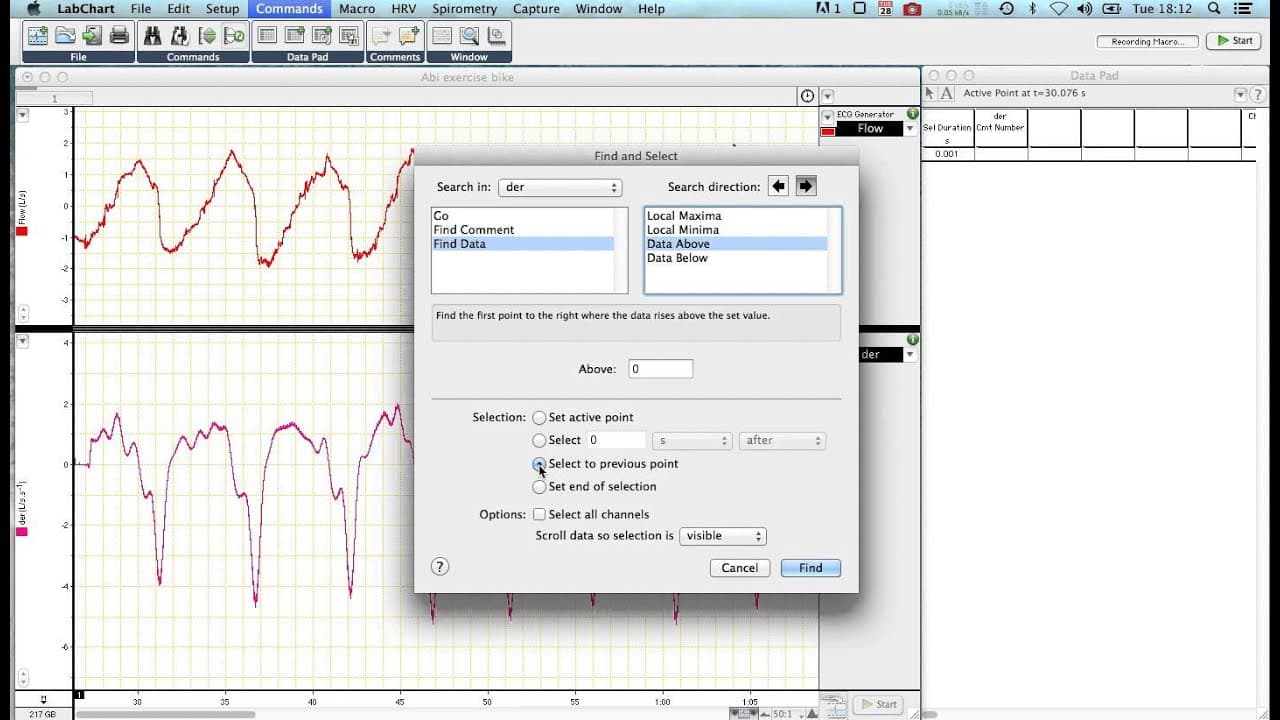
To analyze respiratory data and measure individual inspiration and expiration times, apply a low pass filter to smooth the flow channel, then use its derivative to identify zero crossings. Setting up the data pad correctly is essential for recording timestamps, and macros can automate repetitive measurement tasks for efficiency.
Transcript
hello I've been asked to do a very quick tutorial looking at um some analysis of respiratory traces on the screen you can see in front of you the uh respiratory trace of a student breathing um and you can see we got flow here in the red Channel showing uh breathing in and breathing out in a cyclic uh manner if I look on the second Channel we've got... Read More
Key Insights
- ⏳ Flow and volume data can be analyzed to measure individual inspiration and expiration time in respiratory traces.
- 💐 Applying a low pass filter to the flow channel smoothes the data while preserving its cyclic nature.
- 🚸 Using a derivative of the filtered channel helps identify zero crossings and determine the duration of inspiration and expiration.
- 😫 Setting up the data pad correctly is vital for recording the necessary information in the analysis.
- ⌛ Macros can automate repetitive tasks in the analysis process, saving time and ensuring consistency.
- 🔨 Digital filters and derivatives are powerful tools for manipulating and analyzing respiratory traces.
- 🪡 The analysis demonstrated in the tutorial is suitable for this specific data file, but adjustments may be needed for different datasets.
Install to Summarize YouTube Videos and Get Transcripts
Explore YouTube Video Summarizer or Get YouTube Transcript Extractor
Questions & Answers
Q: How can I measure individual inspiration and expiration time in respiratory traces?
To measure individual inspiration and expiration time, you can apply a low pass filter to the flow channel and use a derivative of the filtered channel to identify zero crossings. By measuring the time between these zero crossings, you can determine the duration of inspiration and expiration.
Q: Can I directly measure inspiration and expiration time without manipulation?
No, measuring individual inspiration and expiration time directly is not possible unless you want to measure each respiratory cycle individually. However, by applying digital filters and using derivatives of the filtered channel, you can indirectly calculate the time between zero crossings and determine the inspiration and expiration time.
Q: What is the purpose of the low pass filter in the analysis?
The low pass filter applied to the flow channel in the analysis smooths the data while preserving the cyclic nature. This filter helps eliminate noise and fluctuations, making it easier to identify the zero crossings and measure inspiration and expiration time accurately.
Q: How can a macro be used in the respiratory traces analysis?
A macro allows you to automate repetitive tasks in the analysis. In this tutorial, a macro is used to find the zero crossings, measure the time between them, add the data to the data pad, and label the inspiratory and expiratory phases. This saves time and ensures consistency in the analysis process.
Summary & Key Takeaways
-
The tutorial demonstrates how to analyze respiratory traces using flow and volume data.
-
By applying a low pass filter to the flow channel, the data becomes smooth while maintaining its cyclic pattern.
-
The tutorial also shows how to use a derivative of the filtered channel to identify zero crossings and measure the time between inspiration and expiration.
Read in Other Languages (beta)
Share This Summary 📚
Summarize YouTube Videos and Get Video Transcripts with 1-Click
Try YouTube Summary with ChatGPT & Claude or YouTube Transcript Generator
Explore More Summaries from Dory Video 📚


Summarize YouTube Videos and Get Video Transcripts with 1-Click
Try YouTube Summary with ChatGPT & Claude or YouTube Transcript Generator