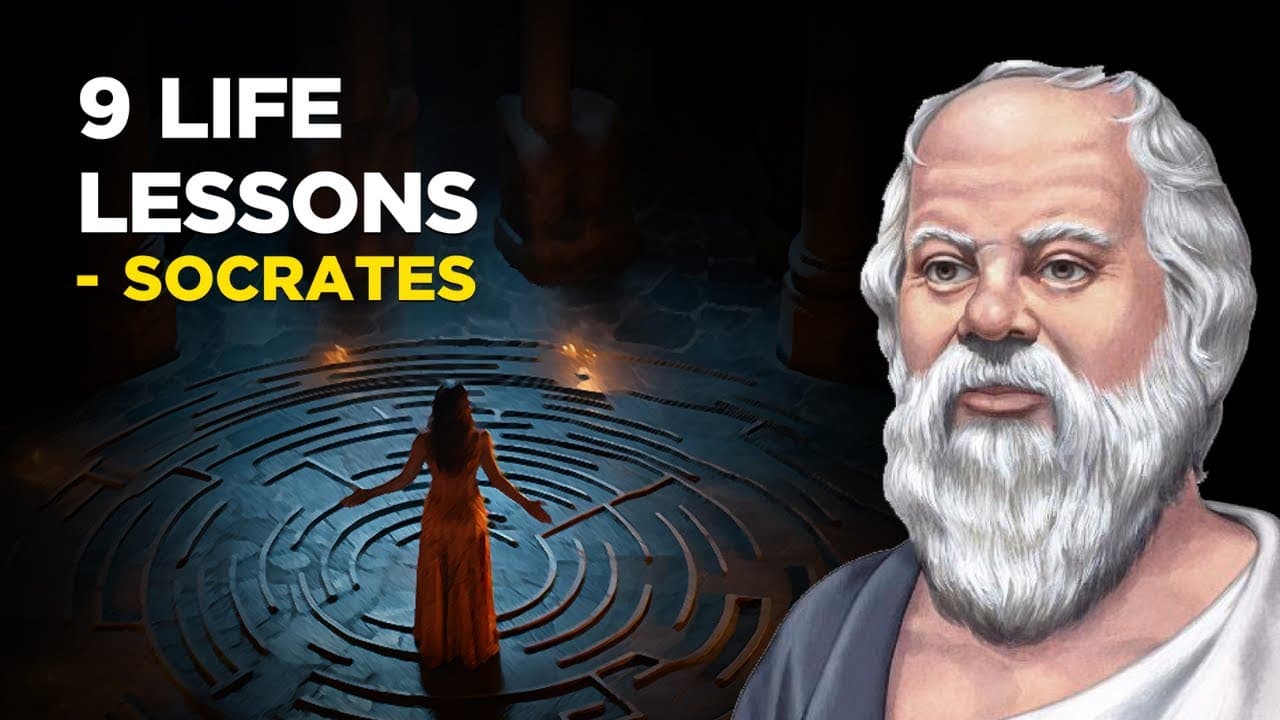
9 Life Lessons From Socrates (Socratic Skepticism)
TL;DR
Socrates’ philosophy offers nine life lessons centered on questioning assumptions, living courageously, and choosing meaningful action over material pursuits. His Socratic method tests an argument’s hypotheses against facts, while his refusal to escape prison after his 399 BCE death sentence illustrates commitment to moral principles. Read on to explore how skepticism, authenticity, humility, simplicity, nonvengeance, and humor can guide everyday life.
Transcript
Socrates lived between 469 and 399 B.C.E. and he is one of the most famous philosophers in the entire history of humankind. He is sometimes considered as the founder of the Western philosophy and his work reflects the philosophy of Skepticism, which has as its main base that knowledge can be obtained through systematic doubt and continual testing. ... Read More
Key Insights
- ❓ Socrates' philosophy emphasizes seeking truth through the Socratic method of questioning and analysis.
- ❓ Courage, authenticity, and humility were integral to Socrates' character and teachings.
- 🌗 Socrates encourages individuals to prioritize meaningful actions over material pursuits for lasting happiness.
- 🥺 Rejecting vengeance and embracing humor can lead to personal growth and stronger relationships.
- 🤩 Being a global citizen, understanding common humanity, and embracing simplicity are key aspects of Socratic wisdom.
- 🤳 Socrates' legacy offers valuable lessons on moral courage, self-awareness, and philosophical inquiry in modern life.
- ❓ Socratic humor can foster resilience, lighten difficult situations, and strengthen interpersonal bonds.
Install to Summarize YouTube Videos and Get Transcripts
Explore YouTube Video Summarizer or Get YouTube Transcript Extractor
Questions & Answers
Q: What are the nine life lessons from Socrates?
The nine lessons are to seek truth, be courageous, live authentically, remain humble, avoid empty busyness, see yourself as a global citizen, be happy with less, reject vengeance, and embrace humor. Together, they emphasize questioning, self-awareness, moral courage, simplicity, and meaningful action.
Q: What is the Socratic paradox?
The Socratic paradox is the idea that true wisdom lies in recognizing that you know nothing. Socrates presented this as the reason he was wise: he did not assume that he already possessed the truth.
Q: How does the Socratic method help people seek truth?
The method, also called elenchus, analyzes every part of an argument and identifies the hypotheses supporting it. It then asks whether those hypotheses are factual and valid, using continual questions to investigate the issue more deeply.
Q: How can the Socratic method be used at work?
If told to follow a design methodology without understanding why, ask who established it, what evidence supports it, and which methods were used to validate it. If the explanation is unsatisfactory, proposing a better method could improve the design’s overall quality.
Q: How did Socrates demonstrate courage?
Socrates challenged Athenian beliefs and continued questioning accepted ideas despite personal danger. After being sentenced to death in 399 BCE, he refused an opportunity to escape prison and died by drinking poison hemlock.
Q: What does Socrates teach about moral courage?
Moral principles should be defended regardless of personal cost. The examples given include refusing a boss’s request to betray a colleague and challenging racist or bigoted remarks at a family gathering instead of remaining silent.
Q: Why did Socrates caution against constant busyness?
He warned against a hectic but empty life dominated by routine and material pursuits. His lesson is to prioritize meaningful activities, introspection, and contentment in order to pursue happiness and purpose.
Q: Why are humility and continual learning important in Socratic philosophy?
Acknowledging that you do not know something puts you in a position to ask questions and develop your knowledge and skills. Socrates’ approach calls for continually seeking evidence, learning new things, and revisiting what you believe to be fact.
Summary & Key Takeaways
-
Socrates, a renowned philosopher, founded Western philosophy on skepticism.
-
His teachings emphasize seeking truth through questioning and self-improvement.
-
Socrates' life and philosophy offer valuable lessons on courage, authenticity, humility, and happiness.
Read in Other Languages (beta)
Share This Summary 📚
Summarize YouTube Videos and Get Video Transcripts with 1-Click
Try YouTube Summary with ChatGPT & Claude or YouTube Transcript Generator
Explore More Summaries from Philosophies for Life 📚



Summarize YouTube Videos and Get Video Transcripts with 1-Click
Try YouTube Summary with ChatGPT & Claude or YouTube Transcript Generator