How Does Breathing Work in the Brain and Body?
TL;DR
Every breath begins in the preBötzinger complex, a brainstem region of a few thousand neurons that fires to activate the diaphragm and intercostal muscles. The diaphragm moves only about two-thirds of an inch downward yet expands an alveolar membrane roughly a third the size of a tennis court, raising blood oxygen from 40 to 100 mmHg.
Transcript
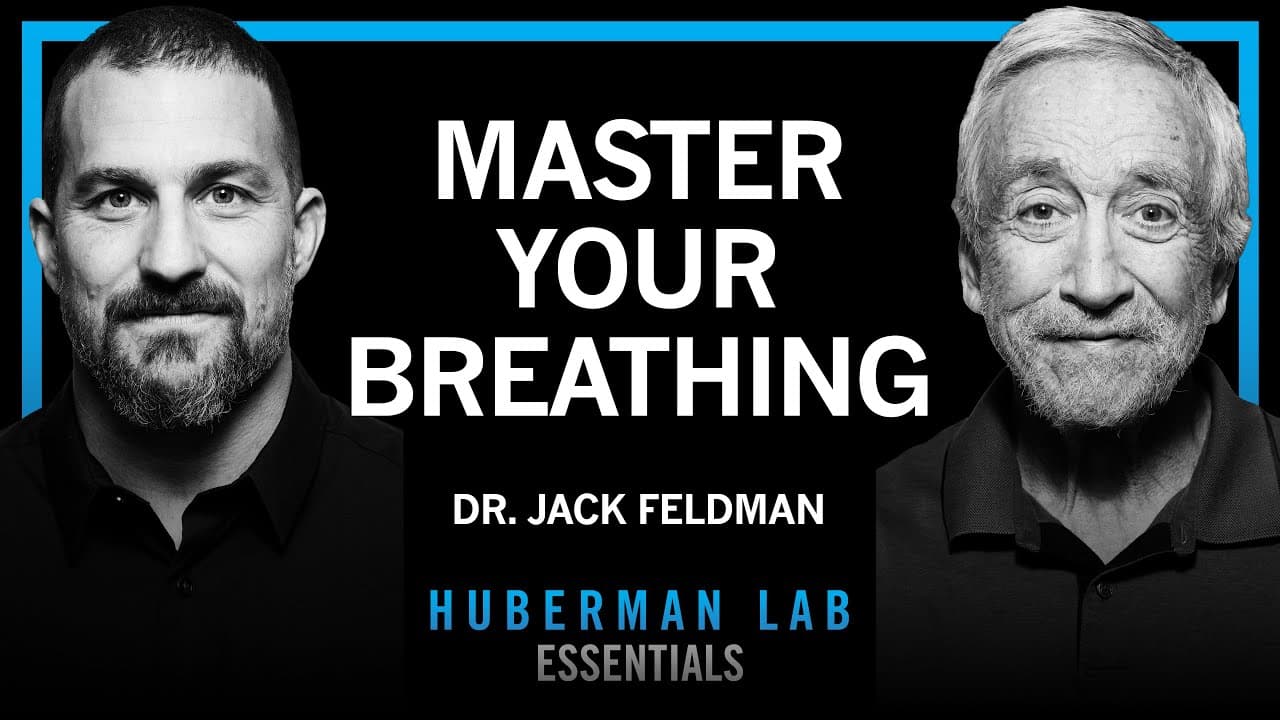
Welcome to Huberman Lab Essentials, where we revisit past episodes for the most potent and actionable science-based tools for mental health, physical health, and performance. I'm Andrew Huberman and I'm a professor of neurobiology and opthalmology at Stanford School of Medicine. And now for my conversation with Dr. Jack Feldman. Thanks for joining ... Read More
Key Insights
- The primary purpose of breathing is to bring in oxygen for aerobic metabolism and expel carbon dioxide, which must be removed because it shifts the acid-base balance (pH) of the blood, and all living cells are highly sensitive to pH.
- The preBötzinger complex is a brainstem region containing a few thousand neurons in humans, located on either side and working in tandem, where every breath begins before those neurons signal the motor neurons controlling the diaphragm.
- Inhalation is active while resting exhalation is passive: the diaphragm contracts and pulls down to expand the lungs, then relaxes like a released spring, allowing the lung and rib cage to recoil and push air out.
- A second, independent oscillator near the facial nucleus generates active expiration. It is silent at rest but becomes active during exertion, such as forceful exhaling or exercise, to drive the muscles that push air out.
- The retrotrapezoid nucleus, located near the trapezoid nucleus on the ventral brainstem surface, acts as a central chemoreceptor sensing carbon dioxide to keep brain pH stable, because the brain is extraordinarily sensitive to pH changes.
- Mammals are the only class of vertebrates with a diaphragm. Amphibians and reptiles lack this powerful inspiratory muscle, so they breathe by actively expiring and passively inspiring rather than actively inhaling.
- Oxygen crosses the alveolar-capillary membrane entirely passively, so surface area is the key factor. Mammals pack 400 to 500 million alveoli, creating a membrane about a third the size of a tennis court, roughly 70 square meters.
- The diaphragm is mechanically efficient: moving just two-thirds of an inch down expands lung volume from about 2.5 liters by 500 milliliters (about 20%), raising blood oxygen partial pressure from 40 to 100 mmHg.
Install to Summarize YouTube Videos and Get Transcripts
Explore YouTube Video Summarizer or Get YouTube Transcript Extractor
Questions & Answers
Q: Why does the body need to remove carbon dioxide when breathing?
Carbon dioxide is produced when oxygen is used in aerobic metabolism, and it must be expelled because it affects the acid-base balance, or pH, of the blood. All living cells are very sensitive to pH values, so the body is highly interested in regulating pH. Removing carbon dioxide through exhalation keeps that balance stable and prevents disruption to cell function throughout the body.
Q: What is the preBötzinger complex and what does it do?
The preBötzinger complex is a small region in the brainstem, above the spinal cord, that generates the breathing rhythm. In humans it contains a few thousand neurons, located on either side and working in tandem. Every breath begins with these neurons becoming active. They connect to the motor neurons going to the diaphragm and external intercostal muscles, causing the inspiratory effort. When their burst of activity ends, inspiration stops and passive exhalation begins.
Q: How does the diaphragm generate an inhale?
The diaphragm is the principal breathing muscle, sitting inside the body just below the lungs. To inhale, you contract the diaphragm and it pulls down, inserting pressure forces that make the lung want to expand. At the same time the rib cage rotates up and out, expanding the thoracic cavity. This lowers the pressure inside the air sacs called alveoli, so air flows in because outside pressure is higher than inside pressure during expansion.
Q: Why do humans breathe through the nose at rest but the mouth during exercise?
At rest the tendency is nasal breathing because the airflow needed for normal breathing is easily managed passing through the nasal cavities. However, when ventilation needs to increase during exercise, you must move more air, and you do that through your mouth because those airways are much larger and can move much more air. At the level of the diaphragm and intercostals, contraction is almost agnostic to whether the nose or mouth is open.
Q: What is active expiration and where does it come from?
Active expiration is forcefully moving air out, as when you exhale hard or begin to exercise, rather than letting the lungs passively recoil. It is driven by a second, independent oscillator located in a region around the facial nucleus. This group of cells is silent at rest but suddenly becomes active to drive the expiratory muscles when needed. It is separate from the preBötzinger complex, which handles the resting breathing rhythm.
Q: Why do only mammals have a diaphragm and why does it matter?
Mammals are the only class of vertebrates that have a diaphragm. Amphibians and reptiles lack a powerful inspiratory muscle, so they breathe by actively expiring and passively inspiring, the opposite of mammals. The diaphragm is mechanically extremely efficient, moving only about two-thirds of an inch down to expand a huge lung membrane. Dr. Feldman suggests the diaphragm was a key step enabling large brains, which have a continuous demand for oxygen.
Q: How much does breathing change lung volume and blood oxygen levels?
At rest the volume of air in your lungs is about 2.5 liters. When you take a breath, you add another 500 milliliters, or half a liter, roughly the size of a fist, increasing the volume by about 20%. Despite this modest change, you are pulling on a membrane around 70 square meters in size. That is enough fresh air to raise the partial pressure of oxygen in your bloodstream from 40 millimeters of mercury to 100 millimeters of mercury.
Q: Is diaphragmatic breathing actually healthier than chest breathing?
Dr. Feldman said he is not aware of any particular studies that have directly examined the health benefits of diaphragmatic versus non-diaphragmatic breathing. In the context of breath practice, he is agnostic about whether breathing is primarily driven by the diaphragm or by moving the abdomen. While some breathing patterns clearly work through different mechanisms, he does not claim that belly-based breathing is inherently better or healthier than lifting the rib cage and chest.
Summary & Key Takeaways
-
Breathing exists to supply oxygen for aerobic metabolism and remove carbon dioxide. CO2 matters because it changes the blood's pH, and all living cells are sensitive to pH, so the body tightly regulates it. Inhaling contracts the diaphragm downward and rotates the rib cage up and out.
-
The preBötzinger complex, a brainstem site of a few thousand neurons in humans, initiates every breath and drives the diaphragm and external intercostals. A separate oscillator near the facial nucleus, silent at rest, produces active expiration during exertion. The retrotrapezoid nucleus senses carbon dioxide to protect brain pH.
-
Only mammals have a diaphragm, letting them actively inhale rather than passively inspire like amphibians and reptiles. This efficient muscle expands an alveolar membrane about a third of a tennis court in size, moving only two-thirds of an inch to raise blood oxygen from 40 to 100 mmHg, possibly enabling larger brains.
Read in Other Languages (beta)
Share This Summary 📚
Summarize YouTube Videos and Get Video Transcripts with 1-Click
Try YouTube Summary with ChatGPT & Claude or YouTube Transcript Generator
Explore More Summaries from Andrew Huberman 📚





Summarize YouTube Videos and Get Video Transcripts with 1-Click
Try YouTube Summary with ChatGPT & Claude or YouTube Transcript Generator