How Do Polymorphic Applications Change Themselves?
TL;DR
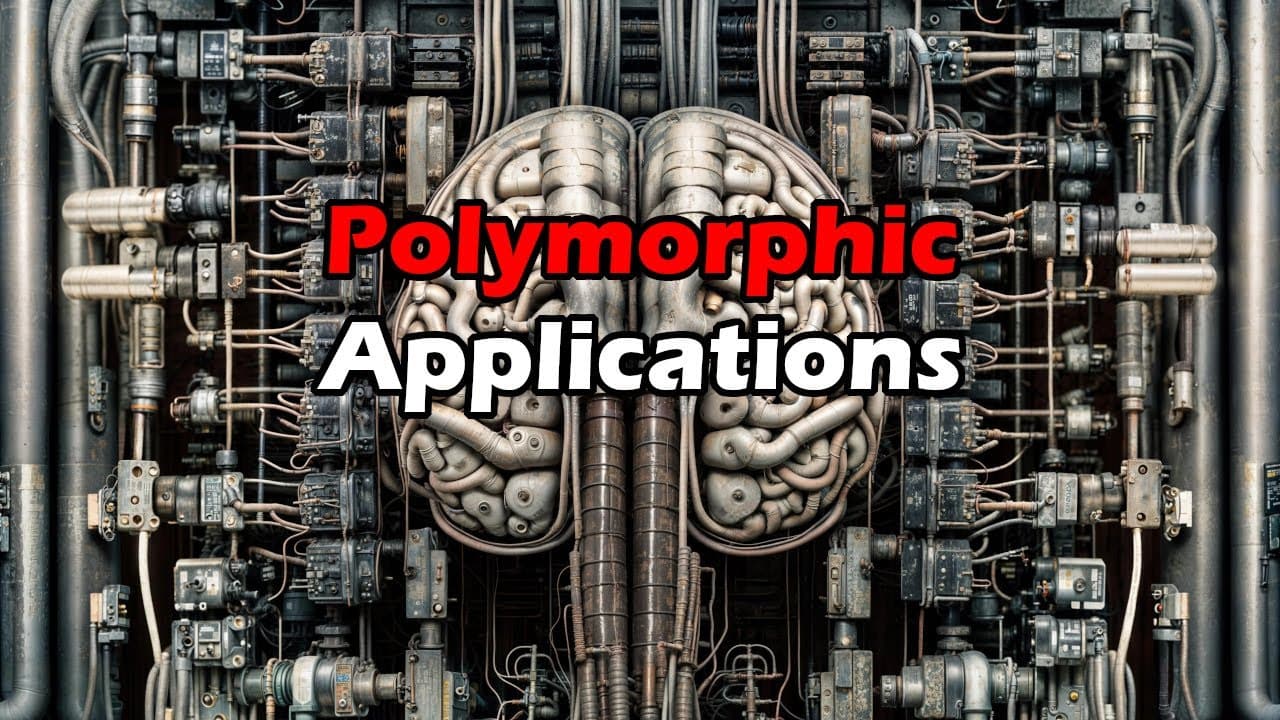
Polymorphic applications pursue a measurable mission by using a language model to reason, make decisions, create tools, and reconfigure modular software components. Their foundation combines API access, automated code generation and testing, plug-and-play architecture, and a cognitive architecture that determines which tools and components are needed to advance the mission.
Transcript
good morning everybody David Shapiro here with another video so uh I mentioned a few videos ago you may or may not have seen it I mentioned the concept of polymorphic applications and a bunch of you are like what is this concept tell me more and some people are like yeah whatever that's not possible so this video is here to teach you a new ... Read More
Key Insights
- Mission-oriented programming is a software paradigm in which a clear, measurable, and purposeful mission drives an application's behavior, adaptation, and evolution. It shifts the primary organizing principle away from objects and toward the outcome that the application is expected to pursue.
- Polymorphic applications are self-changing applications that can adapt their composition and behavior in pursuit of a mission. Their flexibility comes from modular components, configurable front ends and back ends, microframeworks, and an architecture designed to let interchangeable pieces be connected as requirements change.
- Language models are reasoning engines when they are used for more than generating prose. Their relevant capabilities include brainstorming, planning, problem solving, coding, writing tests, interpreting bugs, and making decisions, all of which can be combined into an automated application workflow.
- Generative AI is a form of automation that adds language-based reasoning and creation capabilities to existing technical systems. Infrastructure engineers, developers, and software architects can therefore treat it as an automation engine that performs tasks and responds to problems within a defined objective.
- Function calling and API use allow a language model to serve as middleware between systems. If an organizational tool exposes an accessible API, the model can potentially communicate with it, giving the reasoning engine a way to coordinate actions across a broader technology stack.
- An automated tool factory generates software components on demand. Because a language model can write code, test it, read manuals, call APIs, and interpret user stories or epics, these abilities can be combined to fabricate the building blocks required for a larger application.
- Plug-and-play architecture enables an application to change shape by combining modular building blocks in different ways. Once tools can be generated on demand, the system can connect them as needed, making modularity the technical foundation for polymorphic behavior.
- A cognitive architecture coordinates the tool factory and its modular components. It acts as the application's brain by determining which tools are required, how they should be connected, and what decisions or plans will best advance the application's assigned mission.
Install to Summarize YouTube Videos and Get Transcripts
Explore YouTube Video Summarizer or Get YouTube Transcript Extractor
Questions & Answers
Q: What is a polymorphic application in software development?
A polymorphic application is a self-changing software system designed to adapt its behavior and composition while pursuing a defined mission. It uses modular, plug-and-play components and may generate new tools when necessary. Configurable front ends, configurable back ends, and microframeworks provide lower-level flexibility, while a reasoning engine helps decide how the application should change.
Q: What is mission-oriented programming?
Mission-oriented programming is a software development paradigm that organizes an application around a clear, measurable, and purposeful mission. That mission becomes the main driver of the application's behavior, adaptation, and evolution. Instead of functioning only as a passive tool, the application gains autonomy and agency to make decisions and take actions that advance its assigned objective.
Q: How do language models enable self-changing applications?
Language models enable self-changing applications by combining several capabilities that are normally handled separately. They can brainstorm, plan, solve problems, make decisions, write code, create unit tests, interpret bugs, read manuals, and work with user stories. When these capabilities are assembled into one workflow, the model can generate and coordinate software components according to changing needs.
Q: Why are APIs important for polymorphic applications?
APIs give the reasoning engine a practical way to communicate with tools and systems throughout an organization's technology stack. Function calling and API use can make a language model operate as universal middleware. When a service exposes an accessible API, the model can call that service, coordinate its actions with other components, and incorporate it into mission-driven workflows.
Q: What is an automated tool factory for software?
An automated tool factory is a system that creates code-based tools on demand. A language model can generate code, test the result, interpret errors, consult manuals, call APIs, and understand development requirements such as user stories and epics. Combining these abilities produces reusable software building blocks that can later be connected to form or modify a larger application.
Q: How does plug-and-play architecture support polymorphism?
Plug-and-play architecture breaks an application into modular pieces that can be created, replaced, and connected in different arrangements. A tool factory supplies the pieces, while the broader system assembles them according to current requirements. The application is polymorphic because its underlying components are interchangeable, allowing it to change shape without depending on one permanently fixed configuration.
Q: What role does cognitive architecture play in mission-driven software?
Cognitive architecture serves as the coordinating brain of mission-driven software. A tool factory can create components, but another mechanism must determine which tools are needed and how they should connect. The cognitive architecture automates planning, problem solving, and decision making so the system can select or request appropriate building blocks while continuing to pursue its mission.
Q: What is the ACE model for autonomous cognitive entities?
The ACE model is presented as a cognitive architecture for autonomous cognitive entities and as an organizing framework for next-generation polymorphic applications. Its name emphasizes autonomy, cognition, and a somewhat self-contained entity. The model is intended for systems that resemble a coordinated artificial agent, rather than generative AI deployed only as a distributed capability across unrelated services.
Summary & Key Takeaways
-
Mission-oriented programming organizes an application around a clear, measurable, and purposeful mission instead of treating objects as its primary organizing feature. The mission guides the software's behavior, adaptation, and evolution. A polymorphic application consequently acts as an agent that can make decisions and modify its capabilities while pursuing an objective.
-
Language models can support polymorphic software because they can brainstorm, plan, solve problems, make decisions, write code, create unit tests, interpret bugs, and process development requirements. Function calling and API use also let a model operate as middleware that communicates with organizational systems and services that expose suitable APIs.
-
An automated tool factory is the first step toward a self-changing application. It generates and tests code components on demand, while a plug-and-play architecture allows those components to be assembled in different configurations. A cognitive architecture then acts as the coordinating brain that selects, creates, and connects tools according to the mission.
Read in Other Languages (beta)
Share This Summary 📚
Summarize YouTube Videos and Get Video Transcripts with 1-Click
Try YouTube Summary with ChatGPT & Claude or YouTube Transcript Generator
Explore More Summaries from David Shapiro 📚


Summarize YouTube Videos and Get Video Transcripts with 1-Click
Try YouTube Summary with ChatGPT & Claude or YouTube Transcript Generator