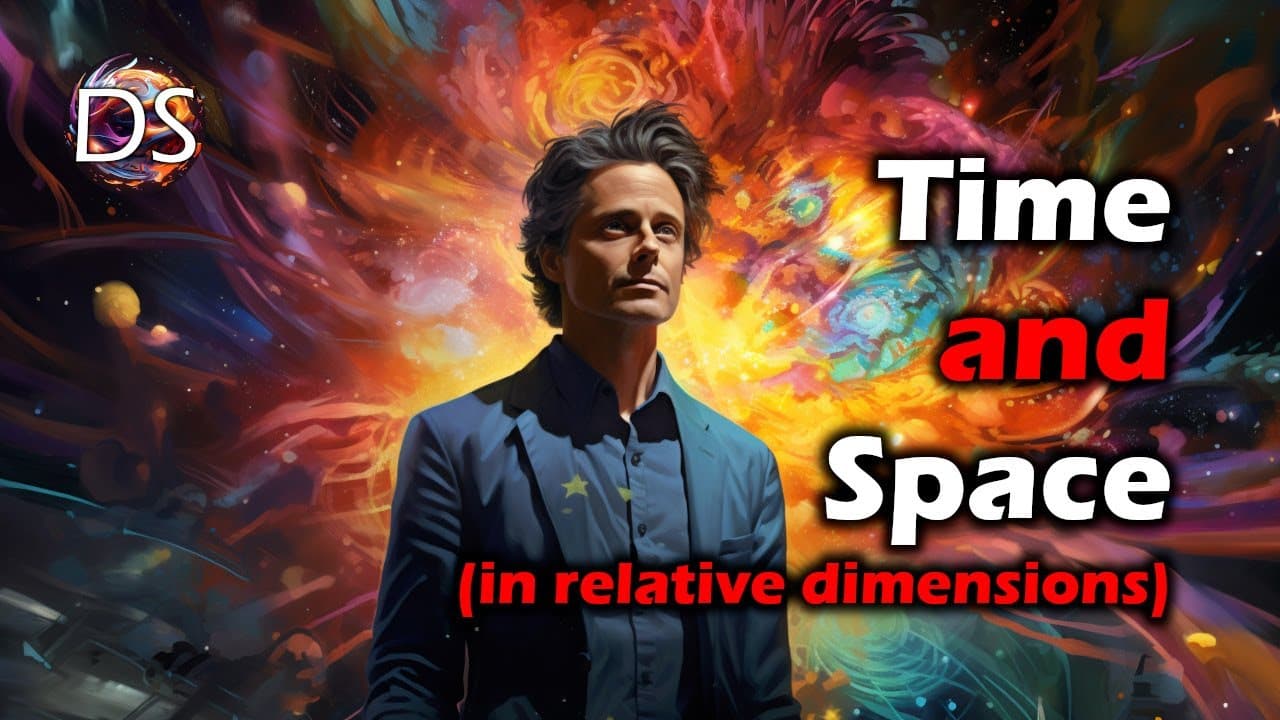
How Do Language Models Understand Time and Space?
TL;DR
Language models like Llama 2 can encode and understand geospatial and chronological concepts, enabling them to generalize abstract ideas. This understanding arises from their training on extensive text data, allowing them to create internal models of the spaces they operate in. The findings suggest a deeper convergence in how both AI and human brains process and understand the world.
Transcript
what does AI actually understand one of the most common things that we see and hear is that AI is no more than a stochastic parrot and of course I'm one of the first people to say that humans are no more than a stochastic parrot because why when you say that AI is a stochastic parrot you are just parting something that you heard based on your train... Read More
Key Insights
- 💡 AI language models, like Llama 2, can encode geospatial and temporal concepts, showcasing their ability to understand and represent abstract ideas.
- 👾 Sufficient training data and deep neural networks enable AI models to generate increasingly abstract representations of the problem space they operate in.
- 👾 The ability to generalize knowledge and intelligence is not limited to being a "stochastic parrot," but rather involves the development of an internal model of the problem space.
- 🌍 Both humans and AI models rely on prediction engines and internal models to understand and interact with the world.
- 💗 There is a growing awareness and exploration of what it means for AI models to truly understand something.
- 🤨 The convergence between AI language models and human understanding raises questions about the similarity between humans and machines.
- 🤔 System one and system two thinking can be applied to AI models, with the goal of engaging in more deliberate and thoughtful responses.
Install to Summarize YouTube Videos and Get Transcripts
Explore YouTube Video Summarizer or Get YouTube Transcript Extractor
Questions & Answers
Q: How did the researchers demonstrate that AI language models can understand geospatial and temporal concepts?
The researchers trained Llama 2, a language model, on large corpora of text and found that it was able to encode geospatial data and chronological time. They also identified the specific parameters or neurons responsible for encoding these concepts.
Q: What does this discovery imply about AI's ability to generalize knowledge?
This discovery suggests that, through extensive training on text data, AI language models can learn to generalize and represent abstract concepts, such as space and time. They can go beyond being a "stochastic parrot" and develop an internal model of the problem space they are operating in.
Q: How does this align with the concept of system one and system two thinking?
System one thinking, which is fast and intuitive, is akin to the initial response provided by AI language models. System two thinking, on the other hand, involves deliberate and slow thinking. The goal is to develop AI models that engage in system two thinking, allowing them to generate well-considered responses instead of off-the-cuff answers.
Q: How does this recent paper contribute to the understanding of AI's capabilities?
The paper highlights the convergence between AI language models and human understanding. Despite the differences in training methods and brain substrates, both humans and AI models share the problem space, leading to similar abilities to represent and understand abstract concepts.
Summary & Key Takeaways
-
A recent paper by Max Tegmark and West Gurny of MIT reveals that language models, even ones like Llama 2, can embed and comprehend the concepts of geospatial data and chronological time.
-
These models learn to generate increasingly abstract representations of the problem space, given enough training data and a deep neural network.
-
This finding aligns with the idea that human brains also rely on prediction engines and generate internal models to understand and interact with the world.
Read in Other Languages (beta)
Share This Summary 📚
Summarize YouTube Videos and Get Video Transcripts with 1-Click
Try YouTube Summary with ChatGPT & Claude or YouTube Transcript Generator
Explore More Summaries from David Shapiro 📚
Summarize YouTube Videos and Get Video Transcripts with 1-Click
Try YouTube Summary with ChatGPT & Claude or YouTube Transcript Generator