How to Understand and Use AI Agents in 2026
TL;DR
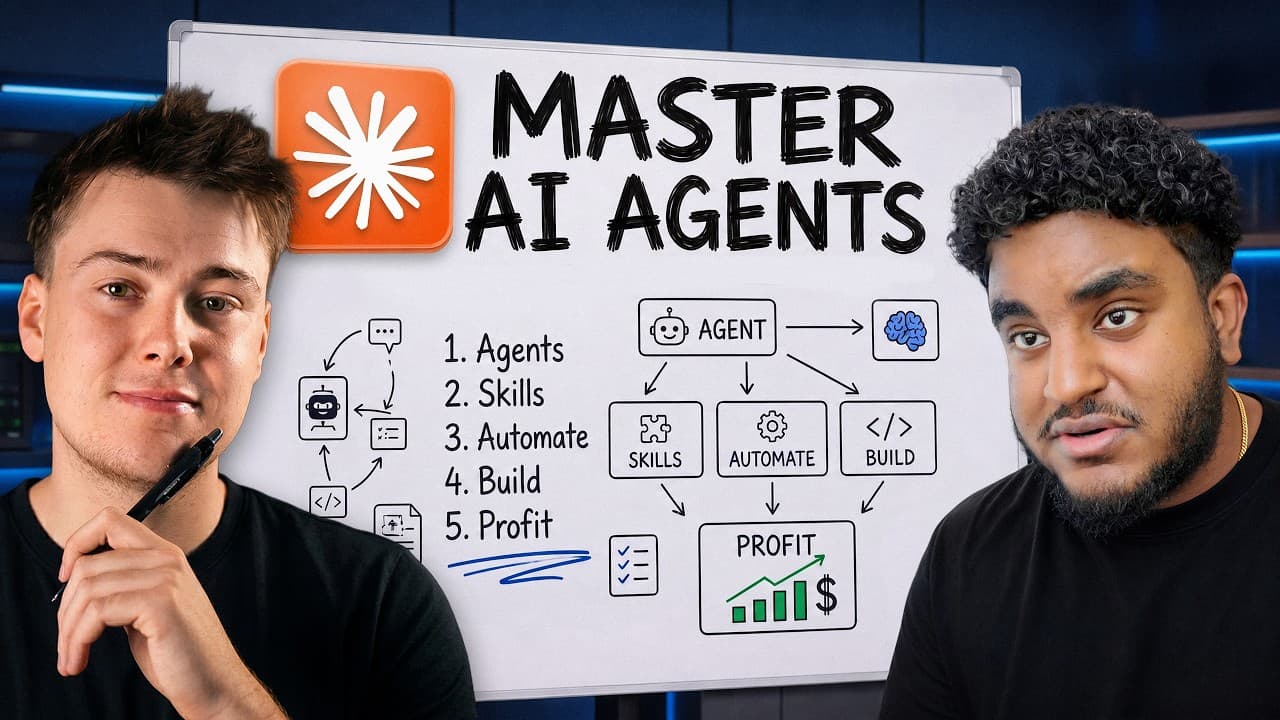
An AI agent combines a large language model with tools and a loop that continues working until a defined objective is reached. Beginners should understand this structure first, then choose a harness based on cost, available models, and quality. Reading tool calls and errors reveals where an agent failed, making these systems easier to operate and troubleshoot.
Transcript
This is one of the best conversations that I've ever had on the channel. I'm joined by Mickey, an expert in AI agents, to give you guys a full crash course on AI agents in 2026. How to think about agents and skills, how to set them up, and most importantly, how you can make money from them in 2026. We're going to run you through the full step-by-st... Read More
Key Insights
- An AI agent is an LLM combined with tools and a loop. The language model functions as the reasoning component, tools connect it to outside software or information, and the loop directs it to continue taking steps until the requested objective is reached.
- A large language model is described as a next-token predictor. It converts submitted language into tokens rather than understanding text exactly as a person does, then uses those representations to generate a response based on the sequence and context it receives.
- Tools give an LLM the ability to interact with external systems. They can enable actions such as calling an API, writing code, reading a database, or accessing email, turning a response generator into a system capable of performing practical work.
- The loop is what keeps an agent working after its first action. It repeatedly evaluates progress and continues through necessary steps, such as accessing emails, reading them, and summarizing them, until the system reaches the desired state defined by the request.
- A harness is the surrounding system that supplies an LLM with tools, looping behavior, and other operational capabilities. Understanding the harness helps users distinguish the underlying model from the software environment that enables the model to plan and take actions.
- Agent logs can identify the exact stage where a workflow failed. If repeated errors appear during email summarization, the user can locate the problem within that step instead of treating the entire agent as an unexplained failure.
- Harness selection depends on cost, model availability, provider restrictions, and quality. The discussion notes that pricing subsidies and platform decisions can materially affect which harness offers the most practical value for a particular user or workflow.
- Codex is the guest's preferred general-purpose harness for coding and knowledge work. He highlights its computer-use capabilities and thread management, while describing Claude Code as a strong alternative for software engineering and Hermes as more suitable for personal-assistant use.
- More videos from this channel:
- More from this channel: AI Edge
Install to Summarize YouTube Videos and Get Transcripts
Explore YouTube Video Summarizer or Get YouTube Transcript Extractor
Questions & Answers
Q: What is an AI agent in simple terms?
An AI agent is a large language model connected to tools and placed in a loop. The model acts as the reasoning component, while tools let it interact with outside systems such as APIs, email, code, or databases. The loop keeps the system working through multiple actions until it reaches the objective specified by the user.
Q: How does an LLM process a user's request?
A large language model converts the user's text into tokens, which are sections of text rather than consistently sized letters or words. The model uses those token representations to interpret the request and predict subsequent tokens. If it is part of an agent, it can also reason about the task, form a plan, and select an appropriate tool.
Q: Why do AI agents need tools?
AI agents need tools because an LLM by itself can generate a response but cannot independently interact with outside software. Tools provide controlled access to capabilities such as calling an API, writing code, reading a database, or opening email. That access allows the model to perform actions required to complete practical, multistep tasks.
Q: Why is a loop necessary for an AI agent?
A loop allows an agent to continue working after completing a single action. For an email-summary request, accessing the inbox is only one step. The agent must then read the messages, determine their importance, summarize them, and return the result. The loop keeps this sequence running until the requested outcome is reached.
Q: What is an AI agent harness?
An AI agent harness is the surrounding system that combines a language model with tools, looping behavior, and supporting capabilities. The LLM serves as the brain, but the harness enables it to interact with external services and continue working. Codex, Claude Code, Hermes, and Open Claw are discussed as examples of harness options.
Q: How can tool-call logs help troubleshoot an AI agent?
Tool-call logs reveal the sequence of actions an agent attempted and show where errors occurred. If the agent successfully accesses and reads emails but repeatedly reports an error while summarizing them, the user can isolate the failure to the summarization step. Understanding the LLM, tools, and loop structure makes these logs easier to interpret.
Q: How should someone choose an AI agent harness?
A harness should be evaluated according to cost, model choice, provider restrictions, and overall quality. Subscription subsidies may make one option more economical, while access to a preferred model may favor another. The discussion also recommends considering the harness's reliability, computer-use capabilities, thread management, intended workflow, and suitability for either coding or personal assistance.
Q: Which AI agent harness does the guest recommend?
The guest recommends Codex as the strongest general-purpose choice for coding and knowledge work, citing its computer-use capabilities, thread management, and subscription value. He describes Claude Code as a strong contender for software engineering, although with fewer resets and a weaker desktop app in his view. Hermes is presented as more suitable for personal-assistant tasks.
Summary & Key Takeaways
-
An AI agent consists of an LLM, tools, and a loop. The LLM interprets the request and plans the work, while tools provide access to outside systems such as email, APIs, code, and databases. The loop keeps the process moving until the requested outcome has been produced.
-
The email example illustrates a complete agent workflow. A request is converted into tokens, interpreted by the model, and transformed into a plan. The agent then uses a tool to access messages, reads them, summarizes their contents, and continues working until it returns the requested summary and prioritization.
-
Harness selection should consider cost, model choice, provider restrictions, and overall quality. The guest favors Codex as a general-purpose option for coding and knowledge work, while describing Claude Code as a strong software engineering contender. He considers Hermes more appropriate for personal assistance and finds Open Claw unreliable across updates.
Read in Other Languages (beta)
Share This Summary 📚
Summarize YouTube Videos and Get Video Transcripts with 1-Click
Try YouTube Summary with ChatGPT & Claude or YouTube Transcript Generator
Explore More Summaries from AI Edge 📚





Summarize YouTube Videos and Get Video Transcripts with 1-Click
Try YouTube Summary with ChatGPT & Claude or YouTube Transcript Generator