How Can Legacy Code Be Modernised?
TL;DR
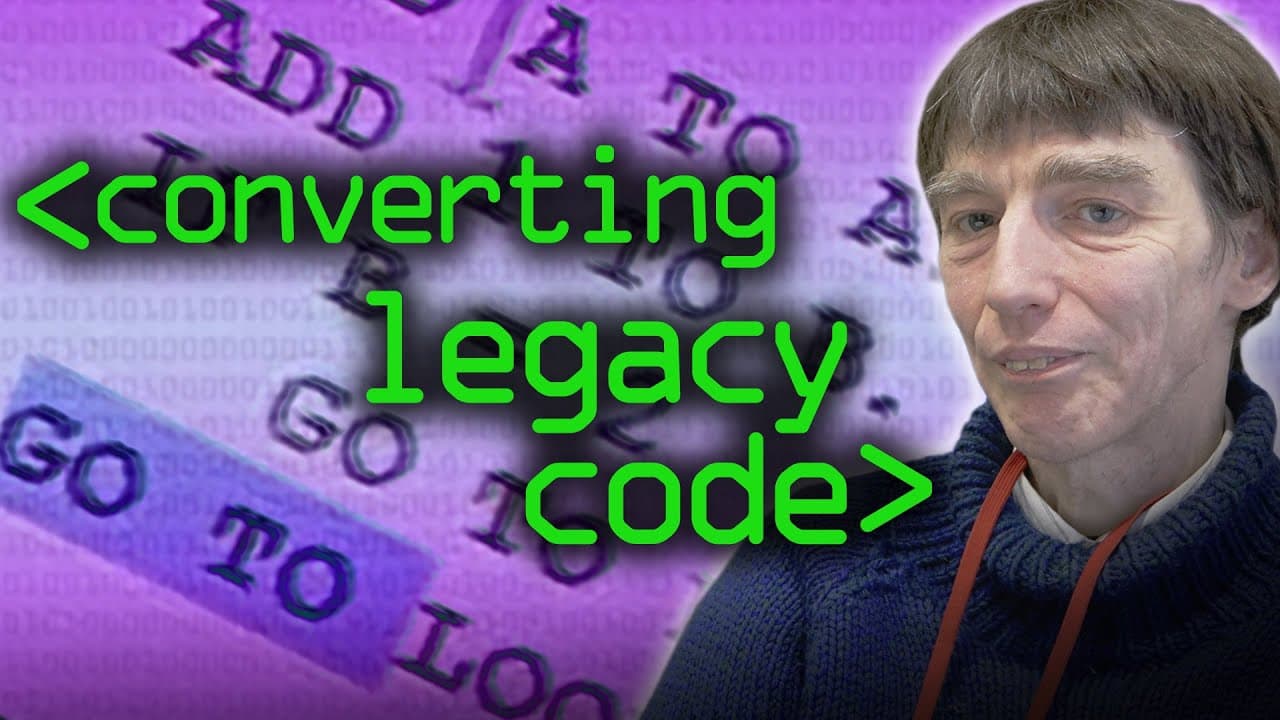
Modernising legacy code from languages like Cobol and Visual Basic involves automatic abstraction to clarify functionality, followed by forward engineering to generate equivalent code in modern languages such as Java and Python. This process addresses maintenance challenges and enhances the adaptability of critical business applications, despite the existing trust issues with new code.
Transcript
so here on on the left you've got an example of a an actual cobal program and this is the kind of structure in which you might see in Legacy cobal with lots of go-to's and it would take even a cobal expert at some time to figure out what that's doing the automatic abstraction is this it has the same functions as the previous code as the original ve... Read More
Key Insights
- 👨💻 Legacy code in languages like Cobol and Visual Basic can be challenging to maintain and understand, causing operational issues and hindering modernization efforts.
- 🥺 Financial institutions and corporations often have critical business applications locked in legacy software, leading to costly modernization endeavors.
- 👨💻 Automatic abstraction and forward engineering offer solutions to modernize legacy code by making the functionality explicit and generating code in new languages.
- 👶 Trust in the new code is a major barrier to re-engineering, but mathematical proof can provide assurance of functionality preservation.
Install to Summarize YouTube Videos and Get Transcripts
Explore YouTube Video Summarizer or Get YouTube Transcript Extractor
Questions & Answers
Q: Why is legacy code in Cobol and Visual Basic difficult to understand and maintain?
Legacy code in these languages often uses complex structures and go-to statements, making it challenging to determine the code's functionality. Additionally, frequent changes over time have made it hard for anyone to grasp the full understanding of the code.
Q: Why is it important to translate legacy code to new languages?
Legacy code in languages like Cobol and Visual Basic can be outdated, inflexible, and incompatible with modern programming environments. Translating it to new languages allows for easier maintenance, addition of new functionalities, and adaptation to evolving business environments.
Q: How does automatic abstraction help in modernizing legacy code?
Automatic abstraction makes the functionality of the code explicit, allowing it to be translated to new languages with a more structured and understandable program flow. This eliminates go-to statements and adopts a more modern procedural code structure.
Q: How does forward engineering contribute to legacy code modernization?
Forward engineering tools generate code in new languages, such as Java, Python, and Swift, based on the abstracted legacy code. This provides a better platform for future systems, allowing for easier maintenance and adaptation to changing business environments.
Summary & Key Takeaways
-
Legacy code in languages like Cobol and Visual Basic poses challenges due to its complexity and lack of understanding.
-
Automatic abstraction can make the functionality of the code explicit, allowing for easier translation to new languages.
-
Forward engineering tools can then generate code in languages like Java, Python, and Swift, providing a better platform for future systems.
Read in Other Languages (beta)
Share This Summary 📚
Summarize YouTube Videos and Get Video Transcripts with 1-Click
Try YouTube Summary with ChatGPT & Claude or YouTube Transcript Generator
Explore More Summaries from Computerphile 📚



Summarize YouTube Videos and Get Video Transcripts with 1-Click
Try YouTube Summary with ChatGPT & Claude or YouTube Transcript Generator