What Is Gas Chromatography and How Does It Work?
TL;DR
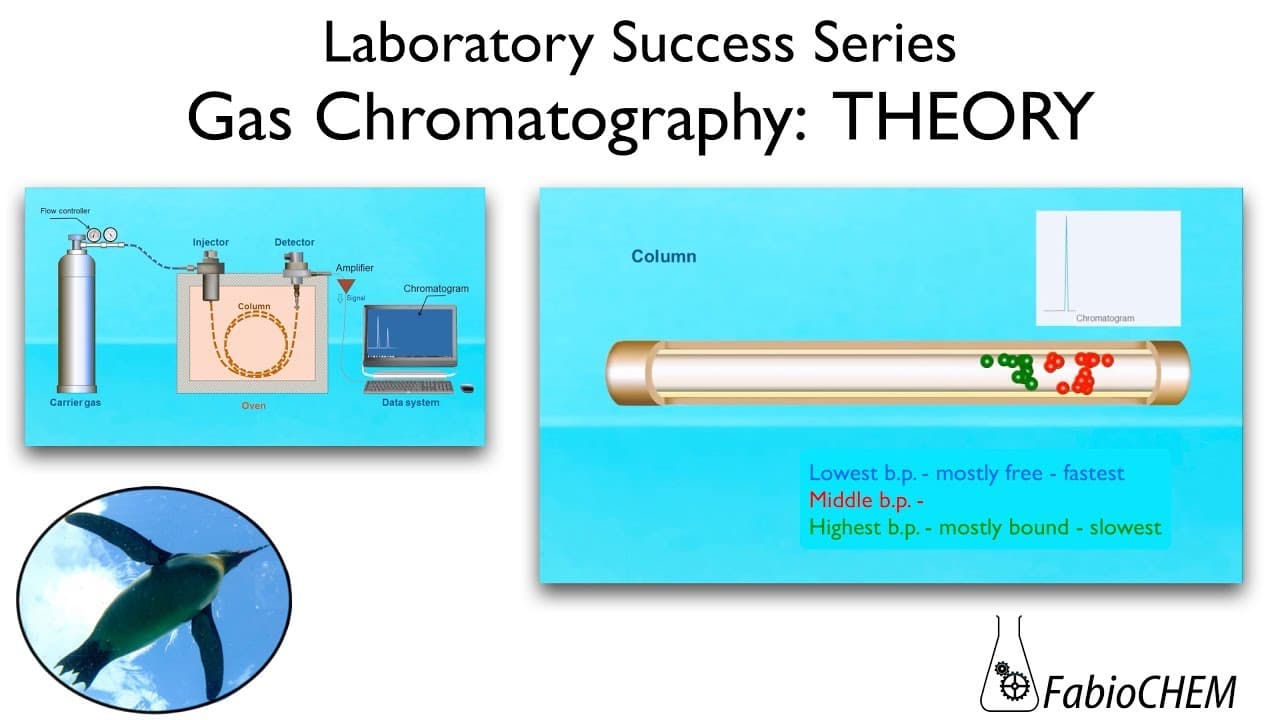
Gas chromatography is a technique that separates compounds based on their boiling points using a stationary phase (high boiling point liquid in a column) and a mobile phase (inert gas). The method produces a gas chromatogram, where retention time and peak area provide essential information about the components in the sample.
Transcript
Hello everybody and welcome to the organic chemistry lab techniques series. This video is a quick overview of the general idea behind gas chromatography. For the details on how to use a gas chromatograph, please watch the video below. Gas chromatography is a separation technique, more specifically it is a chromatographic technique like Thin Laye... Read More
Key Insights
- 🫢 Gas chromatography is a chromatographic technique that separates compounds based on their boiling points.
- 🫢 The stationary phase in gas chromatography is a high boiling point liquid bound to the inside wall of a capillary column.
- 🫢 The mobile phase in gas chromatography is an inert gas that flows through the column and carries the vaporized sample.
- 💨 Compounds with lower boiling points travel faster through the column and appear earlier in the gas chromatogram.
- 🫢 The retention time and area under the peak in a gas chromatogram provide valuable information about the compounds present in a sample.
- 🫢 Gas chromatography is widely used in various fields for compound separation, identification, purity determination, and quantitative analysis.
Install to Summarize YouTube Videos and Get Transcripts
Explore YouTube Video Summarizer or Get YouTube Transcript Extractor
Questions & Answers
Q: What is gas chromatography and how does it work?
Gas chromatography is a separation technique that uses a stationary phase and a mobile phase to separate compounds. The sample, when injected into the hot injector, vaporizes and travels down the column with the carrier gas. As the compounds go through the column, they are in equilibrium between the vapor phase and the liquid phase, bound to the stationary phase. The compounds separate based on their boiling points, with the most volatile component traveling faster and being detected first.
Q: What is the purpose of the detector in a gas chromatograph?
The detector in a gas chromatograph picks up the electrical signal generated by the compounds as they pass through it. This signal is then sent to a computer to generate a gas chromatogram, which is a plot of intensity against time. The detector allows the identification and quantification of the compounds based on their peaks in the chromatogram.
Q: What information can be obtained from a gas chromatogram?
Two main pieces of information can be obtained from a gas chromatogram: the retention time and the area under the peak. The retention time is the time it takes for a compound to travel down the column, similar to the RF value in Thin Layer Chromatography (TLC). It is a characteristic of a compound under specific experimental conditions. The area under the peak is proportional to the amount of compound that generated that peak and can be used to calculate the percent composition of a sample.
Q: How can gas chromatography be used in the lab?
Gas chromatography is a widely used technique in various fields such as chemical analysis, pharmaceutical research, environmental analysis, and forensic science. It can be used to separate and identify components in a mixture, determine the purity of a substance, analyze volatile compounds, and quantify the amount of a specific compound in a sample.
Summary & Key Takeaways
-
Gas chromatography is a chromatographic technique that relies on the partitioning of a sample between a stationary phase and a mobile phase.
-
In gas chromatography, a high boiling point liquid is bound to the inside wall of a long capillary tube called a column, which serves as the stationary phase.
-
The mobile phase in gas chromatography is an inert gas that flows through the column, carrying the vaporized sample and separating its components based on their boiling points.
Read in Other Languages (beta)
Share This Summary 📚
Summarize YouTube Videos and Get Video Transcripts with 1-Click
Try YouTube Summary with ChatGPT & Claude or YouTube Transcript Generator
Explore More Summaries from ThePenguinProf 📚


Summarize YouTube Videos and Get Video Transcripts with 1-Click
Try YouTube Summary with ChatGPT & Claude or YouTube Transcript Generator