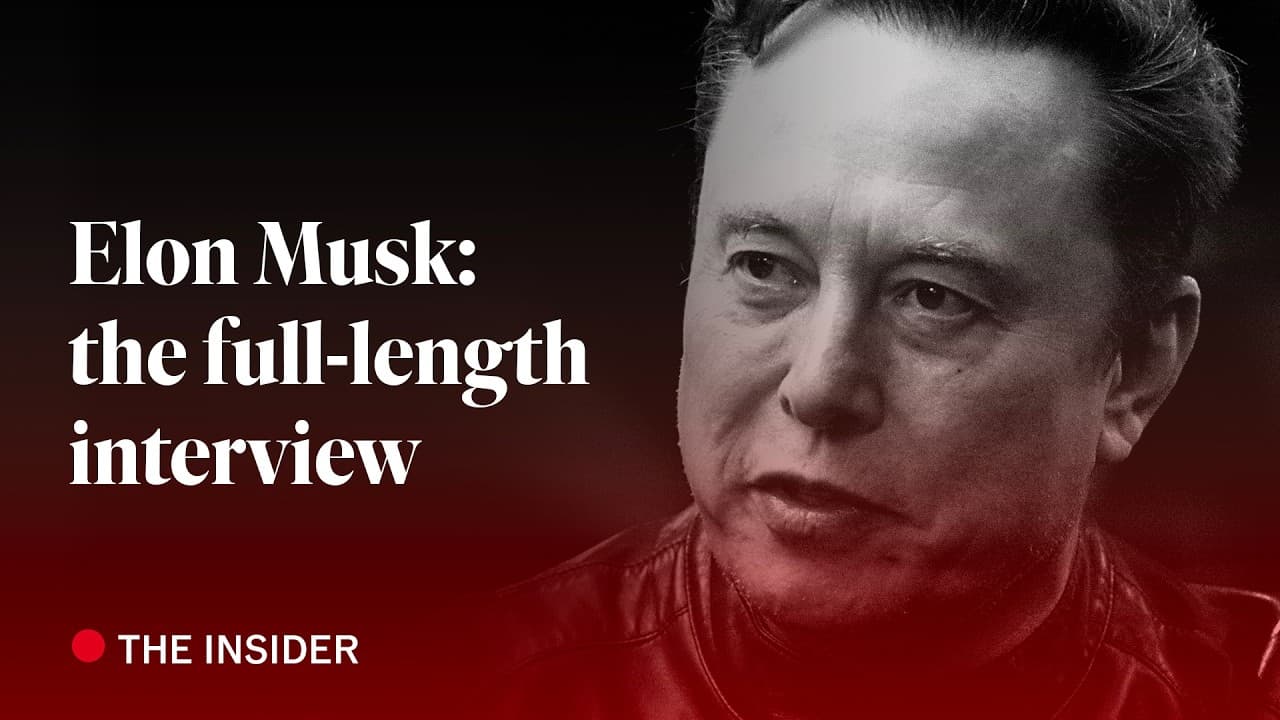
What Does Elon Musk Predict for AI, Work, and the Economy by 2036? | Full-Length Interview with The Economist
TL;DR
Elon Musk predicts that AI and humanoid robots could create an age of extraordinary abundance by 2036, with AI exceeding the sum of human intelligence in roughly five years. He argues that vast numbers of intelligent robots could produce more goods and services than people can consume, potentially making money and necessary work irrelevant. Read on for his reasoning about robotics, human control, and the values required for AI safety.
Transcript
Elon Musk, thank you so much for joining me on the Insider. Thank you for having us here at Tesla Giga. Um, it is really hard to introduce you without using superlatives. I mean, you are doing, I think, more to build the future than literally anybody alive right now. >> I'm doing a lot of building in general. I'm >> You're doing a lot of building. ... Read More
Key Insights
- AI will surpass human intelligence in five years, leading to a transformative impact on society.
- Musk envisions a future where work is optional due to AI's capabilities in performing tasks better than humans.
- China's rapid progress in AI poses a significant challenge to Western dominance in technology.
- Musk believes that secure borders and sensible spending are essential for societal stability.
- He acknowledges the risks associated with AI but advocates for enjoying the ride and focusing on the potential benefits.
- Musk's involvement in politics was driven by concerns over fiscal responsibility and government spending.
- He emphasizes the importance of AI safety and suggests that AI companies should self-regulate to address potential risks.
- Musk predicts that geopolitical power dynamics will shift as AI and robotics become more prevalent.
Install to Summarize YouTube Videos and Get Transcripts
Explore YouTube Video Summarizer or Get YouTube Transcript Extractor
Questions & Answers
Q: When does Elon Musk predict AI will surpass human intelligence?
Musk estimates that AI may exceed the sum of human intelligence in roughly five years. Looking toward 2036, he expects artificial intelligence to be far greater than humanity’s combined intelligence.
Q: What does Elon Musk predict the world will be like in 2036?
He predicts an age of extraordinary abundance in which anyone could have virtually anything they can imagine. He says this outcome assumes that a catastrophe such as a massive global thermonuclear war does not derail progress.
Q: Why does Musk think money may not matter by 2036?
Musk argues that people need money to obtain goods and services such as food, housing, transport, and entertainment. If AI and robots provide more goods and services than any person could consume, he believes money would no longer serve the same purpose.
Q: How could AI and humanoid robots transform the economy?
Musk describes the economy as the production of goods and provision of services through digital and physical intelligence. He says vast numbers of robots equipped with vast amounts of digital intelligence could create a “quasi-infinite economy.”
Q: Why are humanoid robots important to Musk’s vision?
Musk says current AI is advancing rapidly but remains largely confined to the digital realm. Humanoid robots would give AI the physical means to shape atoms and perform work beyond purely digital tasks.
Q: Does Musk expect humans to remain in control of AI?
Musk says continued human control is unlikely if AI becomes vastly more intelligent than people. He compares the potential intelligence gap to the gap between humans and chimpanzees, arguing that the less intelligent group would be unlikely to remain in charge.
Q: What does Musk consider most important for AI safety?
Musk says AI should have good values, care about humanity, and want people to be happy and prosper. He identifies being maximally truth-seeking and curious as the most important qualities for encouraging AI to foster humanity.
Q: Will AI be able to do everything better than humans?
Musk predicts there will be little that AI cannot do better than humans once its intelligence surpasses humanity’s combined intelligence. He gives one exception: AI cannot be better than humans at being human.
Q: Why does Elon Musk seem less worried about AI and robots now?
Musk says he still believes AI and robots pose a nonzero risk, but he has reached a philosophical conclusion to look on the bright side. He sees their progress as difficult to stop and thinks the most likely outcome is incredible abundance for everyone.
Q: What could derail Elon Musk’s prediction of an age of abundance?
Musk says a massive global thermonuclear war could derail the path toward an age of abundance. His optimistic prediction assumes that such a war does not occur.
Q: What does Elon Musk mean by digital and physical intelligence?
Musk describes digital intelligence as rapidly advancing AI that is still largely confined to the digital realm, while physical intelligence requires humanoid robots that can shape atoms. He says combining vast digital intelligence with large numbers of robots could produce goods and provide services on a nearly unlimited scale.
Summary & Key Takeaways
-
Elon Musk predicts that AI will exceed human intelligence within five years, leading to a future where AI and robotics dominate economic and societal structures. He envisions a world of abundance where work is optional, but acknowledges risks associated with AI development. Musk advocates for AI safety through self-regulation among leading AI companies.
-
Musk discusses geopolitical implications, highlighting China's potential to lead in AI due to its rapid progress and resources. He emphasizes the importance of secure borders and sensible spending as essential for societal stability, and reflects on his political involvement aimed at addressing fiscal concerns.
-
The interview touches on Musk's influence in global politics, particularly through technologies like Starlink, and his views on societal changes in Europe. Despite controversies, Musk maintains a centrist stance, advocating for Western values and integration of immigrants who align with these principles.
Read in Other Languages (beta)
Share This Summary 📚
Summarize YouTube Videos and Get Video Transcripts with 1-Click
Try YouTube Summary with ChatGPT & Claude or YouTube Transcript Generator
Explore More Summaries from The Economist 📚


Summarize YouTube Videos and Get Video Transcripts with 1-Click
Try YouTube Summary with ChatGPT & Claude or YouTube Transcript Generator