How Could Gaza Be Governed After the Ceasefire?
TL;DR
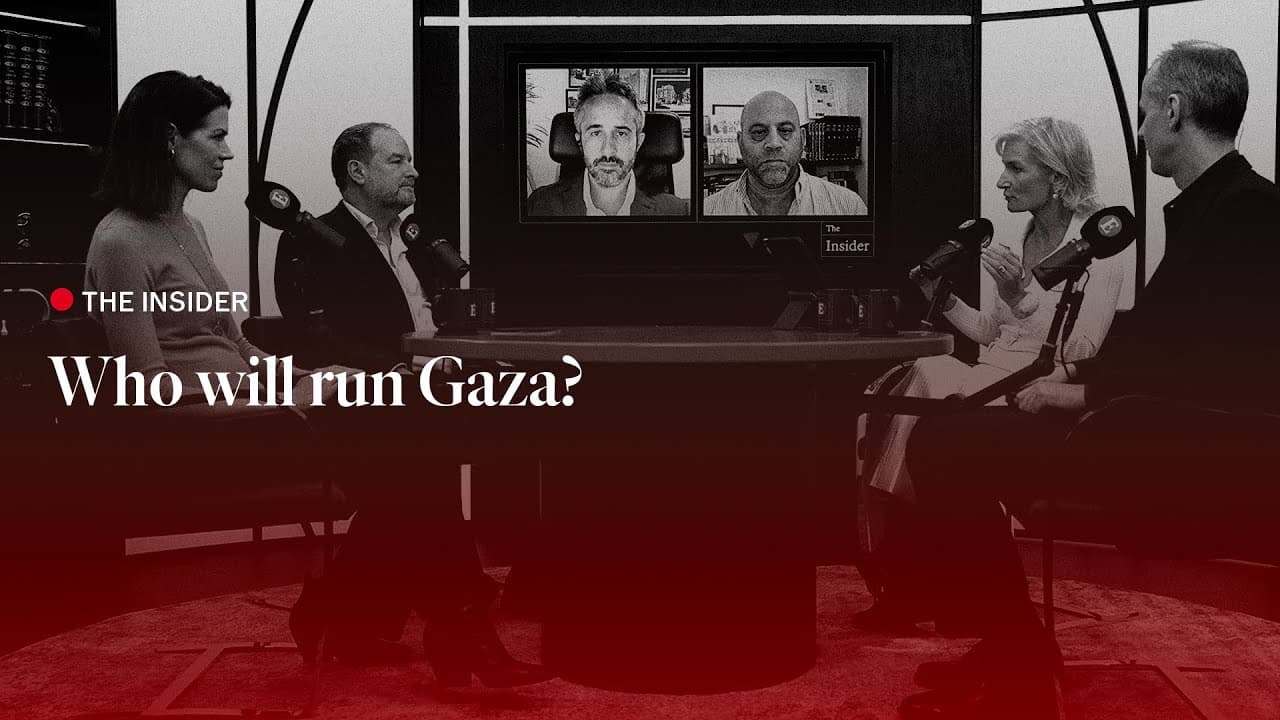
Gaza could be governed after the ceasefire by Palestinian technocrats administering daily affairs under an international board that sets strategy and approves key appointments. The plan may draw on roughly 60,000 civil servants, but disputes over Hamas’s weapons, Palestinian Authority involvement, competing employee lists, reconstruction supplies, and extensive destruction remain unresolved. Read on for how the proposed authority would work and why implementation remains uncertain.
Transcript
Whatever happens, we're going to be in for a remarkable few days, a remarkable few days, a historic few days. But then we get to the next stages of President Trump's 20 point peace plan, where I think there's quite a lot of fine print that hasn't been either agreed or really gone into detail. And the first of those is will Hamas give up its weapons... Read More
Key Insights
- Hamas is unlikely to give up all its weapons because its identity is rooted in armed resistance. Diplomats cited in the discussion believe it might surrender heavier weapons, including rocket launchers, while retaining lighter arms such as rifles, leaving a central condition of the peace plan unresolved.
- Personal safety is another reason Hamas fighters may retain weapons. Hamas is described as deeply unpopular among many Gazans who blame it for drawing the territory into two years of war, and some rank-and-file members reportedly fear reprisals once the ceasefire becomes established.
- The transitional authority is designed as an executive body of technocrats that would administer Gaza. Many officials could be recruited from the Palestinian diaspora, while roughly 60,000 civil servants are described as remaining officially on the payroll and potentially available to support day-to-day administration.
- An international board would set strategy and approve key appointments for the technocratic executive. The proposed board could include as many as ten diplomats, business figures, and financiers, with President Trump as chair and Tony Blair also involved, while reporting to the United Nations Security Council.
- Palestinian participation is essential to the authority’s legitimacy, but its form remains unresolved. Israel and Hamas both oppose a governing role for the Palestinian Authority, although Hamas says it is willing to transfer power to independent technocrats, potentially excluding the main Palestinian representative institution.
- Gaza has two competing groups of public employees that a new administration would need to reconcile. One group was hired by Hamas after it took power in 2007, while former Palestinian Authority employees were sent home and continued receiving PA salaries so they would not join Hamas-run ministries.
- The proposed process differs from the Oslo Accords by relying more heavily on outsiders during the initial stage, seeking to create space for Palestinian civil society, and assigning Arab states a potentially larger role in security and financing rather than focusing primarily on negotiations over maps and constitutions.
- Gaza’s reconstruction depends on access to building materials and equipment permitted by Israel. Although almost 80% of buildings are estimated to be badly damaged, surviving areas in central Gaza City, Khan Younis, and Deir al-Balah could serve as hubs for governance and rebuilding.
Install to Summarize YouTube Videos and Get Transcripts
Explore YouTube Video Summarizer or Get YouTube Transcript Extractor
Questions & Answers
Q: How could Gaza be governed after the ceasefire?
A transitional executive body of technocrats would administer Gaza, potentially with Palestinians recruited from the diaspora and support from existing civil servants. An international board would set strategy, approve key appointments, and report to the United Nations Security Council.
Q: Will Hamas give up its weapons under President Trump’s 20 point peace plan?
The discussion concludes that Hamas is unlikely to surrender all its weapons. Diplomats believe it might relinquish heavier weapons such as rocket launchers, but it is expected to retain lighter arms such as rifles.
Q: Why might Hamas keep lighter weapons in Gaza?
Armed resistance is central to Hamas’s identity, making full disarmament difficult ideologically. Some rank-and-file fighters also fear reprisals because many Gazans blame Hamas for drawing the territory into two years of war.
Q: How would Gaza’s technocratic transitional authority work?
The authority would function as an executive body responsible for administering Gaza. It could include technocrats from the Palestinian diaspora and work with roughly 60,000 civil servants who remain officially on the payroll.
Q: Who would oversee the proposed administration of Gaza?
A board of up to ten people, including diplomats, business figures, and financiers, would oversee the executive body. President Trump would chair it, Tony Blair would also participate, and the board would set strategy and approve key appointments.
Q: Why is Palestinian participation in Gaza’s new government uncertain?
Both Israel and Hamas oppose giving the Palestinian Authority a governing role in Gaza. Hamas says it would transfer power to independent technocrats, leaving unresolved which Palestinians would participate at senior and local levels.
Q: How could Gaza’s two civil services be reconciled?
One employee group was hired by Hamas after it took power in 2007, while former Palestinian Authority employees were sent home and continued receiving PA salaries. The proposal does not explain how these lists would be combined or what would happen to people excluded from the new administration.
Q: How does the proposed Gaza plan differ from the Oslo Accords?
The proposal gives outsiders a larger role during the initial stage instead of beginning with Palestinian rulers building institutions from the top down. It also emphasizes creating space for Palestinian civil society and involving Arab states more directly in security and financing.
Summary & Key Takeaways
-
Definition: Gaza’s proposed transitional authority is an executive body of technocrats responsible for administering the territory.
-
Number: Roughly 60,000 civil servants remain officially on Gaza’s payroll and could support daily administration.
-
Who: Palestinian technocrats, including possible recruits from the diaspora, would serve in the executive authority.
-
Who: President Trump would chair the international board, and Tony Blair would also participate.
-
Number: The oversight board could include up to ten people drawn from diplomacy, business, and finance.
-
Tool: The board would set strategy, approve key appointments, and report to the United Nations Security Council.
-
Compare: Hamas may relinquish heavier weapons such as rocket launchers but is expected to retain lighter arms such as rifles.
-
When: Hamas hired one civil-service group after taking power in 2007, while former Palestinian Authority employees continued receiving PA salaries.
-
Compare: Unlike the Oslo process, the proposal gives outsiders a larger initial role while Palestinian civil society develops from the ground up.
-
Number: Almost 80% of Gaza’s buildings are estimated to be badly damaged, making reconstruction and access to materials central challenges.
Read in Other Languages (beta)
Share This Summary 📚
Summarize YouTube Videos and Get Video Transcripts with 1-Click
Try YouTube Summary with ChatGPT & Claude or YouTube Transcript Generator
Explore More Summaries from The Economist 📚




Summarize YouTube Videos and Get Video Transcripts with 1-Click
Try YouTube Summary with ChatGPT & Claude or YouTube Transcript Generator