How Is AI Revolutionising Protein Folding Research?
TL;DR
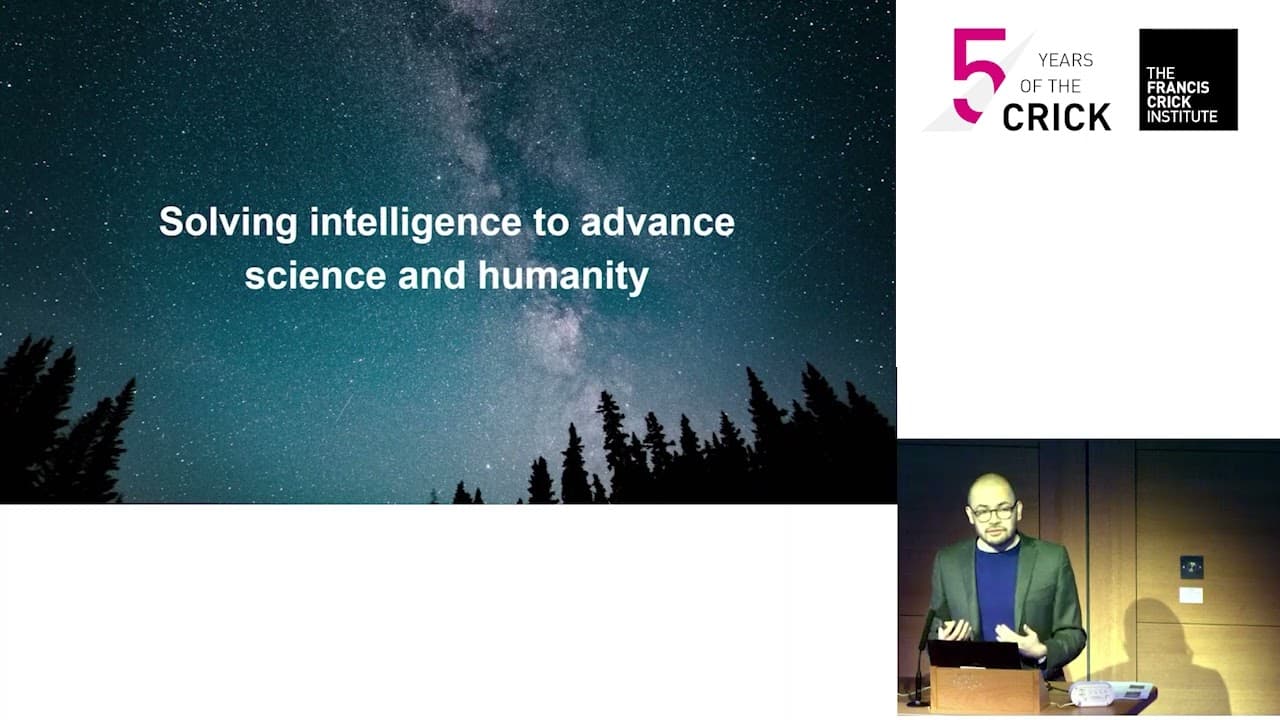
AI, particularly through DeepMind's AlphaFold, is transforming the prediction of protein structures, which is vital for advancements in molecular biology. Demis Hassabis discusses the intersection of artificial intelligence and biology, emphasizing the significance of integrating information management and biological mechanics for future scientific discoveries.
Transcript
hello well welcome everybody it's almost normal almost but when i look around the room and see all these masks isn't quite normal but this is the start of normality so let's celebrate it and we've got a great start with demis hacibus who um all of you will have heard the name and i'm going to put a little bit of color to the name because he has got... Read More
Key Insights
- 🥺 Demis Hassabis's career spans chess, game design, and AI, culminating in leading DeepMind's innovative research.
- 😷 AI's application in protein folding through AlphaFold marks a paradigm shift in predicting molecular structures and has broad implications for medical research and biotechnology.
- 🎰 The synergy between machine learning and evolutionary biology is crucial for enhancing the accuracy of protein structure predictions.
- 🧑🔬 AlphaFold's success highlights the need for interdisciplinary collaboration between computer scientists, biologists, and chemists to address complex scientific challenges.
- 😒 Understanding machine learning models' decision-making processes is vital for building trust and ensuring ethical AI use in sensitive applications such as healthcare.
- ❓ The future of AI in biology may involve tackling dynamic modeling and simulating cellular processes, moving beyond static predictions to more holistic biological insights.
- 🛄 DeepMind aims to navigate ethical considerations proactively, acknowledging the potential risks associated with AI technology in society.
- 🎙️ More videos with Demis Hassabis:
Install to Summarize YouTube Videos and Get Transcripts
Explore YouTube Video Summarizer or Get YouTube Transcript Extractor
Questions & Answers
Q: How did Demis Hassabis become involved in AI and DeepMind?
Demis began his journey as a chess prodigy at age 13, later transitioning to game design. His academic background in computer science and neuroscience led him to co-found DeepMind in 2010, aiming to pursue artificial general intelligence (AGI) for scientific advancements.
Q: What are some key achievements of AlphaFold?
AlphaFold has made significant strides in accurately predicting protein structures, achieving atomic-level accuracy in its predictions during the CASP14 competition, surpassing other methods and revolutionizing the field of protein folding.
Q: How does AlphaFold utilize evolutionary data in its predictions?
AlphaFold incorporates evolutionary information through multiple sequence alignments, allowing it to recognize patterns in protein sequences that are indicative of their structural properties, thus enhancing prediction accuracy.
Q: What challenges does AlphaFold face in predicting protein dynamics?
While AlphaFold excels at static protein structures, it faces challenges in capturing dynamic processes such as protein folding intermediates and interactions with molecular chaperones, which are essential for understanding functional biology accurately.
Q: How does DeepMind address the ethical concerns surrounding AI applications?
DeepMind emphasizes the importance of ethics in AI development by prioritizing diverse input in system design, conducting research on biases, and working collaboratively with stakeholders to ensure responsible AI deployment in various sectors.
Q: What future directions does Hassabis envision for AI in biology?
Hassabis envisions a future where AI contributes to understanding complex biological systems, including dynamic interactions in living cells and the potential for full virtual cell simulations to assist in scientific discoveries.
Summary & Key Takeaways
-
Demis Hassabis shares his journey from chess prodigy to leading DeepMind, focusing on the development of AI technologies for biological challenges.
-
The talk emphasizes how AI, especially AlphaFold, revolutionizes protein folding predictions, impacting molecular biology and scientific discovery.
-
Hassabis discusses the significance of understanding both biological mechanics and information management for future advancements in life sciences.
Read in Other Languages (beta)
Share This Summary 📚
Summarize YouTube Videos and Get Video Transcripts with 1-Click
Try YouTube Summary with ChatGPT & Claude or YouTube Transcript Generator
Explore More Summaries from Google DeepMind 📚

Summarize YouTube Videos and Get Video Transcripts with 1-Click
Try YouTube Summary with ChatGPT & Claude or YouTube Transcript Generator