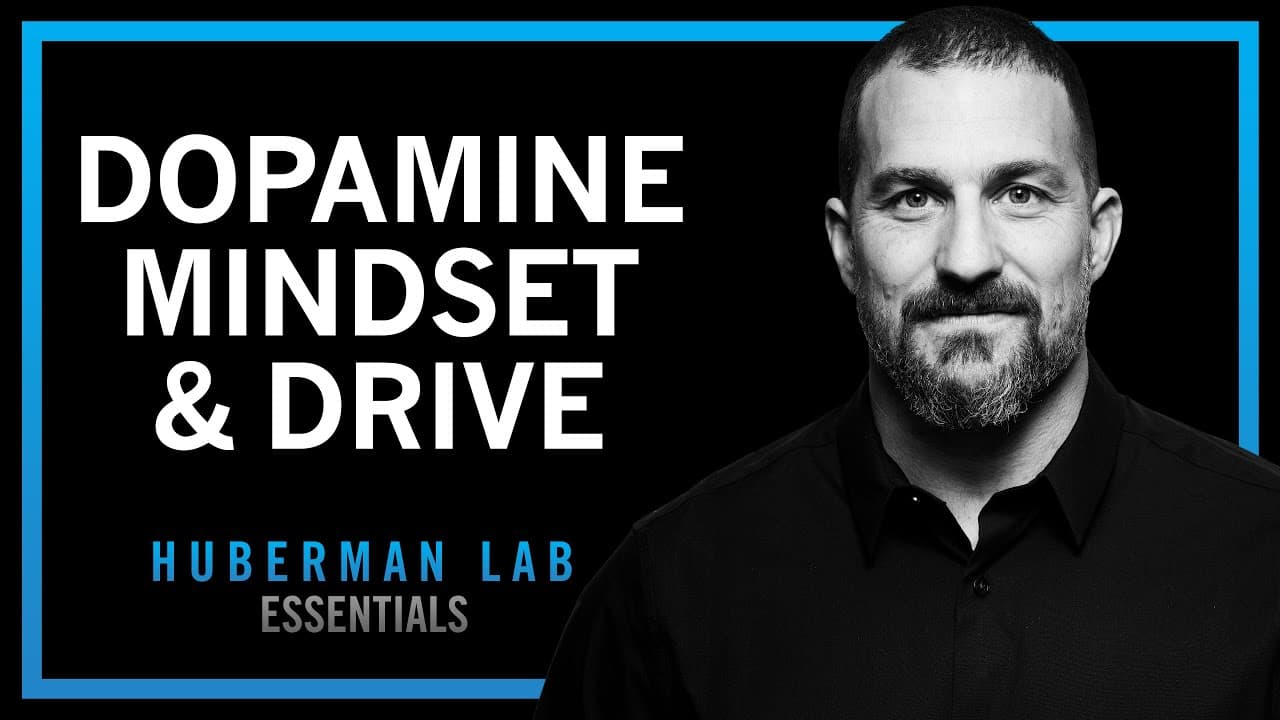
How Can You Control Dopamine for Motivation, Focus & Satisfaction? | Huberman Lab Essentials
TL;DR
Controlling dopamine for lasting motivation means managing peaks relative to your recent baseline and learning to value effort itself. Andrew Huberman explains that chocolate raises dopamine 1.5 times above baseline, sex raises it two times, and smoked nicotine raises it two and a half times, while repeated rewarding experiences can increase the threshold for enjoyment. Read on for practical explanations of dopamine, cold exposure, reward timing, and motivation.
Transcript
Welcome to Huberman Lab Essentials, where we revisit past episodes for the most potent and actionable science-based tools for mental health, physical health, and performance. I'm Andrew Huberman, and I'm a professor of neurobiology and opthalmology at Stamford School of Medicine. Today we are going to talk all about dopamine and what drives you to ... Read More
Key Insights
- Dopamine is a neuromodulator influencing motivation, drive, and craving.
- Dopamine levels affect time perception and can prevent addiction.
- Dopamine is crucial for movement; its depletion leads to diseases like Parkinson's.
- Two main neural circuits use dopamine: one for movement, another for motivation.
- Activities like sex, nicotine, and drugs significantly increase dopamine levels.
- Dopamine's baseline and peaks govern motivation and addiction tendencies.
- Cold exposure can sustainably increase dopamine, enhancing focus and calm.
- Effort-based rewards and growth mindset help maintain healthy dopamine levels.
Install to Summarize YouTube Videos and Get Transcripts
Explore YouTube Video Summarizer or Get YouTube Transcript Extractor
Questions & Answers
Q: How can you control dopamine for motivation and focus?
Pay attention to dopamine peaks and how they compare with your recent baseline, because that relationship shapes motivation, drive, and the desire to pursue goals. Avoid repeatedly chasing large peaks, and emphasize effort-based rewards so the work itself becomes rewarding. Cold exposure can also produce a sustained dopamine increase associated with focus and calm.
Q: How does dopamine influence motivation, drive, and craving?
Dopamine is a neuromodulator that changes the probability that particular neural circuits will become active or inactive. It encourages people to look outside themselves, pursue goals, and crave things. Motivation depends on the amount of dopamine present relative to the recent level.
Q: How do dopamine peaks and baseline levels affect motivation?
Your experience and motivation depend on current dopamine relative to your recent dopamine experience. Repeatedly engaging in something enjoyable raises the threshold for enjoyment, so the same activity can become less satisfying. High peaks followed by drops below baseline can also reduce motivation and contribute to addictive patterns.
Q: Which activities or substances increase dopamine above baseline?
Chocolate raises dopamine to 1.5 times baseline, while pursuing or having sex raises it two times. Smoked nicotine raises it two and a half times above baseline, although that increase is very short-lived. Cocaine and amphetamine also produce high dopamine peaks.
Q: How does cold exposure affect dopamine and focus?
Cold exposure can raise dopamine gradually and sustainably, reaching up to two and a half times above baseline. This sustained increase can enhance focus and calm while supporting a higher dopamine baseline. It differs from the brief peak described for smoked nicotine.
Q: Why can repeatedly chasing dopamine peaks reduce satisfaction?
Repeated enjoyable experiences can push the threshold for enjoyment higher and higher. As a result, more stimulation may be needed to produce the same subjective experience. Avoiding constant high peaks helps preserve motivation and satisfaction.
Q: How do effort-based rewards support healthy dopamine management?
Effort-based rewards promote intrinsic motivation by making the effort itself feel rewarding. Focusing on effort instead of only the outcome can reduce reliance on large reward-driven dopamine spikes. This approach supports a growth mindset, motivation, and satisfaction.
Q: Why is dopamine important for movement as well as motivation?
The brain has two main dopamine circuits: one primarily related to movement and another related to reward, reinforcement, and motivation. Depletion or death of dopamine neurons in Parkinson's and Lewy body dementia can cause shaky movement, difficulty speaking, and problems initiating movement. Because dopamine also affects mood and motivation, depletion can accompany reduced motivation and depression.
Summary & Key Takeaways
-
Dopamine regulates motivation, focus, and satisfaction. Understanding dopamine fluctuations can optimize motivation and well-being. Techniques like cold exposure, caffeine, and effort-based rewards help manage dopamine levels. Avoiding constant high dopamine peaks prevents addiction and maintains motivation.
-
Dopamine is a neuromodulator influencing motivation and craving. It affects time perception and can prevent addiction. Two neural circuits use dopamine: one for movement, another for motivation. Activities like sex, nicotine, and drugs increase dopamine levels significantly.
-
Cold exposure sustainably increases dopamine, enhancing focus and calm. Effort-based rewards and growth mindset maintain healthy dopamine levels. Avoiding constant high dopamine peaks prevents addiction and maintains motivation. Social connections also stimulate dopamine pathways.
Read in Other Languages (beta)
Share This Summary 📚
Summarize YouTube Videos and Get Video Transcripts with 1-Click
Try YouTube Summary with ChatGPT & Claude or YouTube Transcript Generator
Explore More Summaries from Andrew Huberman 📚





Summarize YouTube Videos and Get Video Transcripts with 1-Click
Try YouTube Summary with ChatGPT & Claude or YouTube Transcript Generator