Should You Buy the Mac Mini for Local AI?
TL;DR
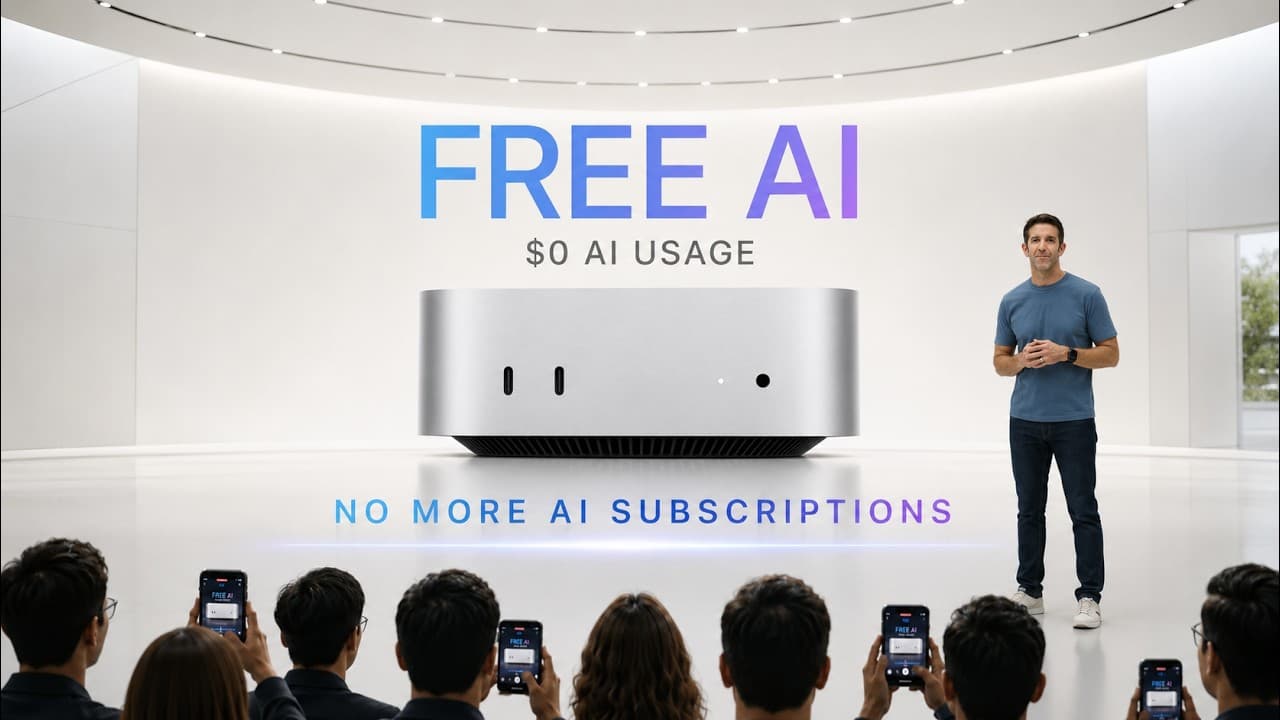
Buy the Mac Mini M4 Pro for efficient, private local inference and always-on agent workflows, but choose an AMD system when maximum model capacity per dollar matters more. The recommended Mac configuration has 48 GB of unified memory, yet demanding models remain slow or cannot fit, and a rumored M5 Mini makes waiting potentially worthwhile.
Transcript
Last time we cracked open a $2,000 AMD box and killed a Chad GPD subscription with it. Today I'm swapping it for this, the Mac Mini M4 Pro. Same promise, different silicon, and honestly, a completely different verdict. If you watch the AMD Stricks Halo video, you already know the pitch. You stop paying $20 a month per AI subscription. You run the m... Read More
Key Insights
- The Mac Mini M4 Pro provides 273 GB per second of memory bandwidth, not the 550 GB per second figure frequently attributed to it. The higher figure belongs to the M4 Max, so confusing the chips creates unrealistic expectations for Mac Mini inference performance.
- The practical local AI configuration is the Mac Mini M4 Pro with 48 GB of unified memory. Configurations below that level impose too many restrictions on which models can load, while Apple has removed the previously available 64 GB memory option.
- The Mac Mini M4 Pro draws between 30 and 65 watts during real inference workloads. That efficiency makes it particularly attractive for continuous agent loops, background task queues, database updates, and other workloads that may operate throughout the day and night.
- The Mac Mini performs best with smaller and mixture-of-experts models. Models in the 7 to 8 billion parameter range reach 20 to 30 tokens per second, while Qwen 3 30B A3B reaches 40 to 75 tokens per second and performs well on coding and reasoning.
- The 48 GB memory ceiling prevents the Mac Mini from serving every large model. Models with 70 billion parameters run at only 3 to 5 tokens per second, and GPT-OSS 120B requires at least 60 GB of unified memory, so it cannot load.
- The AMD Strix Halo system offers stronger memory value and larger-model capacity. Its 128 GB of unified memory costs less per gigabyte than the Mac Mini, and the tested system ran GPT-OSS 120B at 34 tokens per second while the Mac Mini could not load it.
- The Mac Mini earns its premium through efficiency and software rather than raw memory value. It costs more per gigabyte than the compared AMD systems, but its measured bandwidth, compact design, and suitability for isolated, always-on inference distinguish it from larger GPU towers.
- The purchase timing is uncertain because an M5 Mini is rumored for October or November 2026. The report also says Apple may skip higher-tier M6 chips and move directly toward M7, so buyers should weigh immediate needs against potentially significant upcoming hardware changes.
Install to Summarize YouTube Videos and Get Transcripts
Explore YouTube Video Summarizer or Get YouTube Transcript Extractor
Questions & Answers
Q: How well does the Mac Mini M4 Pro run local AI models?
The Mac Mini M4 Pro runs small and mid-sized local models at practical speeds. Models with 7 to 8 billion parameters reach 20 to 30 tokens per second, while 14 billion parameter models reach 10 to 20 tokens per second. Dense models around 30 to 32 billion parameters remain workable, and mixture-of-experts models such as Qwen 3 30B A3B feel especially responsive.
Q: How much memory does a Mac Mini need for serious local AI?
The recommended Mac Mini configuration for serious local AI work has 48 GB of unified memory. Lower-memory configurations create substantial restrictions on which models can load and how much context or supporting software can run alongside them. Apple removed the 64 GB option, so buyers who need more capacity must consider a different Mac or an alternative system with greater unified memory.
Q: What is the correct memory bandwidth of the Mac Mini M4 Pro?
The Mac Mini M4 Pro provides 273 GB per second of memory bandwidth. The commonly repeated figure of 550 GB per second, or 546 GB per second more precisely, belongs to the M4 Max rather than the M4 Pro installed in the Mac Mini. Using the M4 Max figure when evaluating the Mini substantially overstates its available bandwidth.
Q: Can the Mac Mini M4 Pro run 70B and 120B AI models?
A 70 billion parameter model can run on the 48 GB Mac Mini M4 Pro, but performance falls to roughly 3 to 5 tokens per second, making responses feel slow. GPT-OSS 120B does not fit because it requires at least 60 GB of unified memory. Buyers focused on that class of model need a higher-memory Mac or an AMD alternative.
Q: Why is the Mac Mini useful as an always-on AI server?
The Mac Mini is useful as an always-on AI server because it combines local data processing with low power consumption. Under real inference workloads, it draws between 30 and 65 watts. It can remain isolated from a primary computer while running agent loops, handling tool calls, processing queued tasks, and writing results to a database throughout the night.
Q: Is an AMD Strix Halo system better than the Mac Mini for local AI?
An AMD Strix Halo system is better when memory capacity and large-model performance are the main priorities. The compared system includes 128 GB of unified memory and ran GPT-OSS 120B at 34 tokens per second, while the 48 GB Mac Mini could not load that model. The Mac Mini is more compelling when power efficiency, measured bandwidth, and its software environment matter more.
Q: Should buyers wait for the rumored M5 Mac Mini?
Waiting may be sensible for buyers who do not need a local AI server immediately. The M5 Mini is rumored for October or November 2026, although that timing remains unconfirmed. Existing M5 results cited in the source show meaningful MLX performance improvements on M5 Max hardware, but the exact specifications and performance of an M5 Mini have not been confirmed.
Q: Can a Mac Mini replace paid AI subscriptions?
A Mac Mini can replace some paid AI subscriptions when the required tasks are supported by models that fit within its memory. Local inference keeps prompts on the machine and removes per-token or monthly service charges for those workloads. It is not a complete replacement when users require very large models, hosted media tools, or capabilities unavailable in the selected local software.
Summary & Key Takeaways
-
The Mac Mini M4 Pro is presented as a compact local AI server that keeps prompts on the machine and avoids recurring AI service fees. Its strongest qualities are practical inference speed on smaller models, low power consumption under sustained workloads, and software support that makes it suitable for private assistants and automated agent tasks.
-
Its main limitation is memory capacity. The recommended 48 GB configuration handles smaller and mid-sized models well, but 70 billion parameter models become noticeably slow, while GPT-OSS 120B does not fit. AMD systems provide substantially more unified memory per dollar and are therefore better suited to very large local models.
-
The buying decision depends heavily on timing and workload. Apple raised Mac Mini M4 Pro prices and removed the 64 GB option, weakening its value. A rumored M5 Mini could arrive in October or November 2026, while reported M7 plans suggest much larger future gains, making an immediate purchase difficult to recommend universally.
Read in Other Languages (beta)
Share This Summary 📚
Summarize YouTube Videos and Get Video Transcripts with 1-Click
Try YouTube Summary with ChatGPT & Claude or YouTube Transcript Generator
Explore More Summaries from AI Master 📚




Summarize YouTube Videos and Get Video Transcripts with 1-Click
Try YouTube Summary with ChatGPT & Claude or YouTube Transcript Generator