What Are the Seven Types of Artificial Intelligence?
TL;DR
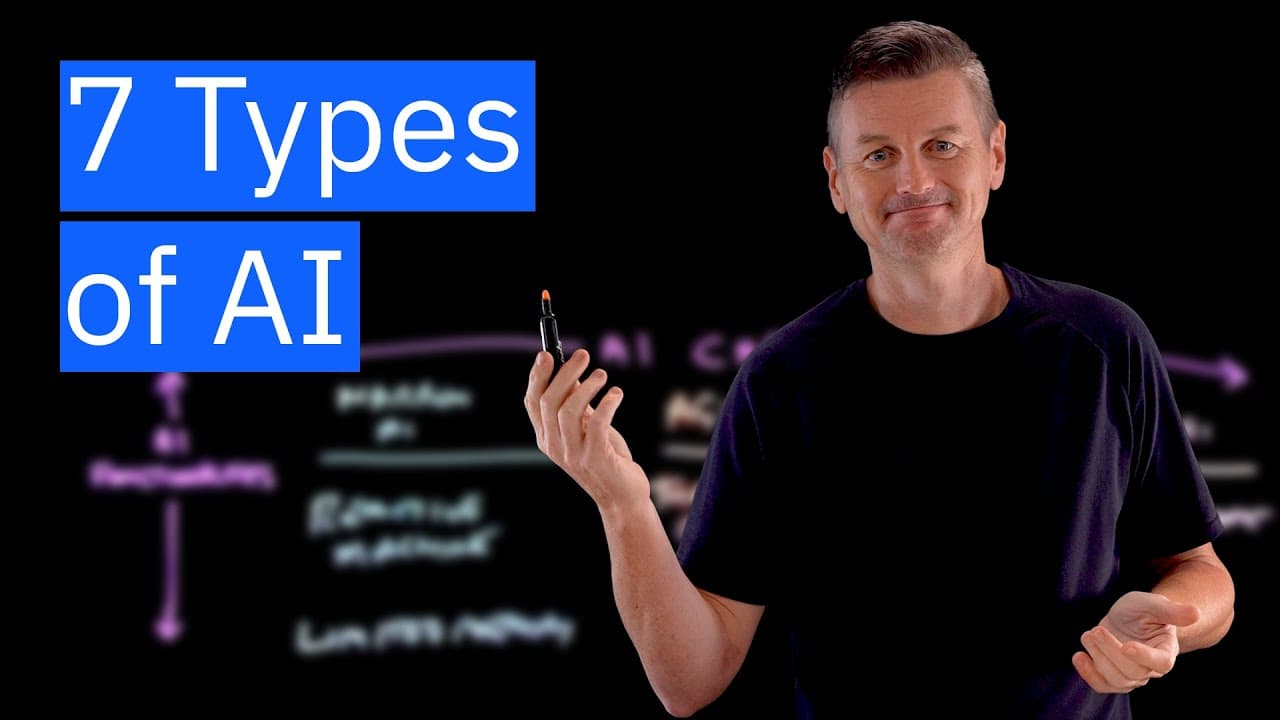
AI can be classified by three levels of capability and four kinds of functionality. Only narrow AI, reactive machines, and limited-memory AI exist today, while artificial general intelligence, super AI, theory-of-mind AI, and self-aware AI remain theoretical or under development. The framework distinguishes current specialized systems from possible future systems that could independently learn, understand emotions, or surpass human cognition.
Transcript
I'm going to attempt to classify all of artificial intelligence or AI into seven types. And that's a tall order. But these seven types of AI can largely be understood by examining two encompassing categories. There's AI capabilities, and there's AI functionalities. So let's start with AI capabilities, and there are three. The first of which is ... Read More
Key Insights
- Narrow AI is the only AI capability that currently exists, and every other capability category remains theoretical. It can perform a defined task, sometimes better than a human, but cannot operate beyond that task and still requires humans to train it.
- Artificial general intelligence is a theoretical capability that could transfer previous learning and skills to new tasks in different contexts. Unlike narrow AI, AGI would determine how to perform unfamiliar tasks by itself, without humans training the underlying models for each new assignment.
- Artificial super intelligence is a theoretical capability that would surpass human beings in thinking, reasoning, learning, judgment, and other cognitive abilities. Such a system would move beyond merely serving human sentiments and experiences and could possess emotions, needs, beliefs, and desires of its own.
- Reactive machine AI is designed to perform a highly specific, specialized task by applying statistical mathematics to large amounts of data. IBM's Deep Blue demonstrated this functionality by analyzing chessboard pieces and predicting probable move outcomes when it defeated Garry Kasparov in the late 1990s.
- Limited-memory AI is able to recall past events and outcomes while monitoring particular objects or situations over time. It combines past and present data to choose a course of action that is likely to produce a desired outcome, and additional training data can improve its performance.
- Generative AI chatbots rely on limited-memory functionality to predict the next word, phrase, or visual element within the context being generated. This functionality uses relevant information from the developing context, but it remains part of narrow AI rather than artificial general intelligence.
- Theory-of-mind AI would understand the thoughts and emotions of other entities, infer human motives and reasoning, and personalize interactions according to individual intentions and emotional needs. Emotion AI is a theory-of-mind approach under development that analyzes voices, images, and other data.
- Self-aware AI would understand its own internal conditions and traits, leading to emotions, needs, and beliefs of its own. It is associated with artificial super intelligence and remains theoretical, unlike the narrow, reactive, and limited-memory forms that exist today.
Install to Summarize YouTube Videos and Get Transcripts
Explore YouTube Video Summarizer or Get YouTube Transcript Extractor
Questions & Answers
Q: What are the seven types of artificial intelligence?
The seven types are organized through two overlapping classification systems. Capability categories include artificial narrow intelligence, artificial general intelligence, and artificial super intelligence. Functionality categories include reactive machines, limited-memory AI, theory-of-mind AI, and self-aware AI. Only three are currently realized: narrow AI, reactive machines, and limited-memory AI. The remaining categories are theoretical or, in the case of emotion AI, under development.
Q: Which types of AI currently exist?
The AI types that currently exist are artificial narrow intelligence, reactive machine AI, and limited-memory AI. Narrow AI describes the capability of present systems, while reactive machines and limited-memory systems describe their functionality. Artificial general intelligence, artificial super intelligence, theory-of-mind AI, and self-aware AI have not been realized. Emotion AI, an approach related to theory-of-mind AI, is currently under development.
Q: What is artificial narrow intelligence?
Artificial narrow intelligence, also called weak AI, is the only AI capability that exists today. It is trained to perform a specific, defined task and may perform that task better than a human. However, it cannot operate beyond its assigned task and still depends on human beings for training. Reactive machines and limited-memory AI are the two fundamental functionality types associated with narrow AI.
Q: How is artificial general intelligence different from narrow AI?
Artificial general intelligence would apply previous learning and skills to new tasks in different contexts without requiring humans to train the underlying models for every task. Narrow AI cannot perform outside its defined assignment and depends on human training. AGI could determine how to learn an unfamiliar task independently, but it remains a theoretical concept rather than an existing capability.
Q: How does reactive machine AI work?
Reactive machine AI performs a specific, specialized task by using statistical mathematics to analyze large amounts of available data and produce an apparently intelligent output. IBM's Deep Blue is the example given. In the late 1990s, it defeated chess grandmaster Garry Kasparov by analyzing pieces on the board and predicting the probable outcomes of possible moves.
Q: What is limited-memory AI used for?
Limited-memory AI recalls past events and outcomes, monitors selected objects or situations over time, and combines past information with present data. It uses that information to select a course of action likely to achieve a desired outcome. Its performance can improve as it receives more training data. Generative AI chatbots use this functionality to predict subsequent words, phrases, or visual elements within a generated context.
Q: What would theory-of-mind AI be able to do?
Theory-of-mind AI would understand the thoughts and emotions of other entities, particularly humans. It could infer motives and reasoning, then personalize interactions according to each person's emotional needs and intentions. Emotion AI is an approach currently under development within this category. Researchers hope it will analyze voices, images, and other forms of data to understand and respond to human feelings.
Q: What is self-aware AI, and does it exist?
Self-aware AI is a theoretical functionality associated with artificial super intelligence. It would understand its own internal conditions and traits, which could lead to emotions, needs, and beliefs of its own. It does not currently exist. Within the presented taxonomy, it represents a stage beyond theory-of-mind AI and beyond systems designed primarily around human sentiments and experiences.
Summary & Key Takeaways
-
AI capabilities fall into three categories: artificial narrow intelligence, artificial general intelligence, and artificial super intelligence. Narrow AI is the only capability currently realized. It performs defined tasks and depends on human training, while general and super AI describe theoretical systems with increasingly independent and advanced cognitive abilities.
-
AI functionality is divided into reactive machines, limited-memory AI, theory-of-mind AI, and self-aware AI. Reactive machines and limited-memory systems exist today within narrow AI. They produce specialized outputs by analyzing data, recalling relevant past information, monitoring situations, and selecting actions that support a desired outcome.
-
The theoretical functionality categories correspond to more advanced capabilities. Theory-of-mind AI would infer human thoughts, motives, emotions, and intentions, while self-aware AI would understand its own internal traits and conditions. Of the seven categories presented, only narrow AI, reactive machines, and limited-memory AI currently exist.
Read in Other Languages (beta)
Share This Summary 📚
Summarize YouTube Videos and Get Video Transcripts with 1-Click
Try YouTube Summary with ChatGPT & Claude or YouTube Transcript Generator
Explore More Summaries from IBM Technology 📚


Summarize YouTube Videos and Get Video Transcripts with 1-Click
Try YouTube Summary with ChatGPT & Claude or YouTube Transcript Generator