How Microsoft's MAI-Image-1 Changes AI Images
TL;DR
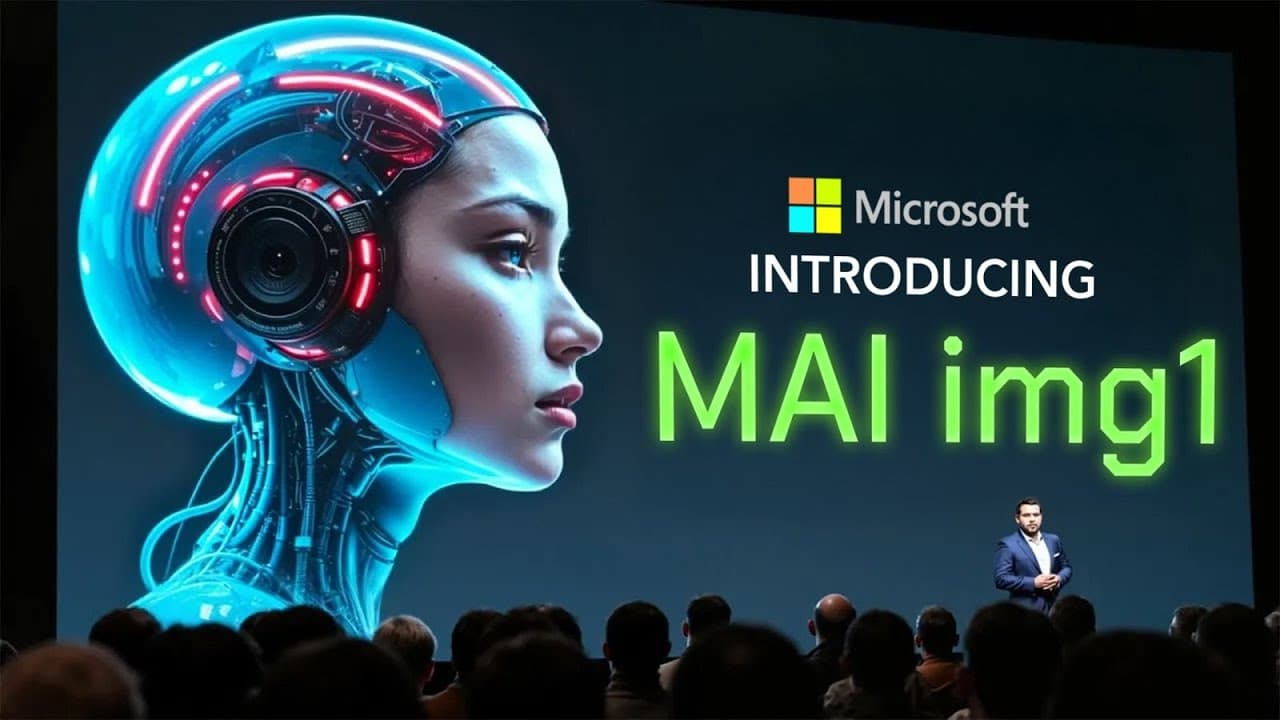
Microsoft’s MAI-Image-1 changes AI image generation by giving Microsoft its first fully in-house text-to-image model, optimized for authentic photorealism and rapid creative iteration. Already ranked among the top 10 image models on LM Arena, it emphasizes complex lighting, bounce reflections, landscapes, and natural textures. Read on to see how it works, where it may appear, and how Microsoft is testing it.
Transcript
So, Microsoft just shocked everyone with its first in-house image generator. Google slipped its nano banana model straight into search. Ant group out of China launched a trillion parameter open-source giant to take on open AI and deepseek. And then Google came back again with a complete overhaul of voice search, removing text entirely from the proc... Read More
Key Insights
- Microsoft’s MAI-Image-1 is the company’s first text-to-image model developed completely in-house. It extends Microsoft’s MAI model family into visual generation and signals a strategy of building proprietary systems instead of depending exclusively on external AI partners.
- MAI-Image-1 is designed to produce authentic-looking visuals rather than repetitive or overly stylized images. Microsoft focused on careful data selection, evaluation methods, and input from creative industry experts so that its training and testing would better reflect professional creative work.
- MAI-Image-1 excels at photorealistic imagery according to Microsoft’s description, particularly complex lighting, bounce reflections, landscapes, and natural textures. The model also prioritizes low latency and rapid iteration, allowing creators to generate several images quickly and continue refining them with editing tools.
- MAI-Image-1 is undergoing public comparison and voting on LM Arena, where it ranked among the top 10 image models. Microsoft is using this testing stage to evaluate outputs and tune safety safeguards before introducing the model into Copilot and Bing Image Creator.
- Google’s Nano Banana integration places image generation inside Search through Lens and AI Mode. Users can select the create option to generate or transform images without leaving the search flow, while SynthID applies visible and invisible watermarks to identify AI-generated content.
- Ant Group’s Ling-1T is an open-source model with one trillion parameters, built for complex reasoning, mathematics, coding, and general software intelligence. The transcript reports approximately 70.4 percent accuracy on named coding and mathematics benchmarks, using more than 4,000 output tokens for each problem.
- Google’s speech-to-retrieval system converts spoken queries directly into mathematical representations of meaning. A dual-encoder design embeds both voice input and web documents, allowing the system to match intended meaning without relying on an intermediate text transcript.
- Speech-to-retrieval outperformed the traditional speech-to-text approach in Google’s tests across 17 languages. The findings indicated that lower transcription errors do not always produce better search results, supporting a shift from exact transcript accuracy toward accurate retrieval of the user’s intent.
Install to Summarize YouTube Videos and Get Transcripts
Explore YouTube Video Summarizer or Get YouTube Transcript Extractor
Questions & Answers
Q: What is Microsoft MAI-Image-1?
MAI-Image-1 is Microsoft’s first text-to-image model built completely in-house. It extends the company’s MAI lineup into visual generation and is designed to create authentic-looking images quickly.
Q: How does MAI-Image-1 change Microsoft’s AI strategy?
Microsoft previously relied heavily on partners such as OpenAI for its generative models. Building MAI-Image-1 internally signals that Microsoft wants to develop more of its own systems and compete directly in image generation.
Q: What kinds of images does MAI-Image-1 generate well?
Microsoft says MAI-Image-1 excels at photorealistic visuals, especially complex lighting, bounce reflections, landscapes, and natural textures. Its training and evaluation focused on avoiding repetitive, overly stylized, or generic-looking output.
Q: How fast is Microsoft MAI-Image-1?
MAI-Image-1 is built for rapid iteration and can generate multiple high-quality images in seconds. It is optimized for quick prompts, low latency, and consistent quality, allowing creators to move outputs into editing tools for further refinement.
Q: Why did Microsoft involve creative industry experts in MAI-Image-1?
Microsoft worked with creative industry experts to make its data selection and evaluation reflect professional creative work. The goal was to reduce generic outputs and produce images that feel more authentic.
Q: How is MAI-Image-1 performing on LM Arena?
MAI-Image-1 ranked among the top 10 image models on LM Arena, where people compare outputs and vote on image quality. Microsoft is using this public testing phase to evaluate results and tune its safety guardrails.
Q: When will MAI-Image-1 be available in Microsoft products?
The transcript does not provide a specific release date. It says the model is expected to enter Copilot and Bing Image Creator after its public testing and safety-tuning stage.
Q: What technical details has Microsoft disclosed about MAI-Image-1?
Microsoft has not shared MAI-Image-1’s architecture, parameter count, or training data. The transcript describes its performance as tuned for interactive throughput, with an emphasis on quick user prompts, low latency, and consistent image quality.
Summary & Key Takeaways
-
Microsoft introduced MAI-Image-1, its first fully in-house text-to-image model, after previously relying heavily on partners such as OpenAI. The system emphasizes authentic-looking images, professional creative workflows, photorealistic lighting, reflections, landscapes, natural textures, and rapid iteration. Public testing on LM Arena is helping Microsoft evaluate quality and refine safety safeguards.
-
Google integrated its Nano Banana image model into Search through Lens and AI Mode. Users can generate or transform images from the search experience by selecting a create button and describing the desired result. The English-only rollout began in the United States and India, with additional regions and languages planned for later expansion.
-
Ant Group released Ling-1T as an open-source, trillion-parameter model for reasoning, mathematics, and software intelligence. Google also introduced speech-to-retrieval, which represents spoken queries as intent-based mathematical embeddings instead of first transcribing them. Tests across 17 languages indicated that direct intent matching can outperform the traditional speech-to-text retrieval process.
Read in Other Languages (beta)
Share This Summary 📚
Summarize YouTube Videos and Get Video Transcripts with 1-Click
Try YouTube Summary with ChatGPT & Claude or YouTube Transcript Generator
Explore More Summaries from AI Revolution 📚

Summarize YouTube Videos and Get Video Transcripts with 1-Click
Try YouTube Summary with ChatGPT & Claude or YouTube Transcript Generator