Why Did Evolution Not Select for Longer Human Lifespans?
TL;DR
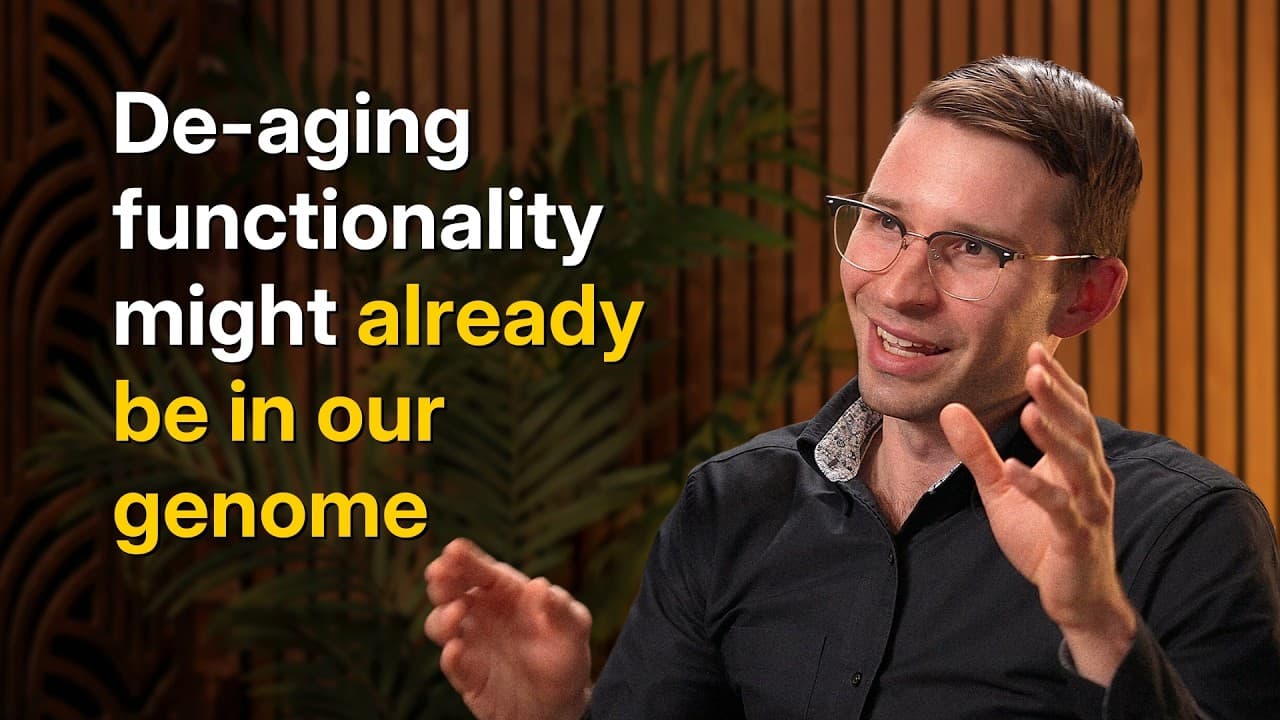
Evolution likely never optimized human longevity because the baseline hazard rate, the chance of dying on any given day from predators, injury, or infection, was so high that few individuals survived long enough for lifespan-extending traits to be selected. Jacob Kimmel, president and co-founder of NewLimit, argues this leaves low-hanging fruit for epigenetic reprogramming of cells back to younger states.
Transcript
Today I have the pleasure of interviewing Jacob Kimmel, who is the president and co-founder of NewLimit, where they're trying to epigenetically reprogram cells to their younger states. Jacob, thanks so much for coming on the podcast. Thanks so much for having me. Looking forward to the conversation. All right, first question. What's the fir... Read More
Key Insights
- The hazard rate is the likelihood of dying on any given day, and it integrates every cause at once: age-related disease, predation, falling off a cliff, or an infection from scraping a foot on a rock. Best available evidence suggests this baseline rate was very high through human evolution.
- Selection for longevity requires individuals to actually reach old age, and with a high baseline hazard rate very few members of a population survived that long. The amount of gradient signal flowing back to the genome for lifespan extension was therefore lower than intuition suggests.
- Natural selection works as a constrained optimizer: the genome is a set of parameters, and only so many mutations can occur at a time, so evolutionary update steps must be spent in particular ways. Those constraints limit what traits can be pushed on simultaneously.
- The first question in engineering any biological property is whether evolution already spent a lot of time optimizing it. If yes, the engineering job becomes insanely hard; if not, there is likely low-hanging fruit available to a deliberate designer.
- Kin selection creates a possible force acting against longevity. Under a selfish gene view, extending maximum lifespan without eliminating aging leaves an individual whose marginal year contributes fewer net calories to the genome than two 20 year olds who could follow behind them.
- A population demographically laden with aged individuals may be net negative for genome proliferation even if fecundity persists later in life. The implication is that a genome should optimize for turnover and for population size at maximum fitness rather than for individual duration.
- Fluid intelligence may peak around age 25 to 30 because that was roughly the age of adults in the largest populations present during most of human evolution. Alleles preserving fluid intelligence late in life saw little selection if few people reached 65.
- Long adolescence is bounded by mortality: extending the learning period too far means dying before reproducing, which removes the payoff for a larger brain. This suggests intelligence itself may have been less heavily optimized than assumed, leaving room for engineering.
Install to Summarize YouTube Videos and Get Transcripts
Explore YouTube Video Summarizer or Get YouTube Transcript Extractor
Questions & Answers
Q: Why did evolution not select for longer human lifespans?
Jacob Kimmel argues the main reason is the baseline hazard rate, the likelihood of dying on any given day, was very high through most of human and primate evolution. That rate integrates everything: diseases from aging, being eaten by a tiger, falling off a cliff, or scraping a foot on a rock and dying of infection. Even absent aging, few individuals reached the outer limits of health where aging becomes the main limitation, so relatively few members of a population were alive at ages where lifespan-extending traits could be selected. The gradient signal flowing back to the genome for longevity was therefore weaker than intuition suggests.
Q: What is the hazard rate in evolutionary biology?
The hazard rate is simply the likelihood that you are going to die on any given day. It is an integrated measure that includes every possible cause at once: diseases arising from aging, predation such as being eaten by a tiger, accidents like falling off a cliff, and infections from something as minor as scraping your foot on a rock. Kimmel notes that from the best evidence available, the baseline hazard rate during the majority of human and primate evolution was very, very high. This matters because a high baseline rate means few individuals survive to ages where aging is the primary constraint on health.
Q: How does kin selection argue against longevity?
Kin selection takes a selfish gene view where the genome optimizes for its own propagation rather than any individual's benefit. Under that framing, longevity becomes tricky because of what Kimmel calls a nasty regularization term. If you extend maximum lifespan but do not counteract declining fitness over time, meaning you have not eliminated aging, then the net calories that individual contributes to the genome in each marginal year, minus their own calorie consumption, is less than what two 20 year olds following behind them would contribute. A population laden with aged individuals can therefore be net negative for genome proliferation, suggesting genomes should optimize for turnover and population size at maximum fitness.
Q: What does NewLimit do?
NewLimit is a company where Jacob Kimmel serves as president and co-founder. The company is working to epigenetically reprogram cells back to their younger states. According to the episode description, Kimmel thinks he can find the transcription factors to reverse aging, and the conversation does a deep dive on why that might be plausible and why evolution has not already optimized for longevity. The broader discussion also covers why drug discovery has been getting exponentially harder, what a new platform for biological understanding to speed up progress would look like, gene delivery, and Kimmel's controversial takes on CAR-T cells.
Q: Why does fluid intelligence peak around age 25 to 30?
Kimmel offers this as his own pet hypothesis. He observes that in mathematics, most great discoveries happen roughly before 30, and questions whether societal explanations, such as becoming staid in your ways or teachers restricting your thinking, could hold true across centuries and across both Eastern and Western cultures. A simpler explanation, he suggests, is that fluid intelligence is roughly maximized at the age where population size during human evolution was maximal. That would be around 25 or 30, approximately the age of adults in the large populations undergoing selection through most of evolution. If few people reached 65, alleles preserving fluid intelligence late in life would see little selective pressure.
Q: How should you decide whether a biological property is easy to engineer?
Kimmel says that in biology, when trying to engineer any given property, whether making something healthier for longer, making something more intelligent, or even at the micro-level of engineering a system to manufacture a protein at high efficiency, you always have to start with one question: did evolution spend a lot of time optimizing this? If the answer is yes, the engineering job is going to be insanely hard, because you are competing against extensive prior optimization. If the answer is no, then there are potentially some low-hanging fruit available. This heuristic is what makes both longevity and intelligence interesting targets, since neither appears to have been strongly selected for.
Q: Why might human intelligence have been easier to evolve than assumed?
The argument runs through mortality. Humans have bigger brains than other primates and also longer adolescences, which potentially help make use of the extra capacity the brain provides. But with a high baseline hazard rate, children die frequently, and an individual must become an adult, contribute resources back to the group, and gather calories rather than freeload. If adolescence were extended too long, someone spending 50 years learning would simply die before having children, removing any payoff from a bigger brain. This means there were contingent reasons evolution did not churn as hard on intelligence as it could have, implying intelligence may be easier to build than commonly assumed.
Q: What are the three components of the evolutionary argument about aging?
Kimmel structures the question into three parts. First, what is the selective pressure that would make an organism live longer and encode for higher health over longer durations, and was that pressure actually present? Second, are there any anti-selective pressures actively pushing against longevity, with kin selection offered as a candidate. Third, what are the constraints of the optimizer itself: if the genome is a set of parameters and natural selection is the optimizer, then only so many mutations can happen at a time and update steps must be spent in certain ways. Each component independently reduces the likelihood that longevity was maximally optimized.
Q: What is the annus mirabilis pattern in scientific discovery?
The annus mirabilis refers to the observation that many of the greatest scientists ever produced a large share of their greatest achievements within a single year. Newton is cited as producing work on optics, gravity, and calculus at 21. Alexander von Humboldt is offered as another example: he took one expedition to South America where he climbed Mount Chimborazo at a time when very few Europeans had done so, and observed ecological layers repeated across latitudes and altitudes. That led him to formulate an understanding of how selection operated on plants at different layers in the ecosystem, and that single expedition became the basis of his entire career.
Q: How is aging like a regularizer in machine learning?
The comparison drawn in the conversation is to length regularization in model training. When companies train models, they may add a regularizer that permits chain of thought reasoning but penalizes chains that grow too long. Aging plays an analogous role for the genome: the calories an individual consumes over the course of their life function as the penalty term. Extending lifespan without eliminating the decline in fitness means the individual keeps consuming while contributing less, so the genome effectively regularizes against excessive length. Evolution is also framed as a long-horizon reinforcement learning problem, with roughly a 20-year horizon and a scalar reward of how many surviving children result.
Summary & Key Takeaways
-
Jacob Kimmel, president and co-founder of NewLimit, works on epigenetically reprogramming cells back to their younger states. The conversation opens with a first principles question: why does evolution discard individuals so readily when longer healthy lifespans would allow more children, longer care for them, and care for grandchildren as well.
-
Kimmel breaks the evolutionary question into three parts: whether a positive selective pressure for longevity existed, whether anti-selective pressures push against it, and what constraints the optimizer itself faces. Treating the genome as parameters and natural selection as the optimizer, only a limited number of mutations and update steps are available.
-
The high baseline hazard rate is central. Even without aging, most individuals died from predation, accidents, or infection before reaching ages where aging becomes the main limitation, so little selective signal reached the genome regarding lifespan extension.
-
The same reasoning extends to intelligence. Long adolescence is costly under high mortality, so evolution may not have churned hard on intelligence either, implying it could be easier to build than assumed. Kimmel adds a pet hypothesis that fluid intelligence peaks near 25 to 30 because that matched the adult age in the largest ancestral populations.
-
On anti-selection, kin selection suggests aging acts like a length regularizer. Extending lifespan without removing aging means an older individual consumes more calories than they contribute relative to two younger replacements, so the genome may favor turnover over duration.
-
The discussion cites the annus mirabilis pattern, including Newton producing optics, gravity, and calculus at 21, and Alexander von Humboldt, whose single South America expedition and climb of Mount Chimborazo produced observations of ecological layers across latitudes and altitudes that formed the basis of his entire career.
Read in Other Languages (beta)
Share This Summary 📚
Summarize YouTube Videos and Get Video Transcripts with 1-Click
Try YouTube Summary with ChatGPT & Claude or YouTube Transcript Generator
Explore More Summaries from Dwarkesh Patel 📚



Summarize YouTube Videos and Get Video Transcripts with 1-Click
Try YouTube Summary with ChatGPT & Claude or YouTube Transcript Generator