What Are AI Agents and How Do They Work?
TL;DR
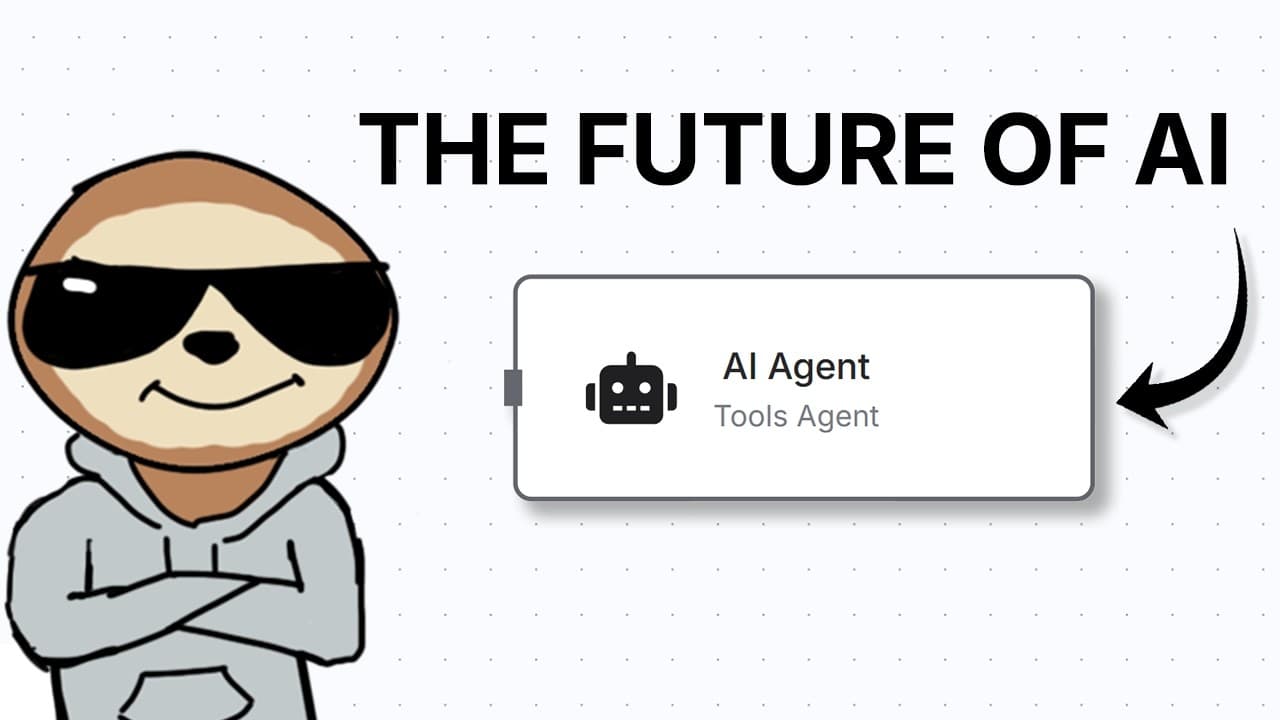
AI agents are language models that use tools in a repeated loop to reason, plan, act, and adjust until they complete a goal or encounter an error. A practical agent combines a suitable model, data and action tools, short-term and long-term memory, and instructions defining its role, goal, available tools, success criteria, and response style.
Transcript
ai agents are literally Jarvis from Iron Man well more like Teimu Jarvis the Bluetooth device so what are AI agents well number one they're not secret agents number two for the purpose of this video we're not talking about reinforcement learning agents because I don't get paid enough to simplify math maybe in a future video but for now we're talkin... Read More
Key Insights
- An AI agent is a language model that uses tools in a continuous loop to reason, plan, act, and adapt until it reaches a goal or encounters an error. The repeated loop distinguishes an agent from a fixed tool-enabled workflow.
- A non-agentic language model reacts to an input using information already available from its training and context. It does not independently retrieve current information, plan additional steps, or solve problems beyond the knowledge and capabilities provided in the interaction.
- An AI workflow can access tools but still follows predefined instructions rather than deciding its own course. An agent becomes more autonomous when it dynamically selects steps, responds to newly discovered information, and continues operating without every action being hard-coded.
- An agent consists of four main parts: the model, tools, memory, and instructions. The model handles reasoning, tools connect it to information and systems, memory maintains context, and instructions establish its role, goal, success criteria, tool access, and response behavior.
- Agent tools fall into three categories: data, action, and orchestration tools. Data tools retrieve information, action tools modify or interact with external systems, and orchestration tools coordinate other agents that perform specialized parts of a larger task.
- Agent memory includes short-term conversation history and long-term facts saved in a database. These memory types help the agent build context, remain aligned with its current task, and improve its decisions as additional relevant information becomes available.
- Agent architectures include single agents, specialized crews, sequential workflows, hierarchical systems, parallel agents, and hybrids. Each pattern offers different tradeoffs involving simplicity, flexibility, speed, coordination, and the difficulty of designing and controlling the overall system.
- Agent development tools can reduce the programming required to assemble models, tools, rules, and workflows. The transcript names Flowise, Make, n8n, LangChain, AutoGen, CrewAI, Google's agent SDK, OpenAI's agent SDK, and Cloudflare's agent SDK as available options.
Install to Summarize YouTube Videos and Get Transcripts
Explore YouTube Video Summarizer or Get YouTube Transcript Extractor
Questions & Answers
Q: What is an AI agent?
An AI agent is a language model that reasons, plans, and acts in a continuous loop until it completes a goal or encounters an error. A concise definition is a language model using tools in a loop. Unlike a normal model response, an agent can choose additional steps, use external capabilities, react to new information, and keep working without having every move specified in advance.
Q: How is an AI agent different from a normal language model?
A normal language model typically receives an input and produces an output using its training data and the context it already has. It reacts to the question but does not independently gather missing information or plan a broader solution. An AI agent can use tools, decide what to do next, incorporate new findings, and repeat this process until it reaches the requested goal or fails.
Q: What is the difference between an AI workflow and an AI agent?
An AI workflow has access to tools, but it follows instructions and predefined steps rather than making dynamic decisions on its own. An AI agent also uses tools, but it repeatedly evaluates the situation, plans its next action, and adjusts when new information appears. The defining difference is the loop that continues until the goal is finished or an error stops the process.
Q: What are the four main components of an AI agent?
The four components are the model, tools, memory, and instructions. The model supplies the reasoning capability and should match the difficulty of the task. Tools retrieve information or interact with systems. Memory preserves conversation history and important stored facts. Instructions tell the agent its role, goal, definition of success, available tools, and expected response format or behavior.
Q: What types of tools can AI agents use?
AI agents commonly use data tools, action tools, and orchestration tools. Data tools retrieve information from sources such as databases, PDF documents, or web searches. Action tools let agents update databases, send emails or texts, and operate a computer to navigate the internet. Orchestration tools allow an agent to manage other specialized agents and coordinate their contributions to a larger objective.
Q: How does memory work in an AI agent?
An AI agent can use short-term and long-term memory. Short-term memory includes information such as the current conversation history, while long-term memory contains important facts stored in a database. Memory gives the agent continuing context, helps it stay focused on the goal, and allows its behavior to improve as it accumulates more relevant information during or across tasks.
Q: What are the common AI agent architectures?
Common architectures include a single agent, a crew of specialized agents, a sequential workflow, a hierarchical system, parallel agents, and a hybrid system. Single agents are simple and sufficient for many projects. Crews divide responsibilities, sequential systems use fixed handoffs, hierarchies employ a manager and workers, parallel systems run tasks simultaneously, and hybrids combine several patterns at greater design complexity.
Q: How can programmers build an AI agent?
Programmers can build an agent by selecting a model, connecting appropriate tools, defining memory, and writing instructions that specify its role, goal, available capabilities, success conditions, and response behavior. The transcript identifies LangChain, AutoGen, CrewAI, Google's agent SDK, OpenAI's agent SDK, and Cloudflare's agent SDK as programming options. Flowise, Make, and n8n are presented as alternatives requiring less programming.
Summary & Key Takeaways
-
An AI agent differs from a normal language model because it can plan actions, use tools, evaluate new information, and continue working toward a goal. A normal model produces an answer from existing knowledge, while a workflow follows predefined instructions. An agent dynamically decides which steps to take next.
-
Every agent combines four main components: a model, tools, memory, and instructions. The model supplies reasoning capability, tools provide access to information and external systems, memory preserves useful context, and instructions define the agent's role, objective, success conditions, available capabilities, and expected way of responding.
-
Agent systems can use a single agent, specialized crews, sequential handoffs, hierarchical management, parallel execution, or hybrid structures. Simple projects may need only one agent, while larger goals can benefit from specialization and coordination. Complexity rises quickly, so the architecture should match the task instead of exceeding its needs.
Read in Other Languages (beta)
Share This Summary 📚
Summarize YouTube Videos and Get Video Transcripts with 1-Click
Try YouTube Summary with ChatGPT & Claude or YouTube Transcript Generator
Explore More Summaries from The Coding Sloth 📚

Summarize YouTube Videos and Get Video Transcripts with 1-Click
Try YouTube Summary with ChatGPT & Claude or YouTube Transcript Generator