How Is NVIDIA Building the Future of AI Computing?
TL;DR
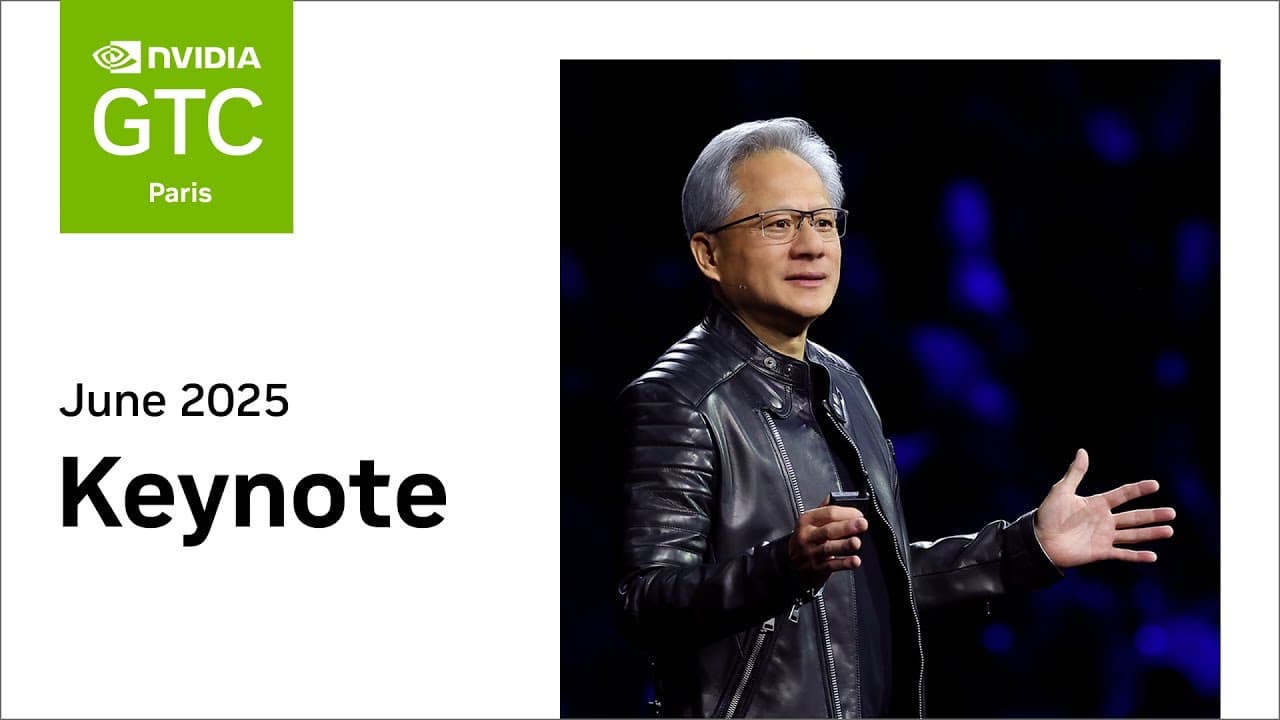
NVIDIA is building AI computing around accelerated hardware, domain-specific CUDA libraries, AI factories, agentic systems, and robotics. Jensen Huang argues that the next wave of AI combines perception, reasoning, planning, tool use, and physical action, while Grace Blackwell, enterprise platforms, sovereign models, and quantum-classical computing provide infrastructure spanning cloud, enterprise, personal, and edge environments.
Transcript
This is how intelligence is made. A new kind of factory. Generator of tokens The building blocks of AI Tokens have opened a new frontier The first step into an extraordinary world. Where endless possibilities are born. Tokens transform images into scientific data. Charting alien atmospheres. And guiding the explorers of tomorrow. They probe the Ear... Read More
Key Insights
- Accelerated computing requires more than compiling existing software for a new processor. Algorithms must be reformulated for highly parallel execution, so NVIDIA develops specialized libraries that help programmers accelerate individual markets and application domains.
- CUDA-X is a suite of libraries built on CUDA for accelerated applications and algorithms. The keynote cites more than 400 additional libraries beyond the featured examples, with each library designed to accelerate a particular computing domain and create opportunities for developers and ecosystem partners.
- cuLitho is an inverse-physics computational lithography library used before chip manufacturing. The keynote identifies computational lithography as a critical semiconductor-design application running in major fabrication environments, including factories operated by TSMC and Samsung.
- CUDA-Q extends CUDA into quantum-classical computing. It allows developers to run applications through emulation before quantum computers arrive and later use quantum and classical processors collaboratively, while cuQuantum supports simulation of qubits and quantum algorithms on classical computers.
- Quantum supercomputing will combine QPUs and GPUs for complementary tasks. The QPU performs quantum computation, while GPUs support preprocessing, control, computationally intensive error correction, and postprocessing within an integrated quantum-classical architecture.
- Artificial intelligence has developed through three broad waves: perception, multimodal generative AI, and systems capable of reasoning and action. Generative models connect language and images, while the emerging wave adds problem decomposition, planning, research, tool use, and execution.
- Agentic AI works as an information robot that can understand a problem, apply previously learned rules, gather new information, seek assistance, use tools, and complete a solution step by step. These abilities reflect the keynote's perception, reasoning, and planning cycle.
- Embodied AI generates physical motion rather than only digital content. In robotics, generative capabilities can produce locomotion, reaching, grasping, and tool use, turning agentic intelligence into systems that act through a physical form.
- More videos from this channel:
- More from this channel: NVIDIA
Install to Summarize YouTube Videos and Get Transcripts
Explore YouTube Video Summarizer or Get YouTube Transcript Extractor
Questions & Answers
Q: How does NVIDIA accelerate computing across different industries?
NVIDIA combines GPUs with domain-specific software libraries that reformulate algorithms for highly parallel execution. Examples in the keynote include cuLitho for computational lithography, cuOpt for optimization, cuDF and cuML for data and machine learning, Earth-2 for weather and climate models, MONAI for medical imaging, Parabricks for genomics, and CUDA-Q for quantum-classical computing.
Q: Why are software libraries essential to accelerated computing?
Accelerated computing is not simply a matter of compiling ordinary software for a different processor. Applications and algorithms must be reformulated so their work can run in parallel, which Huang describes as extremely difficult. NVIDIA's libraries package this specialized work for particular domains, helping developers adopt acceleration while opening new application and ecosystem opportunities.
Q: What is CUDA-Q and how does it support quantum computing?
CUDA-Q is NVIDIA's platform for quantum-classical computing. It extends CUDA so developers can create applications that run through emulation before suitable quantum hardware arrives and later operate through collaboration between quantum and classical processors. The related cuQuantum software uses classical computing to simulate qubits or algorithms intended to run on quantum computers.
Q: How will GPUs and QPUs work together in future supercomputers?
The keynote describes future supercomputers as systems in which a quantum processing unit is assigned and connected to GPUs. The QPU performs quantum computation, while GPUs handle supporting workloads such as preprocessing, system control, computationally intensive error correction, and postprocessing. Together, the two architectures form a quantum-classical accelerated computing system rather than operating independently.
Q: What are the main waves in the development of AI?
The first wave was perception, which enabled computers to recognize and understand information. The second was generative AI, where multimodal systems learned from language and images, accepted prompts, and generated content. The emerging wave adds reasoning, planning, research, tool use, and task execution, creating agentic systems and embodied intelligence for robotics.
Q: What is agentic AI according to Jensen Huang?
Agentic AI is intelligence that can address a complicated problem through a sequence of purposeful steps. It can perceive and understand the task, reason about possible solutions, make a plan, conduct research, learn new information, seek help, use tools, and execute the plan. Huang characterizes these agents as information robots operating in digital environments.
Q: How is embodied AI different from generative AI?
Generative AI commonly produces digital content such as text, images, or video. Embodied AI applies generative capability to physical motion, producing actions such as walking, reaching, grasping objects, and using tools. The physical implementation of agentic intelligence is robotics, where a system must translate reasoning and planning into movement through a physical form.
Q: What role does Grace Blackwell play in NVIDIA's AI strategy?
The keynote presents Grace Blackwell as infrastructure for advanced AI and quantum workloads. Its chapters describe the Grace Blackwell NVL72 as a thinking machine, the GB200 as one giant GPU, and Blackwell as a major step in reasoning inference performance. NVIDIA also announces that its quantum algorithm stack is accelerated on Grace Blackwell 200.
Summary & Key Takeaways
-
NVIDIA's accelerated computing strategy combines GPUs with specialized libraries that reformulate difficult algorithms for parallel execution. Its CUDA-X portfolio addresses fields including semiconductor design, optimization, data processing, machine learning, weather, medicine, genomics, quantum simulation, and scientific computing, with each library opening a distinct application domain for developers and ecosystem partners.
-
Quantum computing is approaching an inflection point as logical qubits become more numerous, robust, and scalable. NVIDIA expects future supercomputers to connect quantum processing units with GPUs, which can handle preprocessing, control, computationally intensive error correction, and postprocessing. CUDA-Q is intended to support applications before and after practical quantum hardware arrives.
-
AI has progressed from perception to multimodal generation and now toward agentic and embodied systems. Agentic AI can understand problems, reason, plan, research, use tools, and execute tasks step by step. Its physical counterpart is robotics, where generative capabilities produce motion, locomotion, manipulation, and tool use instead of only text, images, or video.
Read in Other Languages (beta)
Share This Summary 📚
Summarize YouTube Videos and Get Video Transcripts with 1-Click
Try YouTube Summary with ChatGPT & Claude or YouTube Transcript Generator
Explore More Summaries from NVIDIA 📚

Summarize YouTube Videos and Get Video Transcripts with 1-Click
Try YouTube Summary with ChatGPT & Claude or YouTube Transcript Generator