How to Use RICECO Framework for Better AI Prompts
TL;DR
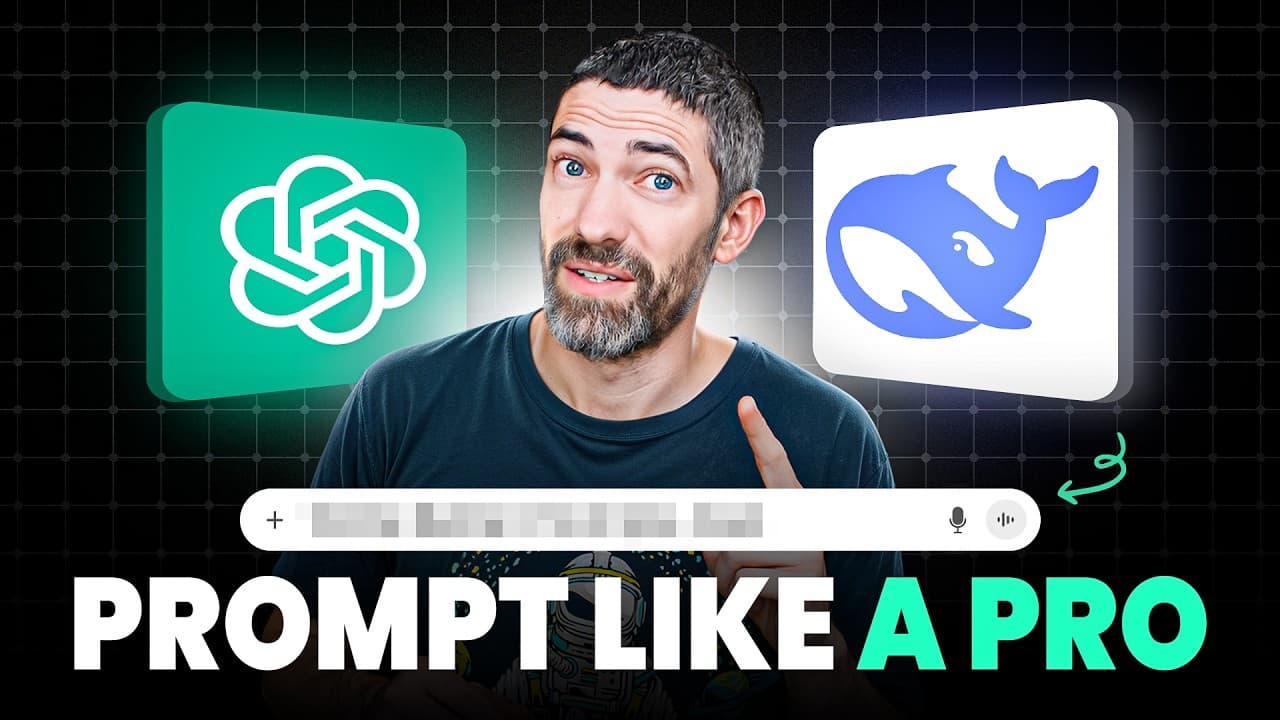
The RICECO framework enhances AI outputs by refining prompts through six key elements: Role, Instruction, Context, Examples, Constraints, and Output format. By specifying these elements, users can guide AI to produce more relevant, detailed, and useful responses, applicable across various large language models like ChatGPT and others.
Transcript
AI models keep getting smarter every day, but there's one thing that never changes. They only give you great answers if you ask them great questions. To do this, you don't need to become technical or learn some advanced logic. You just need one simple framework. It's called Riceco. Six prompt ingredients that when used correctly won't just improve ... Read More
Key Insights
- RICECO is a framework designed to improve AI outputs by refining prompts with six elements: Role, Instruction, Context, Examples, Constraints, and Output format.
- Assigning a role to the AI can significantly alter the tone, perspective, and depth of its responses.
- Clear and specific instructions are essential to prevent AI from generating generic content.
- Providing context helps align AI outputs with the user's goals and audience, enhancing relevance and usefulness.
- Examples guide the AI in understanding desired output structures and tones, improving accuracy and creativity.
- Constraints set boundaries for the AI, preventing undesired habits like verbosity or vagueness.
- Output format instructions ensure AI responses are structured and easy to use, saving time on reformatting.
- The condensed ICC method focuses on Instruction, Context, and Constraints for quick, effective prompting.
Install to Summarize YouTube Videos and Get Transcripts
Explore YouTube Video Summarizer or Get YouTube Transcript Extractor
Questions & Answers
Q: How does assigning a role to AI affect its responses?
Assigning a role to AI changes the tone, perspective, and depth of its responses. By defining a specific role, such as a sleep doctor or a business strategist, the AI can tailor its answers to fit the expectations and expertise associated with that role, resulting in more relevant and contextually appropriate outputs.
Q: What are the key elements of the RICECO framework?
The RICECO framework consists of six key elements: Role, Instruction, Context, Examples, Constraints, and Output format. Each element serves a specific purpose in refining AI prompts to produce more accurate, relevant, and useful outputs. The framework is designed to enhance AI interactions across various large language models.
Q: Why is context important in AI prompting?
Context is crucial in AI prompting as it provides the background information necessary for the AI to generate relevant and aligned responses. It includes details about the audience, platform, purpose, and tone, ensuring that the output meets the user's goals and is appropriate for the intended scenario.
Q: How do examples improve AI outputs?
Examples improve AI outputs by providing a reference for structure, tone, and formatting. By showing the AI what kind of output is desired, examples help guide the model in producing responses that are closer to user expectations. This technique, known as few-shot prompting, is effective in enhancing accuracy and creativity.
Q: What role do constraints play in AI prompting?
Constraints in AI prompting define limits, rules, and must-haves for the AI to follow. They help eliminate undesired habits like verbosity or vagueness and ensure the output meets specific requirements. Constraints can include word limits, tone preferences, and content rules, providing a framework for more precise and targeted responses.
Q: How can output format instructions benefit AI responses?
Output format instructions benefit AI responses by specifying how the content should be structured. This ensures the output is clean, organized, and ready for use, saving time on reformatting. Formats can include bullet points, tables, JSON, or other structures that enhance readability and usability of the AI-generated content.
Q: What is the condensed ICC method in AI prompting?
The condensed ICC method focuses on the three most critical elements of RICECO: Instruction, Context, and Constraints. This streamlined approach is effective for quick prompting, ensuring that the AI receives clear tasks, relevant background, and specific boundaries, leading to more accurate and useful outputs without the need for all six RICECO elements.
Q: How can the RICECO framework improve AI interactions?
The RICECO framework improves AI interactions by providing a structured approach to crafting prompts. By focusing on Role, Instruction, Context, Examples, Constraints, and Output format, users can guide AI to produce more relevant, detailed, and useful responses. This framework is applicable across various large language models, enhancing the quality and effectiveness of AI outputs.
Summary & Key Takeaways
-
The RICECO framework enhances AI outputs by focusing on six elements: Role, Instruction, Context, Examples, Constraints, and Output format. Assigning roles alters AI response tone and depth, while clear instructions prevent generic content. Context aligns outputs with user goals, and examples improve accuracy. Constraints set boundaries, and output format ensures usability.
-
Role assignment in RICECO changes AI response tone and depth. Instructions must be clear to avoid generic content. Context provides background, aligning AI outputs with user goals. Examples guide structure and tone, constraints set boundaries, and output format instructions ensure structured, usable responses.
-
RICECO framework's six elements—Role, Instruction, Context, Examples, Constraints, and Output format—enhance AI outputs. Role changes tone, clear instructions prevent generic content, context aligns outputs with goals, examples improve accuracy, constraints set boundaries, and output format ensures usability.
Read in Other Languages (beta)
Share This Summary 📚
Summarize YouTube Videos and Get Video Transcripts with 1-Click
Try YouTube Summary with ChatGPT & Claude or YouTube Transcript Generator
Explore More Summaries from Futurepedia 📚




Summarize YouTube Videos and Get Video Transcripts with 1-Click
Try YouTube Summary with ChatGPT & Claude or YouTube Transcript Generator