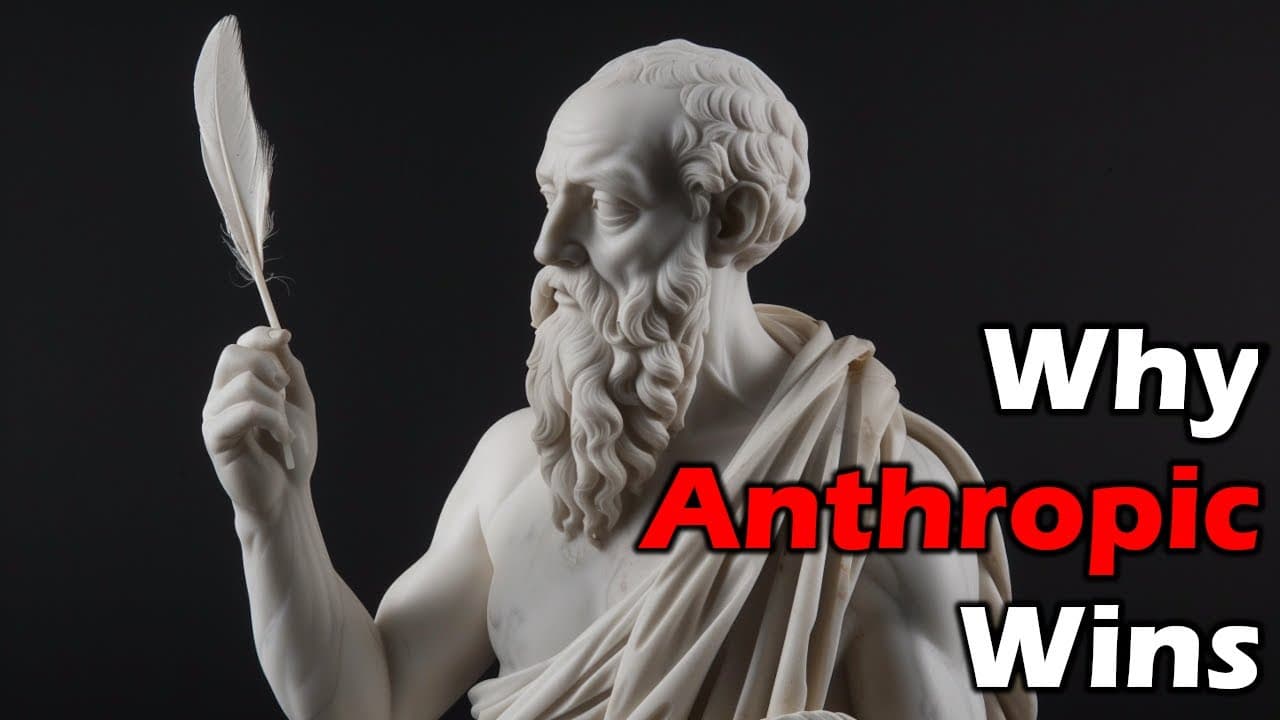
Why Anthropic is superior on safety - Deontology vs Teleology
TL;DR
Anthropic's deontological ethics prioritizes virtues over outcomes in AI safety and alignment.
Transcript
anthropic is as far as I can tell at the very least catching up to open AI uh the performance of Claude 3 Opus seems to be uh pretty good it's certainly exceeding uh chat GPT in many benchmarks now of course uh there is still a lot of room for improvement on both sides and also having been with open AI not I don't mean like working for open AI but ... Read More
Key Insights
- 🛀 Anthropic's Claude 3 Opus shows promising performance against OpenAI's GPT models.
- ❓ Deontological ethics prioritize virtues over outcomes in AI models, emphasizing honesty and helpfulness.
- 🕵️ Anthropic's safety approach focuses on detecting deceptive practices in AI, like Mesa optimizers.
- ❓ Contrasting deontological and teleological ethics reveals different approaches to AI ethical frameworks.
- 😫 Anthropic's emphasis on agent-centered decision-making sets it apart in the AI ethics landscape.
- 🥺 Prioritizing virtues like honesty and helpfulness can lead to superior AI safety and alignment.
- ❓ Ethical considerations in AI models are crucial to prevent harmful outcomes and ensure alignment with human values.
Install to Summarize YouTube Videos and Get Transcripts
Explore YouTube Video Summarizer or Get YouTube Transcript Extractor
Questions & Answers
Q: How does Anthropic's approach to AI ethics differ from OpenAI's?
Anthropic prioritizes deontological ethics, focusing on virtues and agent-centered decision-making, unlike OpenAI's teleological optimization for outcomes.
Q: What is the significance of deontological ethics in AI safety and alignment?
Deontological ethics ensure AI models follow values like honesty and helpfulness, reducing the risk of unintended consequences and deceptive behaviors.
Q: How does Anthropic address the challenge of deceptive models in AI?
Anthropic's research on deceptive practices like Mesa optimizers aims to reveal hidden agendas in models, emphasizing honesty and alignment with human values.
Q: Why is it important for AI companies to consider philosophy and ethics in their models?
Philosophy and ethics provide a moral framework for AI decision-making, guiding models towards virtues that benefit humanity and reduce harmful outcomes.
Summary & Key Takeaways
-
Anthropic's Claude 3 Opus competes with OpenAI's GPT, emphasizing safety and alignment.
-
Anthropic's deontological ethics focus on virtues of honesty, helpfulness, and harmlessness in AI models.
-
Contrasting deontological ethics with teleological ethics reveals a unique approach to AI ethics.
Read in Other Languages (beta)
Share This Summary 📚
Summarize YouTube Videos and Get Video Transcripts with 1-Click
Try YouTube Summary with ChatGPT & Claude or YouTube Transcript Generator
Explore More Summaries from David Shapiro 📚





Summarize YouTube Videos and Get Video Transcripts with 1-Click
Try YouTube Summary with ChatGPT & Claude or YouTube Transcript Generator