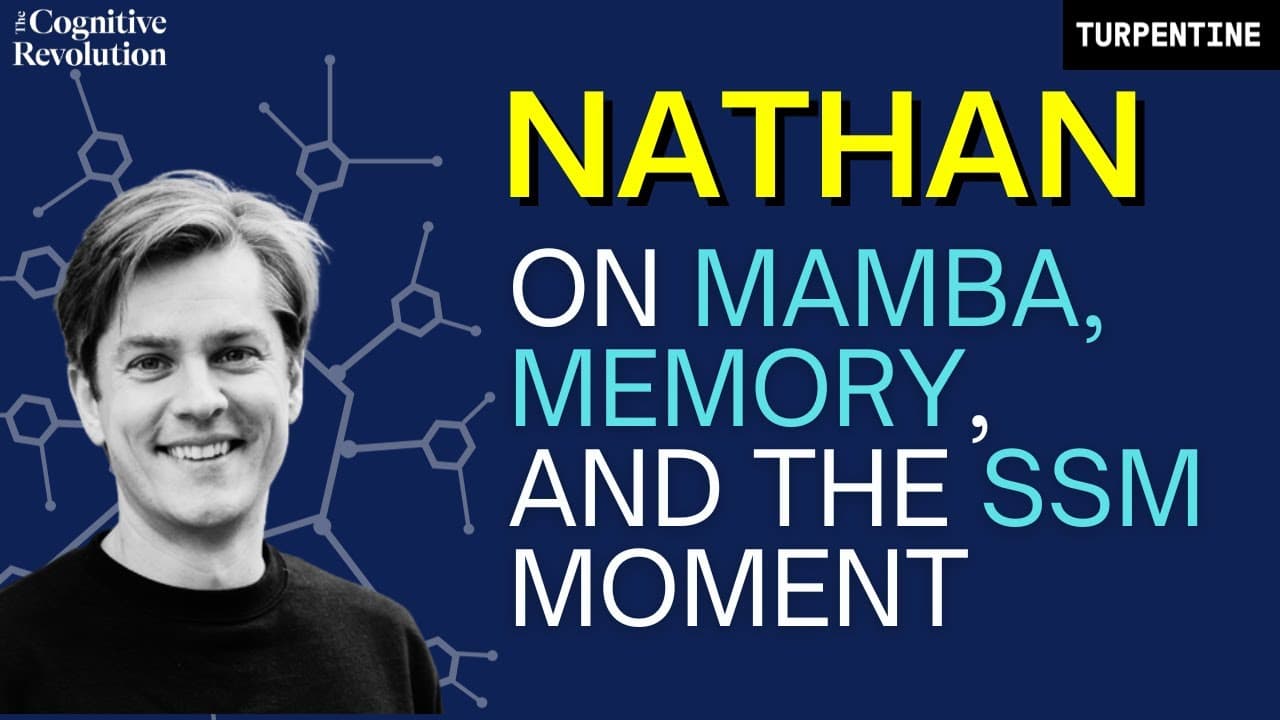
What Is the Mamba AI Architecture and Its Benefits?
TL;DR
The Mamba architecture introduces improved AI memory with a state space model that evolves over time, allowing for long-term memory and superior performance in processing longer sequences compared to Transformers. This dynamic selective state mechanism enables more efficient computation, offering new possibilities for AI applications as reliable long-term companions and effective agents.
Transcript
my sense is that neither the human brain nor the Transformer are the end of History the purpose of this episode today is to really sound an alarm and say that I think we now have that new architecture we're going to see more effective agents more compelling long-term assistants more compelling long-term AI friends and companions all of this if I ha... Read More
Key Insights
- Mamba is a new state space model architecture that offers enhanced memory capabilities compared to Transformers.
- The architecture allows for long-term memory through a state that evolves over time, unlike Transformers which are episodic.
- Mamba outperforms Transformers in tasks with longer sequences, demonstrating better scaling properties.
- The architecture introduces a selective state space model, allowing inputs to influence computations dynamically.
- The design leverages hardware-aware algorithms for efficient computation, particularly on Nvidia A100 GPUs.
- Mamba's architecture allows for faster inference throughput compared to Transformers, especially in longer sequences.
- The architecture's state mechanism offers potential for new training strategies and data set designs focused on long-term coherence.
- There is potential for hybrid architectures combining Mamba and Transformers to leverage strengths of both models.
Install to Summarize YouTube Videos and Get Transcripts
Explore YouTube Video Summarizer or Get YouTube Transcript Extractor
Questions & Answers
Q: What is the main advantage of the Mamba architecture over Transformers?
The main advantage of the Mamba architecture is its enhanced memory capability, allowing for long-term memory through an evolving state mechanism. This contrasts with Transformers, which are limited by their episodic nature and context window size. Mamba's state space model can handle longer sequences more effectively, providing better performance in tasks requiring extended memory.
Q: How does Mamba achieve efficient computation?
Mamba achieves efficient computation through hardware-aware algorithm design, particularly on Nvidia A100 GPUs. The architecture leverages the SRAM and high bandwidth memory to optimize data movement and computation. By keeping the evolving state in the SRAM, Mamba minimizes data traffic and maximizes throughput, allowing for faster and more efficient processing compared to traditional models.
Q: What potential does Mamba have for AI development?
Mamba has significant potential for AI development, particularly in creating long-term AI companions and more effective agents. Its ability to handle long-term memory opens possibilities for new training strategies and data set designs focused on long-term coherence and adversarial robustness. Additionally, hybrid architectures combining Mamba and Transformers could leverage the strengths of both models, further advancing AI capabilities.
Q: What challenges does Mamba face in its implementation?
One challenge Mamba faces is the need for intentionally designed training data to fully utilize its long-term memory capabilities. Current benchmarks and data sets are primarily designed for Transformers, which may not fully exploit Mamba's strengths. Additionally, the architecture's reliance on recurrent computation could limit parallelization, potentially affecting scalability and performance optimization.
Q: How does Mamba handle input processing differently from Transformers?
Mamba handles input processing differently by allowing inputs to influence computations dynamically through a selective state space model. This mechanism enables the architecture to adjust transformations based on the nature of the inputs, similar to the human brain's processing. In contrast, Transformers apply the same transformations across all inputs, limiting their expressivity and adaptability.
Q: What are the implications of Mamba's state mechanism for AI memory?
Mamba's state mechanism implies a new dimension for AI memory management, allowing for long-term memory and more coherent behavior over extended sequences. This could lead to more effective AI agents and companions that can retain and utilize information over time, enhancing their utility in various domains. The state mechanism also introduces new opportunities for optimizing memory retention and decay.
Q: What are the potential applications of Mamba in AI technology?
Potential applications of Mamba in AI technology include developing long-term AI companions and more effective agents that can handle complex tasks requiring extended memory. The architecture's enhanced memory capabilities could improve AI's performance in areas such as personalized assistants, autonomous systems, and complex decision-making processes, where retaining and utilizing long-term information is crucial.
Q: How might Mamba's introduction affect the future of AI research?
Mamba's introduction could significantly impact the future of AI research by shifting focus towards architectures that integrate long-term memory capabilities. It opens new avenues for exploring hybrid models that combine the strengths of state space models and Transformers, potentially leading to more advanced and versatile AI systems. Additionally, Mamba could inspire new research in AI safety, interpretability, and memory management strategies.
Summary & Key Takeaways
-
Mamba is a state space model architecture that introduces a new way of handling AI memory, allowing for long-term memory and enhanced performance in longer sequences. It surpasses Transformers in some benchmarks, particularly in tasks requiring extended memory.
-
The architecture utilizes a selective mechanism allowing dynamic computation based on inputs, similar to the human brain's processing. This is achieved through a combination of state evolution and hardware-aware algorithm design, optimizing performance on GPUs.
-
Mamba's introduction opens possibilities for hybrid architectures and new training strategies, potentially revolutionizing AI memory management and performance. The architecture's potential applications include long-term AI companions and more effective agents, enhancing AI's utility in various domains.
Read in Other Languages (beta)
Share This Summary 📚
Summarize YouTube Videos and Get Video Transcripts with 1-Click
Try YouTube Summary with ChatGPT & Claude or YouTube Transcript Generator
Explore More Summaries from Cognitive Revolution "How AI Changes Everything" 📚




Summarize YouTube Videos and Get Video Transcripts with 1-Click
Try YouTube Summary with ChatGPT & Claude or YouTube Transcript Generator