How to Use Variables and Data Types in Java
TL;DR
Java variables are named containers whose data types determine what values they can hold, such as integers, decimal numbers, characters, or Boolean values. Create one by writing its data type, a valid name, an assignment operator, and a value. Variable names cannot begin with a digit or use reserved keywords, and capitalization produces distinct names.
Transcript
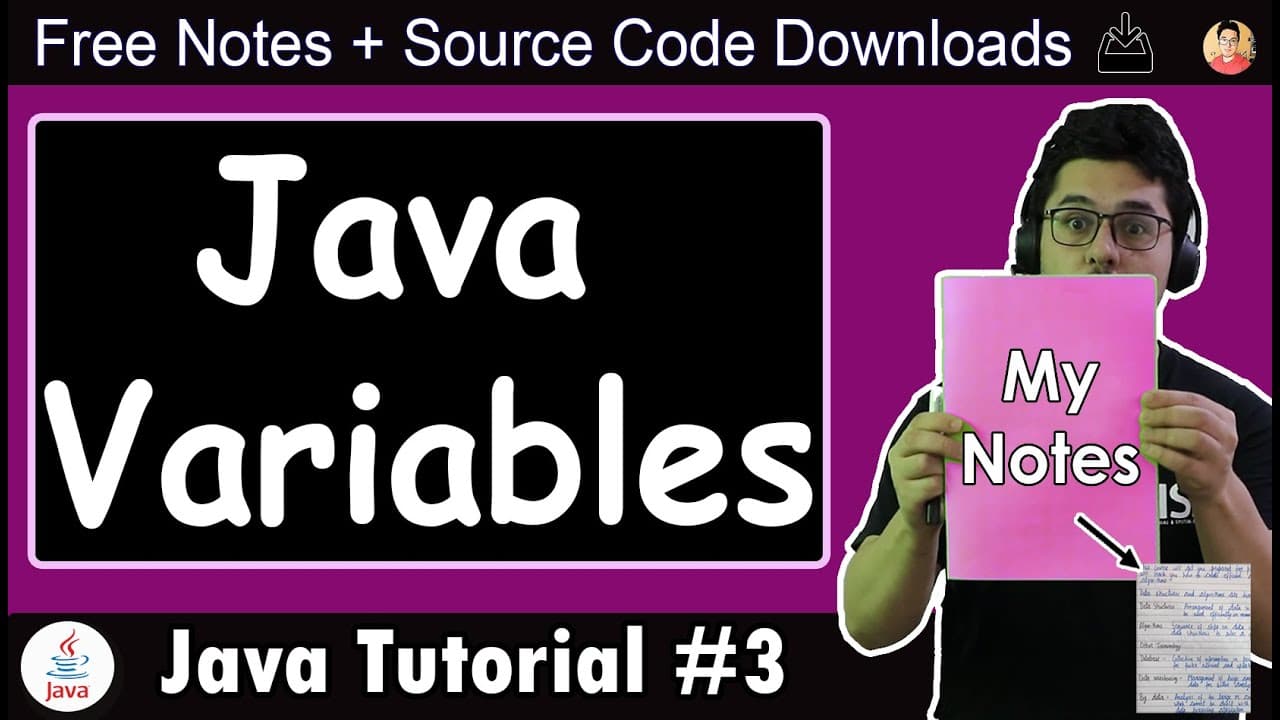
So guys, so far in this Java course, we saw a lot of things You guys saw the whole program of Java That which thing is what in Java In today's this video, I will tell you guys about Variable and Data Type Variable is like a container In which Values are stored Just like I can put water inside this bottle This bottle is the Data Type Which means its... Read More
Key Insights
- A variable is a named container that stores a value, and its contents can be changed later. This ability to change distinguishes a variable from a constant, which the tutorial describes as something that cannot be changed.
- A data type determines what kind of value a variable can contain. The tutorial uses a bottle and water analogy: the container represents the data type, while the water inside represents the stored value.
- Java data types are divided into primitive and non-primitive categories. The primitive category includes byte, int, float, long, char, double, boolean, and short, while non-primitive types are reserved for a later part of the course.
- Primitive data types represent several basic value categories. Int, long, short, and byte store integers, float and double store decimal or floating-point values, char stores one character, and boolean represents either true or false.
- A Java variable declaration combines a data type, a name, and an assigned value. In int number = 8, int specifies the data type, number identifies the container, and 8 is the value placed inside it.
- Variable names cannot begin with a digit. The tutorial demonstrates that 1arr is rejected as invalid, while arr is accepted, allowing the program to run and continue printing its existing Hello World output.
- Java variable names are case-sensitive. The identifiers harry and Harry can hold different integer values because changing the capitalization creates a different name, although using capitalized forms resembling keywords is described as poor practice.
- Reserved Java keywords cannot be used as ordinary variable names. Words such as static, void, and public already have defined roles in Java, so a declaration that attempts to use void as a variable name produces a problem.
Install to Summarize YouTube Videos and Get Transcripts
Explore YouTube Video Summarizer or Get YouTube Transcript Extractor
Questions & Answers
Q: What is a variable in Java programming?
A variable in Java is a named container used to store a value that can change. Its data type controls what kind of value can be placed inside it. For example, int number = 8 creates an integer container named number and assigns 8 to it. If number is printed afterward, the stored value 8 is printed.
Q: What is a data type in Java?
A data type specifies the kind of value that a Java variable can store. The tutorial compares it to a bottle designed to contain water: the bottle represents the data type, and the water represents the value. Java data types can represent integers, floating-point numbers, individual characters, or Boolean values such as true and false.
Q: What are the primitive data types in Java?
The eight primitive data types presented in the tutorial are byte, int, float, long, char, double, boolean, and short. Byte, int, long, and short are used for integer values. Float and double hold decimal or floating-point numbers, char holds one character, and boolean holds either true or false.
Q: How do you declare and assign a variable in Java?
A Java variable is created by writing its data type, choosing a valid name, adding the assignment operator, and providing a value. The example int number = 8 declares an integer variable named number and stores 8 inside it. The data type defines the permitted kind of value, while the name provides a way to access it later.
Q: What rules apply to Java variable names?
A Java variable name must follow the language's syntax rules. It cannot start with a digit, and it cannot be a reserved Java keyword. Variable names are also case-sensitive, so different capitalization creates different identifiers. The tutorial demonstrates that arr is valid, 1arr is invalid, and void cannot serve as an ordinary variable name.
Q: Why are Java variable names case-sensitive?
Java treats capitalization as part of a variable's identity. As a result, harry and Harry are two different names and can store separate values, such as 7 and 21. A capitalized spelling may avoid matching a lowercase keyword, but the tutorial says creating keyword-like names in this way is not good practice.
Q: What are reserved keywords in Java?
Reserved keywords are words that Java has already assigned to specific language purposes. The tutorial identifies static, void, and public as examples. Because these words are reserved, they cannot be reused as ordinary variable names. Attempting to declare a variable with a name such as void causes the development environment and Java to report a problem.
Q: What parts make up the basic structure of a Java program?
The described Java program structure can include a documentation section, a package statement, input statements, interface statements, and additional class definitions. These parts are presented as optional depending on the program. The class containing the main method is essential because the main method serves as the entry point from which the Java program begins executing.
Summary & Key Takeaways
-
Variables store values that can change, while data types specify the kind of value each variable accepts. A declaration such as int number = 8 combines a data type, a valid variable name, an assignment operator, and a value. Printing number afterward produces the value stored in that container.
-
Java divides data types into primitive and non-primitive categories. The eight primitive types presented are byte, int, float, long, char, double, boolean, and short. They cover integers, decimal numbers, individual characters, and true or false values. Non-primitive types are introduced as a topic for later study.
-
Java syntax defines the rules that valid programs and variable declarations must follow. A variable name cannot start with a digit or match a reserved keyword. Names are case-sensitive, so harry and Harry identify different variables. The course recommends reinforcing these concepts through notes and practice instead of memorizing every detail.
Read in Other Languages (beta)
Share This Summary 📚
Summarize YouTube Videos and Get Video Transcripts with 1-Click
Try YouTube Summary with ChatGPT & Claude or YouTube Transcript Generator
Explore More Summaries from CodeWithHarry 📚





Summarize YouTube Videos and Get Video Transcripts with 1-Click
Try YouTube Summary with ChatGPT & Claude or YouTube Transcript Generator