Could 3I/ATLAS Debris Reach Earth This Spring?
TL;DR
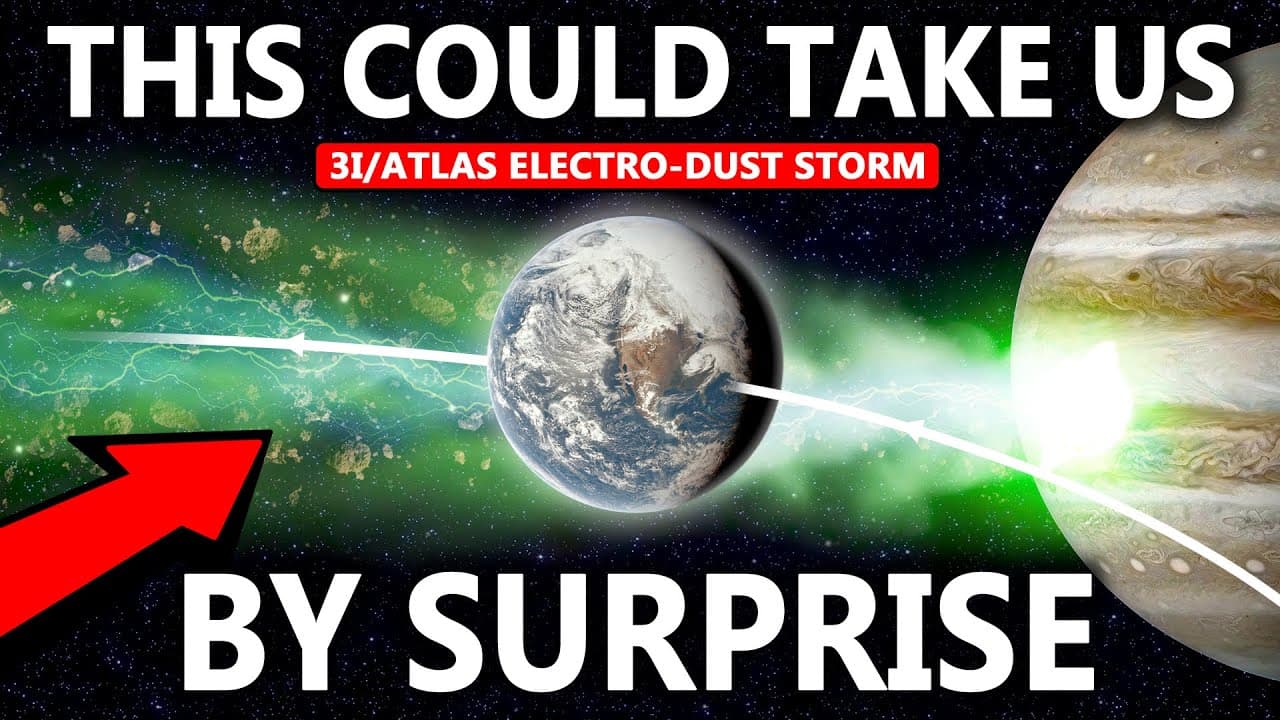
Earth may pass through part of the dust, gas, and plasma trail emitted by 3I/ATLAS during March and April, but the amount of material and its effects remain unknown. The outcome depends on the particles' size, composition, charge, velocity, and distribution, while the object's close approach to Jupiter adds another uncertain interaction.
Transcript
Hello and welcome everyone. I am your host Stefan Burns, geologist, geoysicist, space weather guy, cosmic bro. Here to tell you about three Atlas, what it is doing as far as we know. There's been a lot of discussion about three Atlas for many months now. The latest thing is that someone supposedly put in a freedom of information request with the Un... Read More
Key Insights
- 3I/ATLAS has emitted substantial amounts of dust, gas, and plasma through changing jets observed by amateur astronomers and in processed Hubble data. The source describes the object as rotating approximately every 15 to 16 hours while dispersing material across its surroundings.
- The sunward-facing tail of 3I/ATLAS persisted both before and after perihelion. The source treats this feature as unusual but not exceptionally bizarre, cautioning that familiar comet jetting and a less common tail orientation should be considered together without assuming an extraordinary explanation.
- Earth may encounter remnant material from the path of 3I/ATLAS during March and April. The source presents this as a possibility rather than a prediction, because the encounter depends on how widely the particles dispersed and whether their trajectories intersect Earth's orbit.
- Particle trajectories depend on their original momentum and the direction of their ejection from 3I/ATLAS. Material expelled opposite the object's motion could travel more slowly, while material expelled along its motion could travel faster, creating a broad distribution of possible paths.
- Solar radiation can push sufficiently small dust grains outward, particularly when they are closer to the Sun. Larger grains experience a weaker radiative effect and may follow different paths, so particle size and density help determine whether material escapes, spirals inward, or passes through once.
- 3I/ATLAS is expected to make its closest approach to Jupiter on March 17 at roughly 0.2 astronomical units. The source places this passage just outside Jupiter's Hill radius, where the object, its jets, and its surrounding cloud could experience a distinctive interaction.
- The 1833 meteor storm is presented as a historical example of an intense debris encounter, with reported rates exceeding 250,000 meteors per hour. The source associates the conventional explanation with the Leonid stream and comet 55P/Tempel-Tuttle while also discussing unresolved observational questions.
- The potential effects on Earth remain unknown because the debris distribution, grain sizes, compositions, charges, and velocities are uncertain. A widely dispersed, shotgun-like stream could produce a more noticeable encounter, while a narrowly distributed or diffuse trail could result in only minor effects.
Install to Summarize YouTube Videos and Get Transcripts
Explore YouTube Video Summarizer or Get YouTube Transcript Extractor
Questions & Answers
Q: What is 3I/ATLAS doing as it leaves the solar system?
3I/ATLAS is traveling outward on what the source describes as a one-time passage, with no expected return based on current understanding. During its journey, it has emitted dust, gas, and plasma through multiple changing jets. Its persistent sunward-facing tail and estimated 15 to 16-hour rotation have helped distribute this material around its path through the solar system.
Q: Could debris from 3I/ATLAS reach Earth this spring?
Debris from 3I/ATLAS may reach or pass near Earth during March and April, according to the source, because Earth is moving closer to the object's earlier path through the inner solar system. An encounter is not presented as certain. Its likelihood and intensity depend on how widely the material spread and how particle properties altered individual trajectories.
Q: What effects could the 3I/ATLAS debris have on Earth?
The effects are unknown and could range from minor interactions to a more noticeable dust encounter. The source suggests that charged dust and plasma might interact with Earth geophysically, but it provides no definite magnitude or outcome. Particle density, size, composition, electrical charge, velocity, and the width of the debris stream would all influence what Earth experiences.
Q: Why does the direction of the 3I/ATLAS jets matter?
Jet direction changes the velocity of material relative to 3I/ATLAS and the solar system. Particles expelled along the object's motion may move faster, while particles emitted against that motion may slow down. Perpendicular ejection can spread debris sideways. These differing velocity vectors could produce a broad cloud rather than a narrow trail following the object's exact course.
Q: How does solar radiation affect dust from 3I/ATLAS?
Solar radiation can push sufficiently small grains outward, with a stronger effect closer to the Sun and a force that decreases with distance. Larger or denser grains respond differently because radiation pressure is weaker relative to their mass. The source says some larger grains may spiral toward the Sun, while fast material could instead make a single outward passage.
Q: When will 3I/ATLAS make its closest approach to Jupiter?
3I/ATLAS is expected to make its closest approach to Jupiter on March 17, coming within approximately 0.2 astronomical units. The source describes that distance as just outside Jupiter's Hill radius, its zone of gravitational dominance. The object will carry a surrounding concentration of emitted dust, gas, and plasma into the broader Jupiter encounter region.
Q: What observations indicate that 3I/ATLAS is releasing material?
Amateur astronomers have imaged changing jet structures, and processed Hubble observations from November 30 and December 27, 2025, reveal noncircular features after the circular coma is filtered out. The source interprets these structures as jets. It also cites early activity at unusually large distances and a sunward-facing tail that persisted before and after perihelion.
Q: Why is the 1833 meteor storm relevant to 3I/ATLAS?
The 1833 event demonstrates that Earth has previously experienced extremely intense encounters with space debris, with reported meteor rates exceeding 250,000 per hour. The conventional explanation cited in the source connects it to the Leonid stream and comet 55P/Tempel-Tuttle. It serves as a historical comparison, not proof that 3I/ATLAS will produce a similar storm.
Summary & Key Takeaways
-
3I/ATLAS displayed sustained jets, substantial dust and gas dispersal, and a persistent sunward-facing tail before and after perihelion. Its estimated rotation period is about 15 to 16 hours. Although jetting is normal comet activity, the combined observations suggest that material has spread broadly along and around the object's path.
-
Earth already made its closest approach to 3I/ATLAS on December 19, 2025, but it is moving nearer to the object's earlier path through the inner solar system. The source proposes that Earth could encounter remnants during March and April, while emphasizing that the trail's density, distribution, and geophysical significance remain unknown.
-
3I/ATLAS is expected to approach Jupiter most closely on March 17, passing within about 0.2 astronomical units and just outside Jupiter's Hill radius. The object and its surrounding material may interact with Jupiter, while particle velocity, jet direction, solar radiation, grain size, composition, and charge determine where emitted debris travels.
Read in Other Languages (beta)
Share This Summary 📚
Summarize YouTube Videos and Get Video Transcripts with 1-Click
Try YouTube Summary with ChatGPT & Claude or YouTube Transcript Generator
Explore More Summaries from Stefan Burns 📚






Summarize YouTube Videos and Get Video Transcripts with 1-Click
Try YouTube Summary with ChatGPT & Claude or YouTube Transcript Generator