How Does the Historic Solar Storm, Unseen in Decades, Affect Earth?
TL;DR
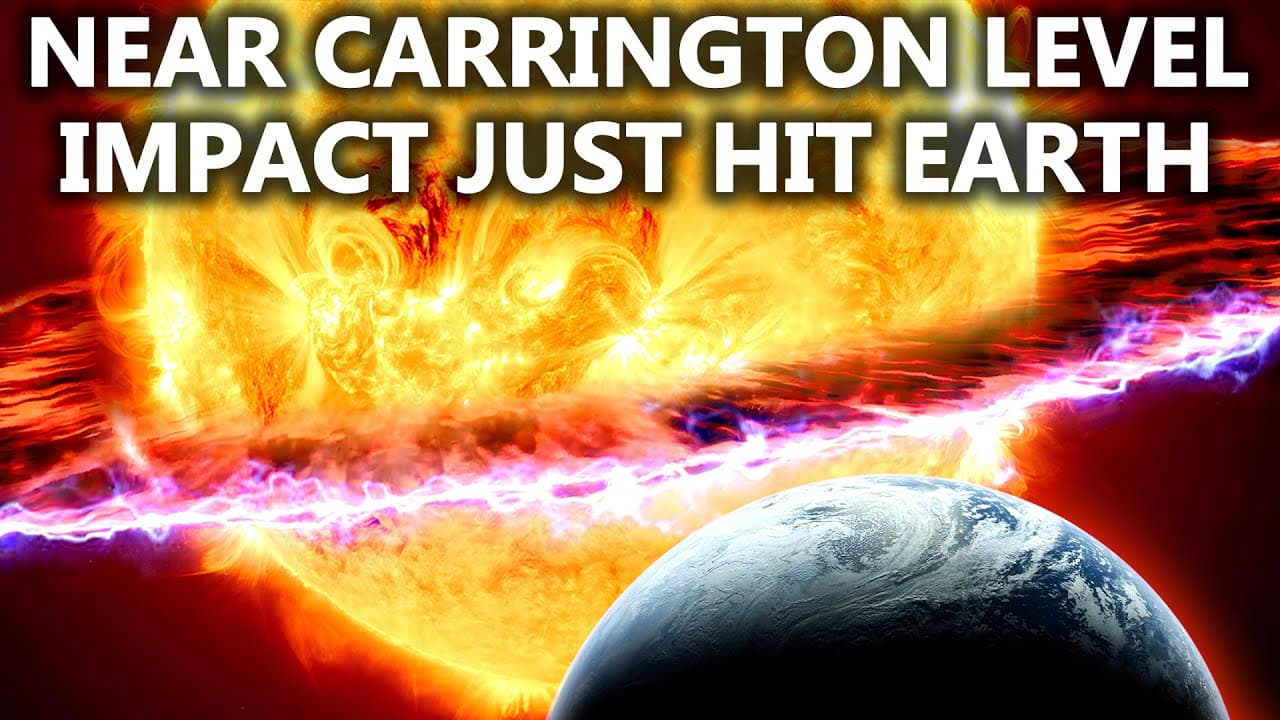
The historic solar storm compressed Earth’s magnetosphere inside geosynchronous orbit and potentially exposed satellites directly to incoming solar plasma and magnetic fields. It brought an S4 radiation storm, solar wind near 1,000 kilometers per second, and a shock magnetic field above 90 nanotesla, but its mainly northward BZ limited sustained geomagnetic escalation. Read on to understand why its speed, field strength, and orientation produced such an unusual impact.
Transcript
Hey everyone, geoysicist Stefon Burns here. We are right now in a historic solar storm impact. Really, this can't be uh stated enough. This is a historic solar storm that's coming in right now. Uh we had an S4 radiation storm, the strongest in 20 years. Solar wind velocity right now is over a thousand kilometers per second for the bulk of the solar... Read More
Key Insights
- Transit time signals exceptional speed: The storm crossed the distance from the Sun to Earth in about 30 hours, which Burns classifies as very fast. That rapid arrival aligns with the measured solar wind remaining near 1,000 kilometers per second. The speed matters because it helps explain the forceful shock and the pronounced compression visible in the magnetosphere animations.
- Sustained velocity was especially unusual: Solar wind remained near 1,000 kilometers per second for about six hours and briefly approached 1,200 kilometers per second. Burns contrasts that persistence with strong impacts that may initially reach 700 or 800 kilometers per second before rapidly declining. Here, the continued velocity prolonged the pressure applied to Earth’s magnetic environment.
- Radiation reached the severe category: The event produced an S4 severe radiation storm, described as the strongest in 20 years and the strongest since the Halloween storms of 2003. This classification was one reason Burns repeatedly called the impact historic. It occurred alongside an immediate G4 geomagnetic storm rather than as an isolated radiation measurement.
- Magnetic strength rose dramatically: The shock magnetic field exceeded 90 nanotesla, while the ongoing field remained above 60 nanotesla. The existing measurements compare this with an ordinary value near 5 nanotesla, making the shock level roughly 18 times that reference value. Burns treats values above 50 nanotesla as evidence of an unusually large impact.
- Orientation controlled the final response: A powerful magnetic field does not automatically produce the strongest possible geomagnetic storm. The BZ component must be oriented favorably for strong coupling with Earth. When BZ became northward, the storm retained exceptional speed and total field strength, but it could not sustain KP 9 or G5 conditions.
- Southward BZ strengthened coupling: Early in the impact, BZ became strongly negative, meaning the interplanetary magnetic field pointed southward. That orientation supported a strong connection with Earth’s magnetic field and drove intense geomagnetic activity. The subsequent northward turn explains why the initial escalation did not continue at the same level despite the storm’s remaining power.
- KP captured the sudden disturbance: The KP index moved from very quiet conditions before arrival to 8.33 immediately after the shock, then reached 8.67 during a later three-hour interval. Because the KP scale stops at 9, Burns also refers to the higher-resolution HP measure. HP recorded a value of 10 for one hour.
- The magnetopause moved inside satellites: The sunward magnetopause is described as normally lying near 10 Earth radii, but the storm compressed it inside geosynchronous orbit at 5.6 Earth radii. This placed that orbital region beyond the compressed magnetic boundary. Satellites there were therefore potentially exposed directly to the storm’s plasma and magnetic field.
- Visualizations show impact progression: The magnetosphere animations depict the moments before the storm, the arrival of its first shock, and the resulting compression. Their velocity scale becomes entirely red because the storm exceeded the displayed level near 600 kilometers per second. Burns explicitly warns that these animations illustrate the process better than they provide extractable numerical data.
- Carrington remained substantially faster: Burns says the current event was not a Carrington-level impact. Carrington is described as reaching Earth in about 16 hours, within an estimated range of 14 to 20 hours, compared with roughly 30 hours here. It also carried a strong magnetic field oriented to connect effectively with Earth, unlike the later northward field in this storm.
- The 1972 comparison emphasizes luck: Burns likens the magnetic configuration to the 1972 solar storm, which he calls the lucky storm because its orientation avoided a much larger disturbance. Nevertheless, he says that earlier event set off recently deployed sea mines near Vietnam. The comparison separates a storm’s raw speed and strength from the consequences permitted by its magnetic orientation.
- Forecast claims remain the speaker’s view: Burns says he forecast the storm more than a year in advance by following historic planetary geometry and later focused on January 2026 as a period with a higher likelihood of powerful solar storms. He also interprets northward fields as affecting global electric circuits, telluric currents, and earthquake activity. These are presented as his analysis rather than measurements establishing causation.
Install to Summarize YouTube Videos and Get Transcripts
Explore YouTube Video Summarizer or Get YouTube Transcript Extractor
Questions & Answers
Q: How strong was the historic solar storm when it reached Earth?
It produced an S4 severe radiation storm, described as the strongest in 20 years and since the Halloween storms of 2003. The shock magnetic field rose above 90 nanotesla, compared with an ordinary value near 5 nanotesla. Solar wind stayed near 1,000 kilometers per second for roughly six hours, while KP reached 8.33 and later 8.67. These combined measurements explain why Burns calls the impact historic, even though its magnetic orientation prevented sustained G5 conditions.
Q: How fast did the solar storm travel from the Sun to Earth?
The storm reached Earth in about 30 hours, or slightly less. Burns defines any transit under 30 hours as very fast, and the measured solar wind remained near 1,000 kilometers per second after arrival. He contrasts that journey with the Carrington event’s roughly 16-hour transit. The shorter Carrington time is one reason he explicitly says the current event was not at Carrington level.
Q: Why did the solar storm not sustain G5 conditions?
The limiting factor was the orientation of the interplanetary magnetic field, especially its BZ component. BZ initially turned strongly negative, or southward, allowing effective coupling with Earth and intense geomagnetic activity. It later became strongly positive, or northward, which weakened that coupling even while the total field and solar wind stayed powerful. The storm therefore approached the top of the KP scale without sustaining KP 9 and G5 conditions.
Q: What does BZ mean during this solar storm?
BZ is the north-south component of the interplanetary magnetic field described by Burns. A negative BZ points southward and connects more effectively with Earth’s magnetic field, supporting stronger geomagnetic activity. A positive BZ points northward and limited this storm’s ability to sustain its most extreme response. This distinction explains why field orientation mattered as much as the field’s unusually high numerical strength.
Q: How did the storm change Earth’s magnetosphere?
The storm sharply compressed the sunward side of Earth’s magnetosphere. Its boundary is described as normally being near 10 Earth radii, but the impact pushed it inside geosynchronous orbit at 5.6 Earth radii. Animations of velocity, density, and pressure show the first shock arriving and the magnetic region being crunched toward Earth. The compression resulted from the storm’s exceptional solar-wind speed, pressure, and magnetic field.
Q: Why were geosynchronous satellites potentially exposed?
Geosynchronous orbit is identified at about 5.6 Earth radii in the source material. The storm compressed the magnetopause inward beyond that orbital distance, removing the usual magnetic shielding from part of the region. Satellites there could consequently face the incoming solar plasma and magnetic field more directly. The concern arose from the boundary’s measured position, not merely from the S4 radiation classification.
Q: Was this solar storm comparable to the Carrington event?
Burns calls the storm historic but states that it was not a Carrington-level impact. The current storm took about 30 hours to reach Earth, while Carrington is described as arriving in roughly 16 hours. Carrington also had an extremely strong field oriented to connect effectively with Earth. In this event, the later northward magnetic configuration limited the geomagnetic response despite the extraordinary speed and field strength.
Q: What did the KP and HP readings show?
KP rose from very quiet conditions before the shock to 8.33 immediately after it arrived. It later reached 8.67 during another three-hour period, placing the storm close to the KP scale’s maximum of 9. Because KP cannot represent values above 9, Burns also cites a higher-resolution HP measurement of 10 for one hour. Together, the readings show a sudden and extremely intense geomagnetic disturbance that stopped short of sustained maximum classification.
Summary & Key Takeaways
-
A historic impact begins: Geophysicist Stefon Burns describes an ongoing solar storm with an S4 radiation event, the strongest in 20 years and since the Halloween storms of 2003. The storm traveled from the Sun to Earth in about 30 hours and maintained solar wind near 1,000 kilometers per second for roughly six hours. Its shock magnetic field exceeded 90 nanotesla, establishing an unusually powerful combination of speed, radiation, and magnetic intensity.
-
Earth’s magnetic shield compresses: Magnetosphere visualizations show the initial shock striking Earth and sharply compressing the sunward magnetic boundary. The displays depict velocity, density, and pressure, although Burns cautions that they function primarily as visual aids rather than precise sources for extracting data. The velocity view tops out visually near 600 kilometers per second even though the measured solar wind was around 1,000 kilometers per second, leaving the display saturated in red during the impact.
-
Historical comparisons add context: Burns compares the storm’s magnetic configuration with the 1972 event, which he calls the lucky storm because its field orientation did not create a larger geomagnetic disturbance, although that event set off sea mines near Vietnam. He also distinguishes the current impact from the Carrington event. This storm took about 30 hours to arrive, whereas Carrington is described as reaching Earth in roughly 16 hours with a powerful field positioned to connect effectively with Earth.
-
Field orientation limits escalation: The storm’s strength alone did not determine the geomagnetic outcome. Its BZ component initially turned strongly southward, enabling an effective connection with Earth’s magnetic field, but later became strongly northward. That change prevented the powerful solar wind and total magnetic field from sustaining the most extreme response. Burns also links the northward configuration to global electric-circuit charging, telluric currents, and possible high-magnitude earthquake activity as his interpretation.
-
Real-time measurements reveal severity: Earth’s geomagnetic field was very quiet immediately before the shock, then the KP index jumped to 8.33 and later reached 8.67 on a scale capped at 9. A higher-resolution HP measurement recorded 10 for one hour. The magnetosphere was compressed inside geosynchronous orbit at 5.6 Earth radii, potentially placing satellites outside its usual protection while the solar wind continued carrying exceptional speed, pressure, and magnetic strength toward Earth.
Read in Other Languages (beta)
Share This Summary 📚
Summarize YouTube Videos and Get Video Transcripts with 1-Click
Try YouTube Summary with ChatGPT & Claude or YouTube Transcript Generator
Explore More Summaries from Stefan Burns 📚

Summarize YouTube Videos and Get Video Transcripts with 1-Click
Try YouTube Summary with ChatGPT & Claude or YouTube Transcript Generator