Why Is 3I/ATLAS Brightening Faster Than Expected?
TL;DR
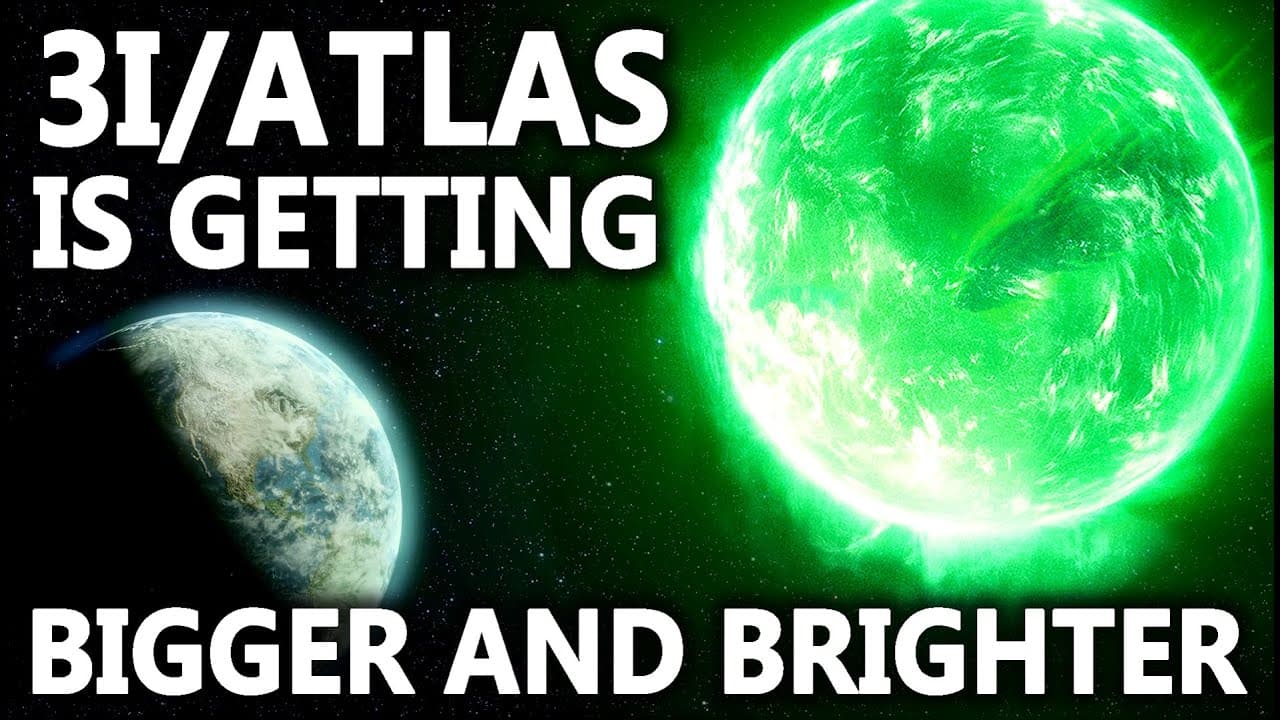
3I/ATLAS may be brightening faster than expected because stronger solar heating is expanding its dusty plasma coma and driving greater sublimation from its nucleus, although differences in instruments and camera apertures may affect the measurements. Its apparent magnitude reached about 12 after it moved within two astronomical units of the Sun. Read on to understand the evidence, uncertainties, and upcoming observation opportunities.
Transcript
Hey everyone, geoysicist Stefan Burns here. Threeey atlas, this mysterious interstellar object which first was detected in July of this year, speeding into our solar system at about 60 kilometers per second, now is within two astronomical units of the sun. Meaning it's closer to the main engine of energy and life in our solar system. And as a resul... Read More
Key Insights
- 3I/ATLAS is only the third detected interstellar object, and it entered the solar system at about 60 kilometers per second. Its velocity is expected to increase to approximately 68 kilometers per second near perihelion before decreasing again.
- The observed brightness of 3I/ATLAS rose sharply around September 7 to 15, near the time it moved within two astronomical units of the Sun. The reported increase is about 20-fold compared with its earlier measured brightness.
- The brightness increase remains uncertain because different telescopes, camera apertures, and assumptions about coma size can produce different apparent-magnitude results. The limited number of observations also makes it difficult to determine how far the object has departed from its predicted light curve.
- The coma of 3I/ATLAS is a complex mixture of dust, gas, and plasma. Its expansion and brightness may result from stronger sublimation, newly volatilized molecules, increased activity at the nucleus, or some combination of these processes.
- The latest discussed image from September 17 shows 3I/ATLAS with a strong green color. C2 is identified as the primary possible source of green optical emission, although initial observations did not indicate an overabundance of that molecule.
- The high velocity of 3I/ATLAS causes it to pass through changing levels of solar heating faster than ordinary solar-system comets. As it approaches the Sun, new materials may rapidly volatilize and alter the composition of its surrounding coma.
- The object will become difficult to observe near its October 21 superior conjunction because Earth, the Sun, and 3I/ATLAS will be approximately aligned. Solar glare will therefore restrict useful Earth-based observations around this critical period.
- The October 3 Mars flyby provides an important observational opportunity. Multiple orbiters and probes are expected to target 3I/ATLAS, measuring its brightness and spectrum while potentially helping researchers constrain the size of its nucleus.
Install to Summarize YouTube Videos and Get Transcripts
Explore YouTube Video Summarizer or Get YouTube Transcript Extractor
Questions & Answers
Q: Why is 3I/ATLAS brightening faster than expected?
3I/ATLAS may be brightening because stronger solar heating is increasing sublimation and expanding its coma as it approaches the Sun. The transcript also says the brightening appears to come from the nucleus, though differences among instruments and camera apertures leave the exact cause uncertain.
Q: How bright is 3I/ATLAS now?
3I/ATLAS had reached an apparent magnitude of about 12 at the time described. Its brightness rose sharply between approximately September 7 and September 15, around when it moved within two astronomical units of the Sun.
Q: What is the coma of 3I/ATLAS made of?
The coma is a complex mixture of dust, gas, and plasma, described as a dusty plasma. Solar heating causes materials to volatilize and influence the coma’s composition as 3I/ATLAS moves closer to the Sun.
Q: How large has the coma of 3I/ATLAS become?
Earlier SPHEREx observations indicated that the coma had grown to about half the size of the Sun. The transcript says it appears to be getting even larger day by day as the object approaches the Sun.
Q: How does the speed of 3I/ATLAS affect its activity?
3I/ATLAS entered the solar system at about 60 kilometers per second, with its speed expected to increase to approximately 68 kilometers per second near perihelion. This rapid motion takes it through changing levels of solar heating faster than ordinary comets, accelerating its sublimation processes and evolution.
Q: Why are measurements of 3I/ATLAS’s brightening uncertain?
Brightness estimates come from amateur astronomers and professional facilities using different instruments, apertures, and methods. Researchers are therefore debating how much of the apparent increase reflects genuine nucleus activity or coma expansion and how much results from observational differences.
Q: Why will 3I/ATLAS become difficult to observe in October?
On October 21, 3I/ATLAS will undergo superior conjunction, placing Earth, the Sun, and the object approximately in a line. The Sun’s glare will then make reliable Earth-based detection increasingly difficult around its late-October perihelion.
Q: What could scientists learn during the October 3 Mars flyby?
Orbiters and probes on and around Mars are expected to measure 3I/ATLAS during its close flyby on October 3. Their images and spectral observations could document its brightness and composition and may help constrain the size of its nucleus.
Summary & Key Takeaways
-
3I/ATLAS is an interstellar object traveling toward the Sun at about 60 kilometers per second. After moving within two astronomical units of the Sun, it brightened more sharply than its expected light curve predicted. Observers are debating whether this reflects genuine physical activity, an expanding coma, or differences among instruments and apertures.
-
Its coma contains dust, gas, and plasma, and earlier observations indicated that it had grown to about half the size of the Sun. A September 17 image also showed a strong green color, possibly associated with C2. This may indicate that additional molecules are volatilizing as solar heating intensifies near perihelion.
-
Observations will become increasingly difficult because solar glare will obscure 3I/ATLAS around its superior conjunction on October 21. A close Mars flyby on October 3 offers an opportunity for orbiters and probes to measure its brightness, spectrum, and possibly constrain its nucleus size before the object reaches perihelion in late October.
Read in Other Languages (beta)
Share This Summary 📚
Summarize YouTube Videos and Get Video Transcripts with 1-Click
Try YouTube Summary with ChatGPT & Claude or YouTube Transcript Generator
Explore More Summaries from Stefan Burns 📚





Summarize YouTube Videos and Get Video Transcripts with 1-Click
Try YouTube Summary with ChatGPT & Claude or YouTube Transcript Generator