Why Does the Sermon on the Mount Aim Upward?
TL;DR
A worthy ethical aim creates positive emotion by giving people evidence that they are moving toward something better. The Sermon on the Mount presents an upward orientation grounded in faith, truthful speech, love, and embodied action, calling people to support and improve existence despite suffering, malevolence, mortality, and the ambiguity of whether life is fundamentally good.
Transcript
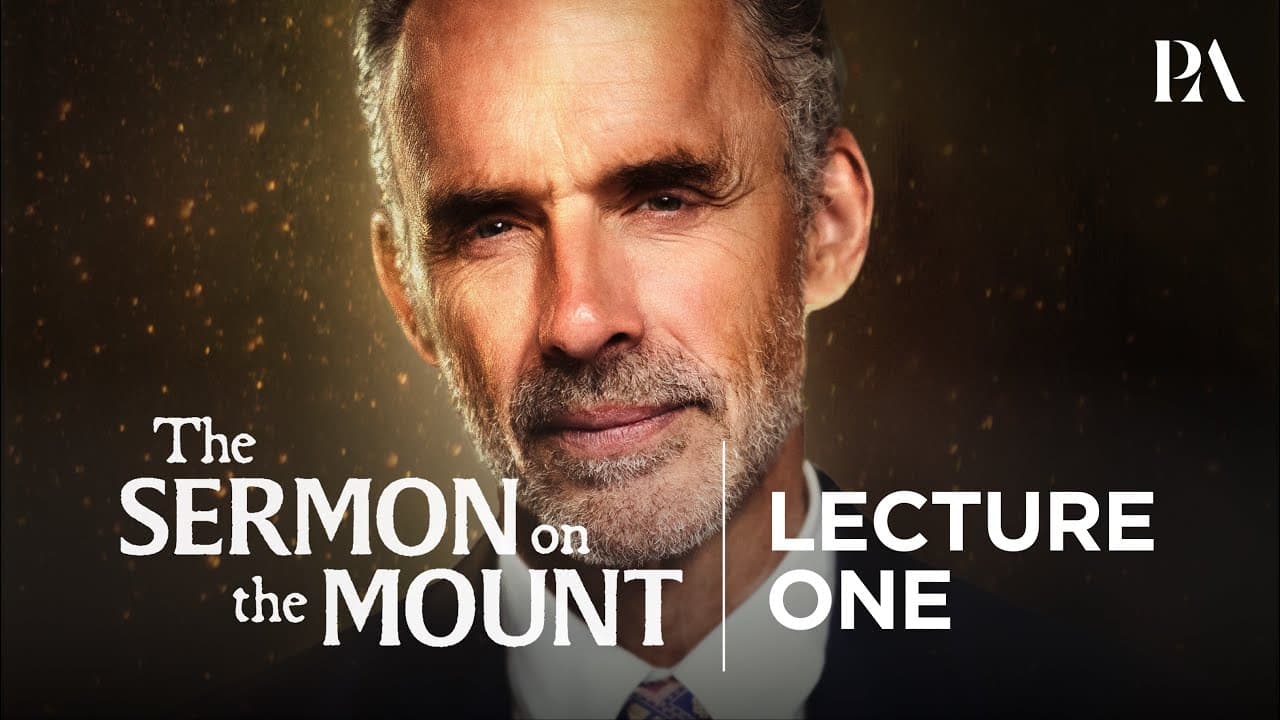
Carl Jung, the great psychoanalyst, he said, "Modern people don't see God because they don't look low enough. That's worth thinking about for the rest of your life." The Sermon on the Mount is the longest continuous discourse [music] attributed to Christ in the Gospels, and it's widely regarded as [music] containing the central doctrines of Christi... Read More
Key Insights
- The Sermon on the Mount is described as the longest continuous discourse attributed to Christ in the Gospels and as a condensed presentation of central Christian doctrines. Its central practical question concerns what a person or an entire society should aim toward.
- The mountain is a symbol of enlightenment because its height provides visibility, light, distance, and proximity to the heavens. By contrast, a valley restricts vision, so the elevated setting embodies the broader perspective associated with wisdom and orientation.
- Human life is framed as a navigation problem because people are mobile creatures continually deciding what to do next. Movement requires a destination, and a worthwhile destination must represent an improvement, which gives upward direction its ethical and motivational significance.
- Speech is presented as a creative force that shapes both personal destiny and the lives of other people. Christian doctrine portrays the truthful Word, oriented by love, as bringing habitable order from chaos, while human beings participate in that ordering process.
- Love is defined as the commitment to support and improve the world despite its suffering and malevolence. This commitment resists bitterness, resentment, and destructiveness, even when personal vulnerability and the harmful actions of oneself or others make existence difficult.
- Faith is necessary because the evidence for the goodness of existence is described as ambivalent. The religious commitment is to proceed as though being, individual life, other people’s lives, and life in general deserve a fundamentally benevolent response.
- Christ is presented as a carpenter to emphasize embodiment rather than detached thought or priestly status. Christian teaching is therefore interpreted as a pattern of behavior to emulate, act out, and embody through practical conduct rather than merely conceptual agreement.
- Positive emotion is associated primarily with noticing progress toward a valued goal, not with possessing an achievement. Attainment brings only fleeting satisfaction, while movement toward a vital ethical aim supplies enthusiasm and helps sustain a person through life.
Install to Summarize YouTube Videos and Get Transcripts
Explore YouTube Video Summarizer or Get YouTube Transcript Extractor
Questions & Answers
Q: Why is the Sermon on the Mount set on a mountain?
The mountain represents enlightenment, expanded vision, and upward orientation. A person in a valley is hemmed in and cannot see far, while someone on a mountaintop has greater light and perspective and is symbolically closer to heaven. Because people historically orient themselves by heavenly bodies, the elevated setting also connects wisdom with navigation, attention, and the pursuit of something better.
Q: What should a person aim for according to this lecture?
A person should aim upward toward something ethically better and sufficiently meaningful to organize action. The lecture associates this direction with the city on the hill, the coming of God’s kingdom, and Christ-like conduct. The aim should guide movement from the present condition toward improvement while producing the positive emotion that arises when meaningful progress becomes visible.
Q: How does speech shape a person’s future?
Speech shapes the future by influencing what becomes real in personal and shared life. The lecture connects this power with the Mesopotamian image of Marduk speaking magic words and with the Christian doctrine of the Word. What a person says changes personal destiny and affects others, so truthful speech oriented by love can help transform chaos and potential into habitable order.
Q: Why does Christian faith require a commitment to existence?
Christian faith requires people to act as though existence deserves benevolent support even when the available evidence is ambivalent. Suffering, mortality, human malevolence, historical catastrophe, and ecological danger can support bitterness or rejection of life. Faith supplies the presupposition that one should nevertheless support life, improve what causes torment, and resist becoming resentful, destructive, or hostile toward being itself.
Q: What does love mean in the lecture’s interpretation?
Love means treating the world as worth supporting and working to improve despite its suffering and malevolence. It is a demanding commitment because tragedy, personal wrongdoing, and the harmful actions of others can produce bitterness and resentment. Love therefore appears as an active orientation toward repairing what causes suffering, including destructive tendencies within oneself, rather than as a merely pleasant feeling.
Q: How are meaningful goals connected to positive emotion?
Positive emotion comes largely from recognizing movement toward a valued goal, rather than from reaching the goal itself. Achievement may provide satisfaction, but that feeling is fleeting because a new question immediately appears: what comes next? A vital aim creates enthusiasm during the journey, and the more meaningful the aim is, the stronger the positive emotion associated with observable progress can become.
Q: Why is Christ described as a carpenter rather than a thinker?
Christ’s identity as a carpenter is used to emphasize Christianity’s focus on embodiment. The teaching is presented not simply as an abstract theory, an intellectual position, or a priestly doctrine, but as a pattern of behavior that people should emulate and enact. The relevant principles become meaningful through truthful speech, constructive work, ethical direction, and conduct that supports and improves life.
Q: How do ancient symbols of vision support the lecture’s argument?
Ancient symbols of vision connect attention with wisdom, height, and effective orientation. Horus is represented by the eye and the falcon, an animal associated with clear sight from above. Marduk is described as having eyes around his head and the power of speech. These images support the claim that seeing broadly, attending carefully, and speaking effectively are central to ordering life.
Summary & Key Takeaways
-
The Sermon on the Mount is presented as the longest continuous discourse attributed to Christ in the Gospels and a condensed expression of central Christian doctrines. Its mountain setting symbolizes enlightenment, expanded vision, heaven, orientation, and the upward direction associated with pursuing something better than one’s present condition.
-
Peterson connects Christian teaching with Egyptian, Mesopotamian, and Jungian symbolism. Horus and the falcon represent elevated attention and clear vision, while Marduk represents perception and powerful speech. Christian doctrine develops this theme through the Word, portrayed as the creative process that brings habitable order from chaos and potential.
-
Faith means acting as though existence deserves benevolent support despite suffering, mortality, human corruption, and historical catastrophe. Because the evidence for life’s goodness is described as ambivalent, the commitment must be enacted through truthful speech, love, and constructive behavior. A meaningful ethical aim then provides direction, enthusiasm, and sustaining positive emotion.
Read in Other Languages (beta)
Share This Summary 📚
Summarize YouTube Videos and Get Video Transcripts with 1-Click
Try YouTube Summary with ChatGPT & Claude or YouTube Transcript Generator
Explore More Summaries from Jordan B Peterson 📚
Summarize YouTube Videos and Get Video Transcripts with 1-Click
Try YouTube Summary with ChatGPT & Claude or YouTube Transcript Generator