How Do Power Laws Break Standard Statistics?
TL;DR
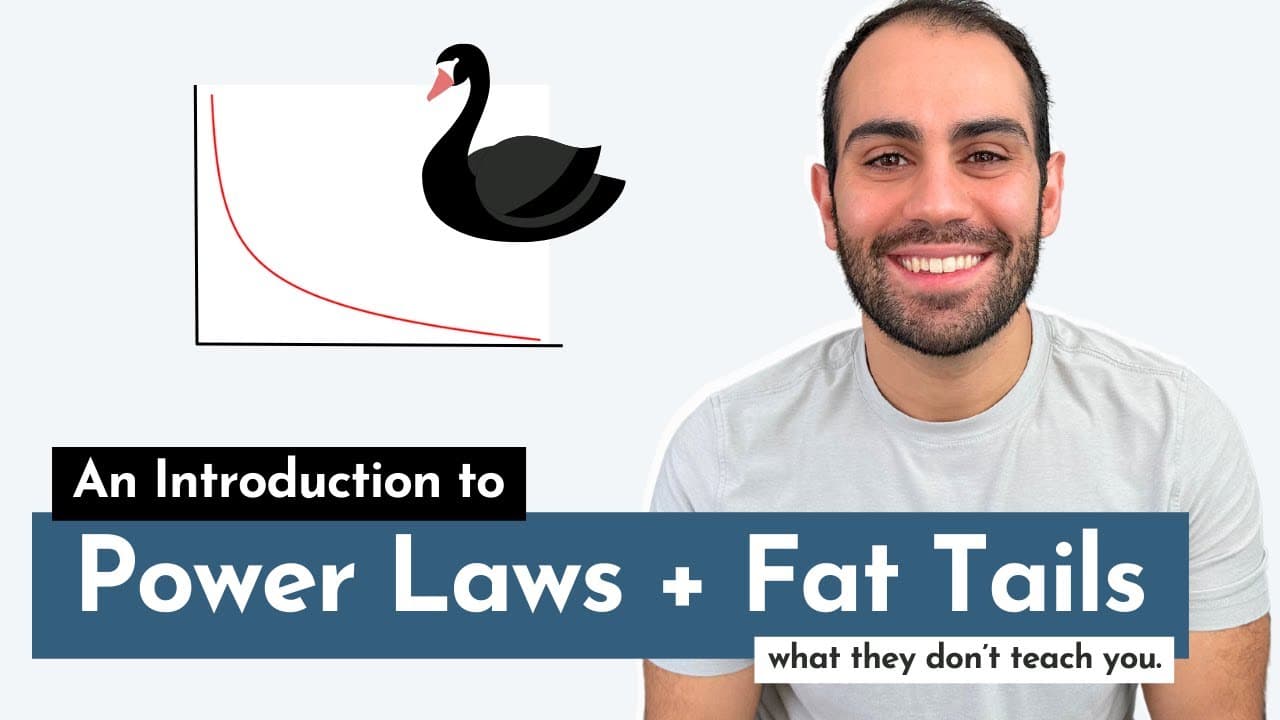
Power-law data can make familiar statistics, especially the sample mean, unstable and misleading because rare, extreme observations can dominate the result. Unlike Gaussian data, which clusters around a typical value, power-law data has a substantial tail and may require far more observations before sample estimates approach the underlying distribution’s true values.
Transcript
statistics is the Bedrock of Science and data analysis this is why we all learn about it in some form or fashion in school however many of our favorite statistical techniques are completely useless when applied to a certain type of data this specific type of data are called Power laws in this video I'll be giving a beginner friendly introduction to... Read More
Key Insights
- Gaussian data is concentrated around a typical value, with observations becoming rapidly less common toward both tails. This structure allows the mean to summarize much of the essential information, while standard deviation or variance measures how widely the observations are spread.
- The Pareto principle originated in the study of Italian land ownership, where Vilfredo Pareto found that about 80 percent of the land was owned by about 20 percent of the citizens. Its business application to sales came later.
- A power law is a broader distribution class that includes the Pareto distribution. Its probability density involves a slowly varying function, a random variable, a shape parameter called alpha, and a minimum value beyond which the power law is defined.
- Mediocristan is Nassim Nicholas Taleb’s label for Gaussian-like data, where no single observation significantly changes aggregate statistics. Adding the heaviest available Italian to a sample of 1,000 people only moves the stated average weight from 175 pounds to 175.2 pounds.
- Extremistan is Taleb’s label for Pareto-like data, where one extreme observation can dominate an aggregate statistic. Adding the richest Italian to a 1,000-person sample raises the stated average net worth from about $300,000 to $7.5 million, roughly a 25-fold increase.
- Power-law behavior appears in consequential quantities such as wealth, sales, city populations, pandemic outcomes, deaths in wars and terrorist attacks, word occurrences, academic citations, and company sizes. These quantities cannot safely be treated as if they always cluster around representative averages.
- The law of large numbers states that a sample mean approaches the true mean as the number of random samples approaches infinity. It applies to Gaussian, Pareto, uniform, and log-normal distributions when their means are finite, but practical analysis always relies on finite data.
- The sample mean of power-law data converges much more slowly than the sample mean of Gaussian data. The presented comparison shows the power-law estimate remaining biased and erratic across 100, 1,000, 10,000, and even 100,000 observations, while the Gaussian estimate stabilizes much sooner.
Install to Summarize YouTube Videos and Get Transcripts
Explore YouTube Video Summarizer or Get YouTube Transcript Extractor
Questions & Answers
Q: What is the difference between Gaussian and power-law data?
Gaussian data clusters around a typical value and decays rapidly toward its tails, so its mean provides a useful summary of what an ordinary observation might look like. Power-law data lacks the same representative center and places more data in its tail. As a result, rare extreme observations can strongly affect aggregates, and the sample mean may remain unstable for large finite samples.
Q: Why can the mean be misleading for power-law data?
The mean can be misleading because a finite sample may not adequately capture the extreme observations that strongly influence a power-law distribution. When an extreme value eventually appears, it can move the average dramatically. The sample mean therefore converges more slowly, behaves more erratically, and may stay biased even when the dataset contains thousands or tens of thousands of observations.
Q: What is the Pareto principle and where did it originate?
The Pareto principle is commonly expressed as the 80/20 rule, such as the claim that 80 percent of sales come from 20 percent of customers. It originated with Italian economist and mathematician Vilfredo Pareto, who observed that about 80 percent of Italy’s land was owned by about 20 percent of its citizens, indicating a strongly unequal distribution.
Q: What do Mediocristan and Extremistan mean in statistics?
Mediocristan and Extremistan are categories used by Nassim Nicholas Taleb in The Black Swan. Mediocristan describes Gaussian-like quantities for which no single observation significantly changes aggregate statistics. Extremistan describes Pareto-like quantities for which one observation can dominate an aggregate. Weight illustrates Mediocristan, while wealth, city populations, sales, citations, and company sizes illustrate Extremistan.
Q: How can one observation change an average in Extremistan?
A single extreme observation can be large enough to dominate the total from which an average is calculated. In the example, 1,000 people have an average net worth of about $300,000. Adding the richest Italian raises that average to $7.5 million, an increase of roughly 25 times. Such sensitivity makes an ordinary average a weak description of power-law data.
Q: Does the law of large numbers apply to Pareto distributions?
The law of large numbers applies to a Pareto distribution when it has a finite mean, just as it applies to Gaussian, uniform, and log-normal distributions with finite means. However, the theorem describes convergence as the number of samples approaches infinity. Real datasets are finite, and convergence of a power-law sample mean can be far slower and less stable than Gaussian convergence.
Q: How much data is needed for a stable power-law mean?
No universal finite sample size is given in the source. The comparison shows that a power-law sample mean can remain erratic and biased at 100, 1,000, 10,000, and even 100,000 observations. The central lesson is that sample size standards suitable for Gaussian data cannot automatically be transferred to power-law data, because the latter’s mean converges much more slowly.
Q: What real-world quantities can follow power-law patterns?
The examples include wealth, sales, city populations, pandemic outcomes, deaths in wars and terrorist attacks, word occurrences in text, academic citations, and company sizes. In these settings, a small number of observations can account for much of the total. That concentration distinguishes them from Gaussian-like quantities such as weight, height, IQ, blood pressure, calorie consumption, and test scores.
Summary & Key Takeaways
-
Gaussian distributions describe quantities that cluster around a typical value and decay rapidly toward their tails. For this kind of data, the mean represents the distribution well, while standard deviation and variance describe its spread. Examples presented include weight, height, IQ, blood pressure, calorie consumption, test scores, car accidents, and mortality rates.
-
Pareto distributions belong to the broader power-law class and do not cluster around a representative typical value. The 80/20 rule originated with Vilfredo Pareto’s observation that about 80 percent of Italian land was owned by about 20 percent of citizens. Similar patterns appear in wealth, sales, city populations, citations, word occurrences, and company sizes.
-
Traditional statistical techniques can become unreliable for finite samples of power-law data. Although the law of large numbers applies to distributions with finite means, convergence is much slower for power laws than for Gaussian distributions. Consequently, a power-law sample mean can remain biased, erratic, and sensitive to new extreme observations even with 100,000 observations.
Read in Other Languages (beta)
Share This Summary 📚
Summarize YouTube Videos and Get Video Transcripts with 1-Click
Try YouTube Summary with ChatGPT & Claude or YouTube Transcript Generator
Explore More Summaries from Shaw Talebi 📚






Summarize YouTube Videos and Get Video Transcripts with 1-Click
Try YouTube Summary with ChatGPT & Claude or YouTube Transcript Generator