How to Optimize AI Agents with Harness Engineering
TL;DR
Improve an AI agent by optimizing the context it receives, the tools it can use, and the automations that run its workflows, then evaluate the results. Start with persistent instructions and reusable skills, connect relevant external sources and services, and choose a harness whose customization level matches both the task and your technical expertise.
Transcript
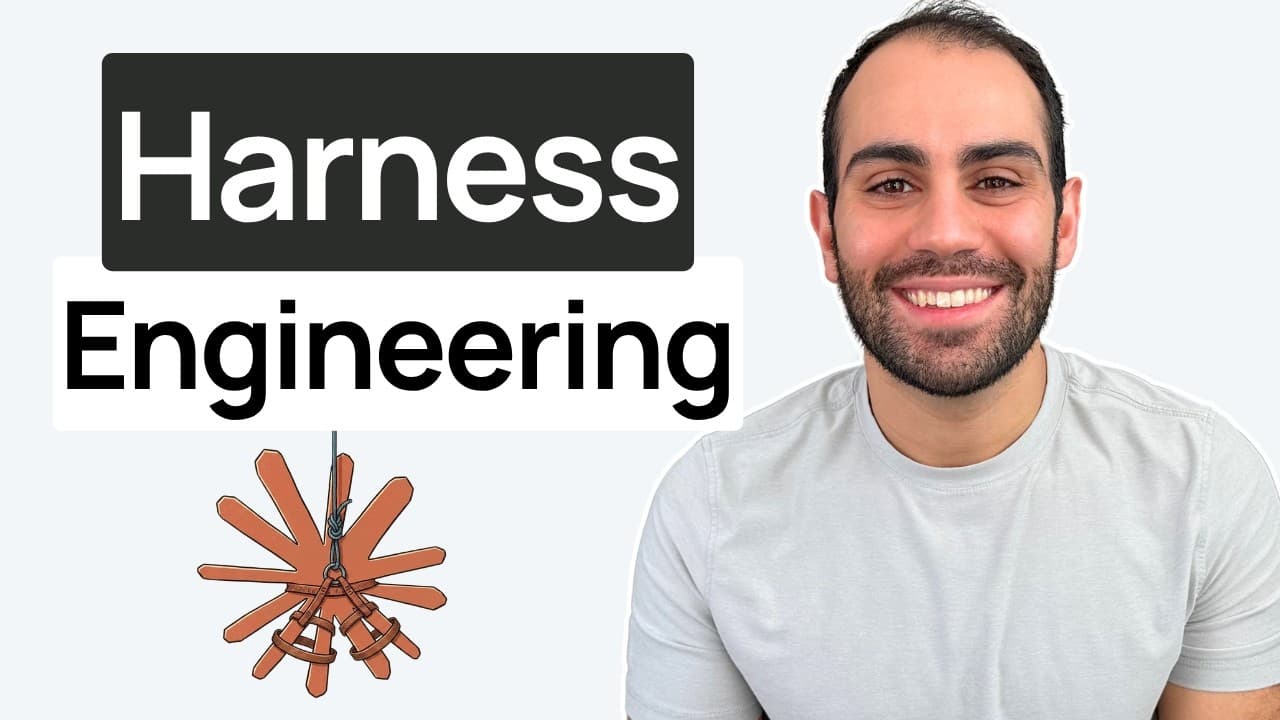
Hey everyone, I'm Sha. In this video, I'm going to explain harness engineering. I'll discuss what it is and why it matters and then talk about three levers you can use to optimize your favorite AI tools. Before we talk about harness engineering, we should first define this term of a harness. And all this is is everything that's built around an AI m... Read More
Key Insights
- An agent harness is everything surrounding an AI model that makes it more helpful, much as a vehicle surrounds its engine with steering, wheels, seats, displays, and a body that turn raw power into something people can practically use.
- Harness engineering has three levels: configuring an off-the-shelf AI product, deeply customizing a more powerful coding-oriented tool, or building a complete harness around an API or open-source model. Greater control also demands greater expertise from the person creating and operating the system.
- The three primary optimization levers are context, tools, and automations, with evaluations presented as an additional lever. These categories provide a practical framework for improving how an existing AI product supports particular tasks without requiring every user to build an entirely custom application.
- Context is the collection of instructions, knowledge, and data made available to an agent. It can include provider-written system instructions, automatically injected metadata, saved memories, persistent guidance files, reusable skills, local files, cloud folders, databases, and information stored in productivity or documentation applications.
- Persistent instruction files are loaded into new conversations and can establish guidance that should apply repeatedly. Because their contents consume attention in every conversation, they are best suited to genuinely recurring requirements, such as asking an agent to identify possible improvements after it uses a skill.
- A skill is a folder containing a required instruction file and optional references, assets, folders, or executable code. It can replace a sophisticated reusable prompt while also supplying supporting materials, such as documentation, a company logo, a presentation template, or a script that the agent can run.
- Progressive disclosure is a method for giving an agent the right context at the right time. The harness initially exposes only each skill's name and description, then loads the detailed instructions and supporting files when a user's task makes that specific skill relevant.
- Tools are actions that let an agent interact with external applications and services. Connectors and MCP servers can retrieve relevant context and can also write information, enabling workflows such as reviewing calendars, CRM notes, and emails, drafting messages, creating invitations, and preparing meeting pages.
Install to Summarize YouTube Videos and Get Transcripts
Explore YouTube Video Summarizer or Get YouTube Transcript Extractor
Questions & Answers
Q: What is an AI agent harness?
An AI agent harness is everything built around an AI model to make it more helpful. The model can be compared to a car engine, while the harness resembles the wheels, body, seats, steering wheel, and instrument cluster. Those surrounding components transform the underlying model into a practical tool that can receive context, use tools, and support workflows.
Q: What are the three levels of harness engineering?
The three levels begin with customizing an off-the-shelf AI product, continue with tuning a more flexible coding-oriented tool, and end with building a custom harness around an API or open-source model. Each level provides more freedom and control than the previous one, but the more customizable approaches also require greater technical knowledge and operating expertise.
Q: What are the main levers of harness engineering?
The three main levers are context, tools, and automations. Context determines which instructions, knowledge, and data the agent can access. Tools determine which external applications and services it can interact with. Automations form the third category for optimizing workflows. Evaluations are also identified as a bonus lever for assessing the harness and its results.
Q: How can context improve an AI agent?
Context improves an agent by supplying the instructions, knowledge, and data needed for the current task. Useful sources include system instructions, metadata, memories, persistent instruction files, skills, desktop files, cloud folders, databases, and documentation systems. The goal is to make relevant information accessible without loading large amounts of unrelated material into every conversation.
Q: What is a skill in an AI agent harness?
A skill is a folder that packages instructions and supporting materials for a particular task or workflow. It contains a special instruction file that functions like a reusable prompt, and it may also contain references, documentation, assets, nested folders, or code. An agent can read those resources and execute included scripts when the skill requires them.
Q: How does progressive disclosure work for AI skills?
Progressive disclosure initially shows the agent only the name and description of every installed skill. When a task matches a skill, the agent loads that skill's detailed instruction file and accesses supporting resources as needed. This approach supplies relevant context automatically while avoiding the unnecessary practice of inserting every instruction, reference, asset, and script into every conversation.
Q: Why store AI context in external applications?
External applications let an agent retrieve information when it becomes relevant instead of placing all available material into its initial context. They also keep business knowledge independent from a single AI product. The same information stored in a productivity, documentation, cloud-storage, or database system can therefore remain accessible across several AI tools that have appropriate connections.
Q: What can connectors and MCP servers enable?
Connectors and MCP servers give agents tools for interacting with external services. An agent could examine sales calls from a recent period, compare CRM notes with email threads, and rank leads. It could also draft emails, create calendar invitations across time zones, review the day's meetings, conduct preparation research, and organize the results in a workspace page.
Summary & Key Takeaways
-
An agent harness is everything built around an AI model to make the model more useful. Like a car built around an engine, the harness supplies the surrounding controls and capabilities. Harnesses range from configurable off-the-shelf products to customizable coding tools and fully custom systems built with APIs and application code.
-
Context includes the instructions, knowledge, and data available to an agent. Persistent instruction files can establish recurring guidance, while skills package specialized prompts, references, assets, and executable code. Progressive disclosure helps by loading detailed skill material only when it is relevant instead of placing every available resource into each conversation.
-
Tools let agents interact with external applications and services. Built-in examples include web search and code interpreters, while connectors or MCP servers can provide access to calendars, email, document systems, databases, and business applications. These integrations support both reading information and writing outputs such as drafts, invitations, and organized meeting-preparation pages.
Read in Other Languages (beta)
Share This Summary 📚
Summarize YouTube Videos and Get Video Transcripts with 1-Click
Try YouTube Summary with ChatGPT & Claude or YouTube Transcript Generator
Explore More Summaries from Shaw Talebi 📚

Summarize YouTube Videos and Get Video Transcripts with 1-Click
Try YouTube Summary with ChatGPT & Claude or YouTube Transcript Generator