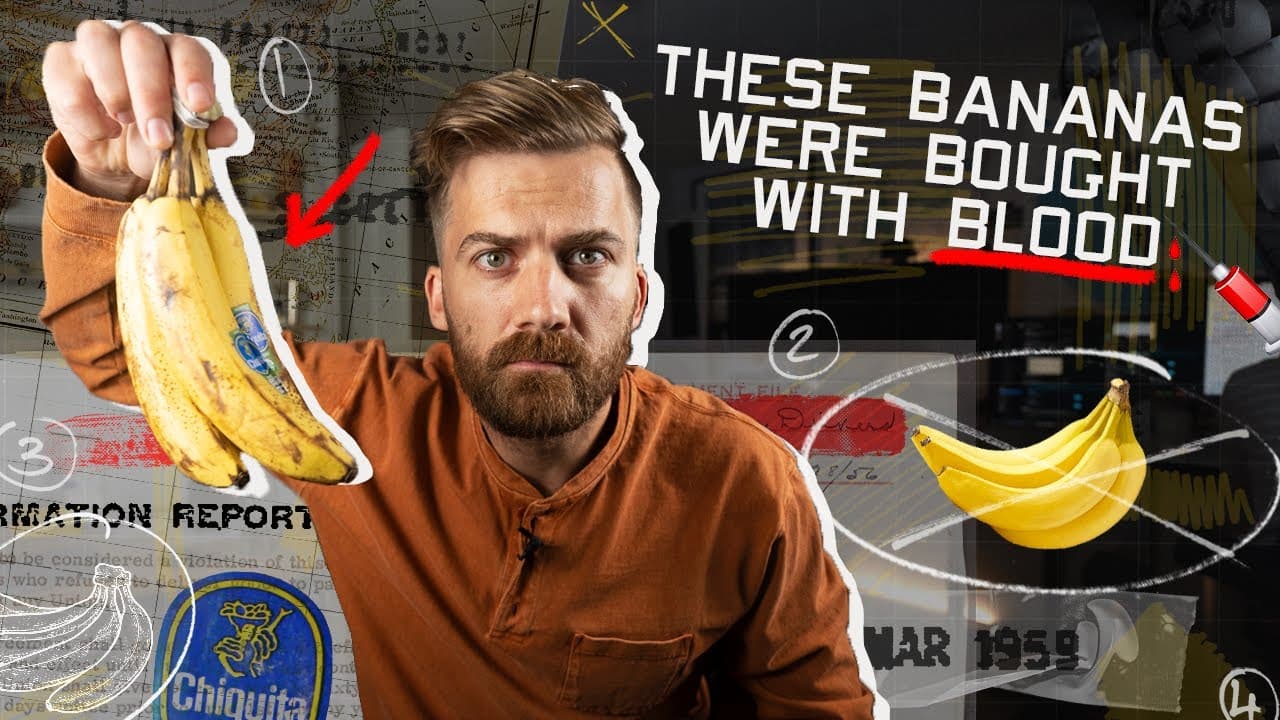
How did the US use bananas to influence Central America?
TL;DR
Banana companies built dominance by controlling land, transportation, and local economies, effectively acting like governments in parts of Central America. They paid workers in vouchers, owned infrastructure, and even toppled governments to protect profits, shaping regional politics and the banana trade for decades.
Transcript
- [Man] The American nation can not, must now, and will not, from empty establishment, form another communist government. - This is called a Cavendish banana. It's the most common banana on earth. It's probably the one that you have in your kitchen right now. It's definitely the one you see in the grocery store. This banana was created in a fancy l... Read More
Key Insights
- Banana companies attempted to control the supply chain from farm to market to protect profits.
- The United Fruit Company emerged as a dominant force, owning land, railways, and even postal services in several Central American countries.
- Workers were often paid in vouchers usable only at company commissaries, limiting financial independence.
- The company built a private navy and even used its power to influence political processes in the region.
- The term Banana Republic describes countries heavily exploited for a single product, illustrating the political risks of monopolistic control.
- The US government and companies collaborated to install favorable leaders and tax arrangements, cementing influence in Central America.
- Over time, resistance led to political pushback and efforts to regain control of land and resources by local governments.
- The story highlights how imperial business interests can resemble state power, affecting national sovereignty.
Install to Summarize YouTube Videos and Get Transcripts
Explore YouTube Video Summarizer or Get YouTube Transcript Extractor
Questions & Answers
Q: What is United Fruit Company and how did it gain power in Central America?
The United Fruit Company started by seeking to control the supply chain for bananas in Central America, which involved owning land, railways, and communications infrastructure. By consolidating control over production, transport, and distribution, the company effectively amassed power that rivaled governmental authority in several countries, leading to a state of corporate dominance over public life.
Q: How did banana companies influence local governments?
Banana companies extended their reach into governmental functions by leveraging their economic power to influence policy, taxes, and even political leadership. They managed assets and services that resembled state functions and used this leverage to install or support leaders favorable to their business model, thereby shaping national governance structures in the region.
Q: What were the working conditions for banana laborers?
Laborers were paid in vouchers rather than real money and could only spend them at company commissaries. This system created a closed economic loop that limited workers’ purchasing options, reduced financial autonomy, and reinforced dependence on the banana company for basic goods and services.
Q: Why were bananas such a strategic commodity for these companies?
Bananas are highly perishable and require rapid, fragile logistics to move from farm to consumer. Controlling the supply chain meant ensuring consistent shipment routes, reliable ports, and dense production, which maximized profitability and allowed a single producer to dominate a large share of regional markets.
Q: What is meant by the term El Pulpo in this context?
El Pulpo, meaning the octopus in Spanish, refers to the United Fruit Company’s extensive reach across land, transportation, media, and even political life in Central America. The metaphor highlights how one corporation extended its tentacles into many sectors of society, influencing daily life and governance.
Q: What role did violence or coercion play in this history?
When governments resisted or attempted land reform, banana companies allegedly organized private forces or influenced regimes to maintain control. This coercive aspect helped maintain the status quo that favored corporate profits over local sovereignty, illustrating the coercive power sometimes exercised by powerful corporate entities.
Q: How did this history affect the perception of US imperialism?
The narrative presents how American corporate power extended beyond commerce into political and military influence, shaping regional outcomes in Central America. The resulting perception is a critique of imperialism where economic interests drive political actions, sometimes undermining democratic processes and local autonomy for profit.
Q: What is the lasting takeaway from this bananas story?
The story shows how a single product can catalyze vast economic, political, and social power structures when a company controls land, transport, and institutions. It underscores the risk of corporate dominance over national sovereignty and invites reflection on how markets and governance interact in shaping history.
Summary & Key Takeaways
-
A powerful banana company system expanded to control land, railways, and media in Central America, creating conditions where governments were influenced or replaced to favor profits.
-
Workers were paid with company vouchers redeemable only at company stores, binding communities to the banana empire and limiting real monetary autonomy.
-
Over time, the company’s reach earned it a nickname like El Pulpo, signaling its tentacles across politics, transport, and the economy.
Read in Other Languages (beta)
Share This Summary 📚
Summarize YouTube Videos and Get Video Transcripts with 1-Click
Try YouTube Summary with ChatGPT & Claude or YouTube Transcript Generator
Explore More Summaries from Johnny Harris 📚




Summarize YouTube Videos and Get Video Transcripts with 1-Click
Try YouTube Summary with ChatGPT & Claude or YouTube Transcript Generator